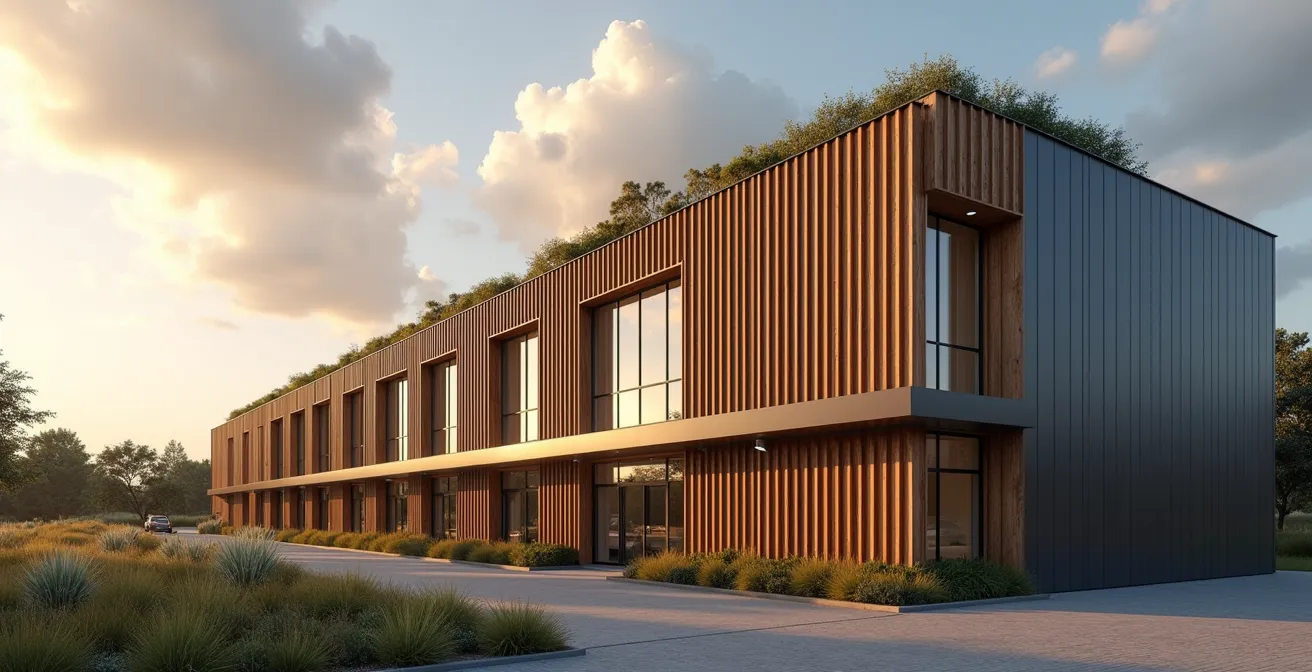
Achieving a BREEAM ‘Outstanding’ rating is a financial strategy as much as a design exercise; the key is to maximize the quantifiable ROI of every facade specification.
- ‘Outstanding’ certified buildings can achieve rental premiums of over 12%, turning sustainability into a direct revenue driver.
- Strategic material selection—like choosing high-recycled-content steel over timber—directly impacts specific BREEAM credits and long-term operational costs.
- Proving your sustainability claims with verified data (EPDs) is now essential to comply with regulations like the UK Green Claims Code and avoid significant penalties.
Recommendation: Shift from a compliance-first mindset to a ‘credit-stacking’ approach, where every facade component is audited for its contribution to BREEAM points, asset value, and legal defensibility.
For a commercial architect, designing a flagship distribution centre that achieves BREEAM ‘Outstanding’ is the pinnacle of sustainable design. Yet, the path is often obscured by vague advice to simply “use sustainable materials” or “focus on energy efficiency.” Many projects aim for ‘Excellent,’ believing the jump to ‘Outstanding’ offers diminishing returns. This approach overlooks the profound financial and technical advantages that a top-tier certification brings, especially when the facade is treated as a high-performance asset rather than mere cladding.
The conventional wisdom focuses on the environmental benefits, but the real conversation for a client-focused architect is about quantifiable value. This involves a strategic game of ‘credit-stacking’ where every decision—from the Psi-value of a junction to the procurement timeline for mass timber—is weighed for its direct impact on BREEAM points, operational costs, and, ultimately, rental yields. The secret lies not in ticking boxes, but in understanding the performance delta between good and outstanding choices.
But what if the key to unlocking ‘Outstanding’ wasn’t just about picking greener materials, but about mastering the data behind them and the risks associated with their claims? This guide moves beyond the platitudes. We will dissect the financial incentives, navigate the critical technical details of facade design, compare materials based on hard metrics, and explore the logistical and legal frameworks that underpin a truly successful ‘Outstanding’ project. We will demonstrate how a meticulously designed facade becomes the primary engine for both sustainability and profitability.
This article provides a detailed roadmap for architects, breaking down the process into clear, actionable stages. The following summary outlines the key areas we will explore to transform your facade design into a BREEAM ‘Outstanding’ achievement.
Summary: A Strategic Guide to BREEAM ‘Outstanding’ Facades
- Why BREEAM ‘Outstanding’ buildings command 12% higher rental yields?
- How to design facade junctions to eliminate heat loss and pass Part L?
- Timber cladding vs Recycled Steel: which scores higher on sustainability metrics?
- The hidden carbon cost of aluminium facades that designers overlook
- When to lock in sustainable material orders to avoid construction delays?
- How to retrofit rainwater harvesting systems to supply site washrooms?
- How to calculate the carbon footprint of a product from cradle to gate?
- Compliance with the UK Green Claims Code: Is Your ‘Eco-Design’ Truly Legal?
Why BREEAM ‘Outstanding’ Buildings Command 12% Higher Rental Yields?
The decision to pursue a BREEAM ‘Outstanding’ rating is fundamentally a financial one. While the environmental accolades are significant, the compelling business case for clients lies in the enhanced asset value and direct impact on profitability. The leap from ‘Excellent’ to ‘Outstanding’ is not just a matter of prestige; it translates into a tangible rental premium. Research confirms that London offices with an ‘Outstanding’ rating achieve an effective rental premium of 12.3% over equivalent un-rated buildings.
This premium is not arbitrary. It is driven by a collection of value-adding factors that resonate with modern tenants and investors. For tenants, an ‘Outstanding’ building promises significantly lower operational costs due to superior energy efficiency and water management. For corporations, leasing such a space enhances their brand, helping to attract and retain top talent who prioritise corporate social responsibility (CSR) and environmental, social, and governance (ESG) criteria. Buildings like The Edge in Amsterdam, which achieved a record-breaking BREEAM score, become landmark assets that generate their own positive PR.
Furthermore, an ‘Outstanding’ certification is a powerful form of future-proofing. These buildings are better insulated against future carbon taxes and increasingly stringent environmental regulations. For investors, this de-risking makes the asset more liquid and attractive to green investment funds and REITs. The combination of lower utility bills, enhanced brand value, and regulatory resilience means these properties spend less time on the market and secure higher-quality, long-term tenants, creating a virtuous cycle of profitability.
How to Design Facade Junctions to Eliminate Heat Loss and Pass Part L?
Achieving an ‘Outstanding’ rating requires a forensic approach to energy performance, and the primary battleground is the facade junction. While specifying high-performance insulation is standard practice, it’s the thermal bridging at junctions—where the facade meets the roof, floor, or structural elements—that sabotages energy efficiency and can lead to failure under regulations like Part L of the UK’s Building Regulations. A meticulously designed thermal break is non-negotiable for top-tier energy credits.
The goal is to create a continuous thermal envelope, which means every connection point must be engineered to minimise heat transfer. This is measured by the Psi-value (Ψ-value), a critical metric in thermal modelling. A lower Psi-value indicates better performance. For industrial buildings, critical junctions include the facade-to-foundation connection, industrial door thresholds, and penetrations for steel cladding rails. Each presents a unique challenge that demands bespoke detailing rather than off-the-shelf solutions.
This level of detail requires moving beyond 2D drawings to 3D thermal modelling early in the design phase. This allows the architect to simulate heat flow, identify weak points, and optimise the specification of thermal break components. These specialised components, often made from materials with low thermal conductivity, are installed between structural elements to interrupt the path of heat loss. While they add to the initial construction cost, their impact on reducing operational energy consumption and securing valuable BREEAM energy credits (Ene 01) provides a clear long-term ROI.
The image below illustrates the sophisticated layering required at a critical junction to achieve a robust thermal break, ensuring the building’s performance matches the design intent.
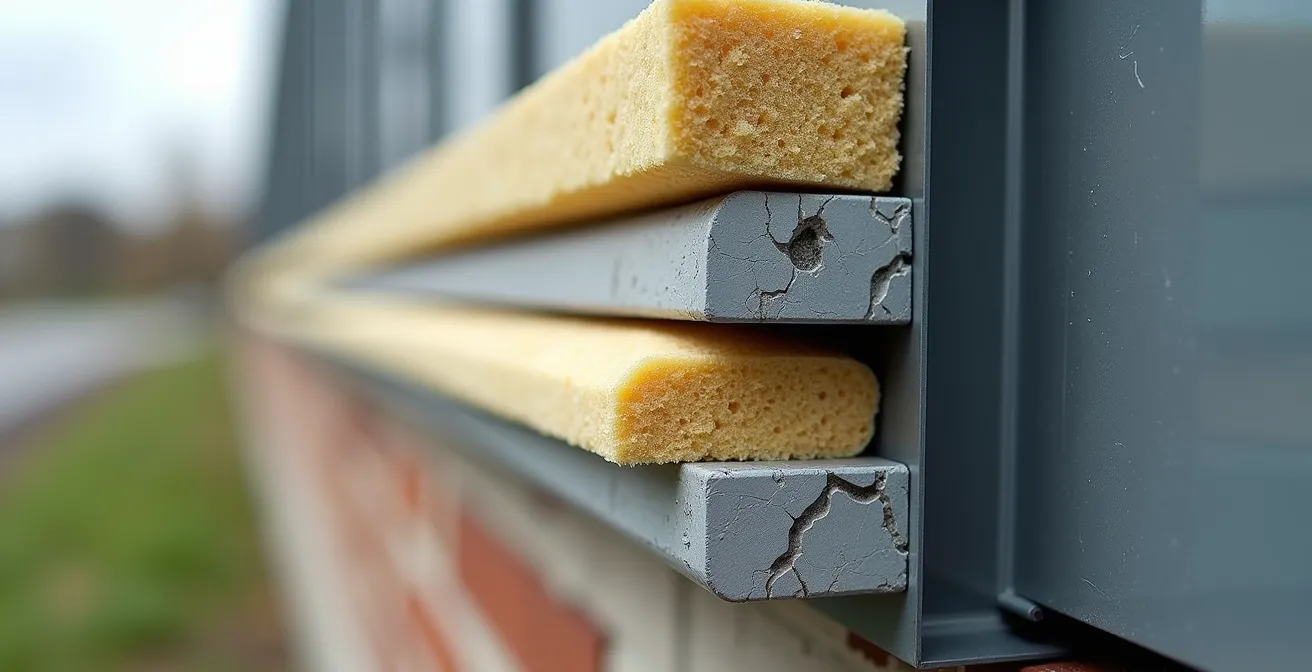
As this detail shows, the careful integration of insulation, vapour barriers, and specialised thermal break components is essential. This precision engineering is what separates an ‘Excellent’ design from an ‘Outstanding’ one, directly contributing to lower operational carbon and demonstrating a commitment to true energy performance beyond mere compliance.
Timber Cladding vs Recycled Steel: Which Scores Higher on Sustainability Metrics?
The choice of cladding material is one of the most visible sustainability decisions an architect makes, and it has a significant impact on BREEAM credit-stacking, particularly within the ‘Materials’ (Mat) and ‘Health and Wellbeing’ (Hea) categories. Two popular choices for sustainable facades are timber and recycled steel, each with a distinct profile of benefits and trade-offs that must be carefully weighed.
Timber cladding, especially when sourced from FSC-certified forests, scores highly on embodied carbon. As a natural material, it sequesters CO2 during its growth phase, potentially making it a carbon-negative choice. The market for FSC-certified timber for facades has seen a growth of 15% annually, reflecting its popularity. However, its performance in other areas requires scrutiny. Fire performance necessitates chemical treatments, which can lead to VOC (Volatile Organic Compound) emissions, impacting credits like Hea 02. Furthermore, timber requires regular maintenance to ensure its durability and appearance, which has long-term operational cost implications.
On the other hand, recycled steel offers a compelling alternative. Its primary advantage is its infinite recyclability without loss of quality, which scores exceptionally well for circular economy principles under Wst 01. While its production is energy-intensive, using a high percentage of recycled content dramatically lowers its embodied carbon. Steel is inherently non-combustible, offering superior fire performance without the need for chemical treatments, thus ensuring minimal VOC emissions. Its durability and low maintenance requirements also contribute to a lower whole-life cost.
The following table, based on an analysis of sustainable building materials, provides a direct comparison across key BREEAM-relevant metrics.
| Criteria | Timber Cladding | Recycled Steel | BREEAM Credits |
|---|---|---|---|
| Embodied Carbon | Negative (stores CO2) | Low (if high recycled content) | Mat 01 |
| VOC Emissions | Variable (depends on treatment) | Minimal | Hea 02 |
| End-of-Life | Bioenergy recovery | Infinite recyclability | Wst 01 |
| Fire Performance | Requires treatment | Inherently fire-resistant | Safety compliance |
| Maintenance | Regular treatment needed | Minimal maintenance | Operational impact |
Ultimately, the “best” choice depends on the project’s specific priorities. If the primary goal is to maximise sequestered carbon, timber is a strong contender. If the focus is on durability, fire safety, and end-of-life recyclability, recycled steel often presents a more robust, long-term solution.
The Hidden Carbon Cost of Aluminium Facades That Designers Overlook
Aluminium is prized in facade design for its lightweight, durable, and versatile properties. However, its sustainability credentials come with a significant caveat that is often overlooked: the vast difference in embodied carbon between primary (virgin) aluminium and recycled aluminium. Specifying “aluminium” without interrogating its origin can inadvertently lock in a massive carbon footprint, undermining the goals of a BREEAM ‘Outstanding’ project.
The production of primary aluminium from bauxite ore is an extremely energy-intensive process. In contrast, using recycled aluminium can reduce energy consumption by up to 95% compared to primary production. This staggering performance delta means that the single most important sustainability factor for an aluminium facade is its recycled content. An architect must therefore go beyond surface-level specifications and demand transparency from suppliers regarding the percentage of recycled material in their extrusions and panels.
The visual below captures the journey of aluminium, from raw ore to finished product and back into the circular economy, symbolizing the critical importance of the recycling loop in mitigating its carbon impact.

This lifecycle perspective is essential for accurate carbon accounting and for securing credits under BREEAM’s ‘Materials’ category. It’s not enough for a product to be recyclable; it must be made *from* recycled materials to have a truly low initial carbon impact.
Case Study: The North American Aluminum Industry’s Carbon Reduction
The journey of the North American aluminum industry demonstrates the power of recycling. A life cycle assessment (LCA) report highlighted that since 1991, the carbon footprint of primary aluminum production in the region has been cut by nearly half. More impressively, the footprint of recycled aluminum production dropped by 60% during the same period. This proves that a concerted focus on recycling technology and processes yields dramatic and measurable carbon reductions, making recycled aluminum a genuinely sustainable choice when specified correctly.
For the BREEAM assessor and architect, the lesson is clear: treat “aluminium” not as a single material but as two distinct ones. Your specification must be precise, calling for a minimum percentage of post-consumer recycled content and demanding an Environmental Product Declaration (EPD) to verify the claim. Only then can you manage its hidden carbon cost effectively.
When to Lock In Sustainable Material Orders to Avoid Construction Delays?
Achieving BREEAM ‘Outstanding’ is not just a design challenge; it is a logistical one. Specifying innovative or high-performance sustainable materials like mass timber (CLT), high-recycled-content steel, or bespoke facade systems introduces supply chain complexities that can derail a project timeline if not managed proactively. The question of *when* to lock in material orders is as critical as *what* to specify.
Unlike conventional materials with established supply chains, many cutting-edge sustainable products have longer lead times. They may be produced by a limited number of specialist manufacturers, require international shipping, or depend on fluctuating availability of raw materials (like certified timber or clean recycled scrap). Waiting until the traditional procurement stage of a project to place these orders is a recipe for significant delays and potential cost overruns as contractors scramble to find alternatives.
The solution is early procurement engagement. The architect must work with the client and quantity surveyor to identify key sustainable materials during the early design stages (RIBA Stage 2 or 3). Once these materials are identified, engagement with the supply chain should begin immediately to understand lead times, pricing volatility, and quality assurance requirements. In many cases, it is necessary to pre-order or reserve production capacity long before a main contractor is even appointed.
Specialists in sustainable procurement and logistics play a critical role in ensuring that the right materials are available on time, keeping project timelines intact.
– Supply Chain Experts
This proactive approach, sometimes called “procurement forensics,” involves mapping out the entire journey of a material from its source to the construction site. For an architect aiming for ‘Outstanding,’ this means collaborating closely with procurement partners to de-risk the supply chain. It transforms the specification from a hopeful item on a list into a secured asset, ensuring that the ambitious design can be delivered on time and on budget.
How to Retrofit Rainwater Harvesting Systems to Supply Site Washrooms?
While the facade is central to a building’s identity and energy performance, an ‘Outstanding’ BREEAM rating demands a holistic view of sustainability that includes water conservation. Rainwater harvesting systems, which collect runoff from the roof and facades to supply non-potable water for uses like flushing toilets in washrooms, are a highly effective way to earn valuable credits in the ‘Water’ (Wat) category.
A well-designed system can achieve a 40-50% reduction in municipal water consumption, drastically lowering a building’s operational footprint and utility costs for the tenant. The process involves channeling rainwater through a filtration system to remove debris, storing it in a large tank (often underground), and then pumping it to supply the building’s washrooms. The key components are the collection area (roof), conveyance (gutters and pipes), filtration, storage, and distribution.
For a new-build distribution centre, integrating such a system is relatively straightforward. However, even in retrofit scenarios, it is a feasible and high-impact upgrade. The financial viability is a key consideration for clients, and a return on investment (ROI) analysis is essential. The initial capital outlay for the tank, pumps, and plumbing must be weighed against the long-term savings on water bills.
This ROI is directly influenced by the system’s size and the BREEAM credits it can secure, as detailed in the following analysis based on data from sustainable building component suppliers. The payback period is a critical metric for architects to present to their clients.
An analysis of typical system sizes, sourced from data on BREEAM-related benefits, shows a clear relationship between investment and return.
| System Size | Installation Cost | Annual Savings | Payback Period | BREEAM Credits |
|---|---|---|---|---|
| 5,000L | £8,000-12,000 | £1,500-2,000 | 4-6 years | Wat 01 (2 credits) |
| 10,000L | £15,000-20,000 | £2,500-3,500 | 5-7 years | Wat 01 (3 credits) |
| 20,000L | £25,000-35,000 | £4,000-6,000 | 6-8 years | Wat 01 (4 credits) |
By presenting a clear business case that links initial cost to payback period and BREEAM credits, an architect can effectively advocate for the inclusion of rainwater harvesting, moving it from a “nice-to-have” feature to an essential component of a financially astute, ‘Outstanding’ design.
How to Calculate the Carbon Footprint of a Product from Cradle to Gate?
In the pursuit of BREEAM ‘Outstanding,’ making vague claims about a material being “eco-friendly” is no longer sufficient. To secure top credits in the ‘Materials’ category, you must provide verifiable, quantitative proof of a product’s environmental performance. The primary tool for this is the Environmental Product Declaration (EPD), and the key metric it contains is the carbon footprint calculated on a “cradle to gate” basis.
“Cradle to gate” is a specific scope for a Life Cycle Assessment (LCA). It covers the carbon emissions associated with a product from the moment its raw materials are extracted (“cradle”) through all manufacturing and processing stages, up to the point it leaves the factory gate (“gate”). This assessment includes energy used in extraction, transportation of raw materials, and the manufacturing process itself. It provides a standardized and comparable measure of a product’s embodied carbon before it is even installed.
For an architect, EPDs are the most reliable source of this data. These documents, which should be third-party verified to be credible, break down a product’s environmental impact across multiple criteria, including Global Warming Potential (GWP), which is its carbon footprint. When comparing two products, like different types of insulation or cladding, their EPDs provide the hard data needed for a true “apples-to-apples” comparison. Specifying products with robust EPDs is a prerequisite for achieving high scores in credits like Mat 01.
The AEC’s EPD includes environmental impacts of tooling and finishing processes like anodizing, reporting average billet recycled content of 54%.
– Aluminum Extruders Council, Environmental Product Declaration Study
As this statement from the Aluminum Extruders Council highlights, a detailed EPD provides the granularity needed for informed decisions. It allows an architect to see not just the final carbon number but also the factors that contribute to it, such as recycled content and specific manufacturing processes. By demanding and analyzing EPDs, the architect moves from guesswork to data-driven design, providing a defensible and evidence-based rationale for every material choice.
Key Takeaways
- An ‘Outstanding’ rating is a financial lever, capable of increasing rental yields by over 12%.
- Technical excellence in details like thermal junctions is non-negotiable for top energy credits and regulatory compliance.
- Material choices must be backed by data (EPDs), comparing options based on embodied carbon, lifecycle, and specific BREEAM credits.
- True sustainability requires supply chain transparency; the carbon cost of primary vs. recycled materials can be immense.
- Using BREEAM’s rigorous documentation process is your best defence against the growing legal risks of greenwashing.
Compliance with the UK Green Claims Code: Is Your ‘Eco-Design’ Truly Legal?
In today’s market, making an environmental claim is not just a marketing decision—it’s a legal one. The rise of “greenwashing” has led to strict regulations like the UK’s Green Claims Code, enforced by the Competition and Markets Authority (CMA). For an architect and their client, this means any claim that a building or its components are “green,” “sustainable,” or “eco-friendly” must be accurate, clear, and fully substantiated. Failure to do so can result in severe penalties.
The stakes are incredibly high. New legislation in 2024 gave the CMA power to fine companies up to 10% of their global turnover for misleading consumers with unsubstantiated green claims. This risk extends to the entire value chain, from the material manufacturer to the developer marketing the final building. A claim like “fully recyclable facade” is illegal if parts of the system are not recyclable in practice, or if the claim is based on only one part of the product’s lifecycle without considering the whole.
Example: Compliant vs. Non-Compliant Green Claims
A non-compliant claim would be marketing a facade as “greener” than competitors simply because it uses less water in one manufacturing stage, while ignoring a higher embodied carbon footprint over its full lifecycle. A compliant claim, in contrast, must be backed up by complete data, such as a third-party verified EPD. It requires honesty and transparency, considering the product’s entire journey from production to disposal. The claim must be true and not hide or omit important information.
This is where the rigorous process of a BREEAM ‘Outstanding’ assessment becomes a powerful legal shield. The scheme’s evidence-based approach forces a project team to document and verify every sustainability claim. The EPDs, Life Cycle Assessments, and chain of custody records required for BREEAM credits are precisely the type of evidence needed to defend against an accusation of greenwashing. In this context, BREEAM is not just a certification; it’s a risk management framework.
Your Action Plan: Using BREEAM for Green Claims Code Compliance
- Document Everything: Ensure all environmental claims made about specified materials are supported by third-party verified Environmental Product Declarations (EPDs).
- Maintain a Paper Trail: Keep complete chain of custody records for all specified sustainable materials (e.g., FSC certificates for timber) to prove their origin.
- Leverage BREEAM Reports: Use the final BREEAM assessment report and its underlying evidence as a primary dossier to substantiate marketing claims about the building’s performance.
- Conduct Regular Reviews: Implement a schedule to regularly review all marketing and communication materials to ensure claims remain accurate and aligned with the latest data and regulations.
- Train Your Teams: Ensure all project stakeholders, from designers to marketing teams, are trained on the requirements of the Green Claims Code to prevent accidental non-compliance.
By shifting your perspective from mere compliance to strategic credit-stacking, you can transform the facade from a cost centre into a value-generating asset. The principles outlined here provide a framework for making informed, data-driven decisions that satisfy clients, meet regulations, and deliver a truly ‘Outstanding’ result. To put these strategies into practice, the next logical step is to apply this forensic level of analysis to your project’s material specifications from day one.