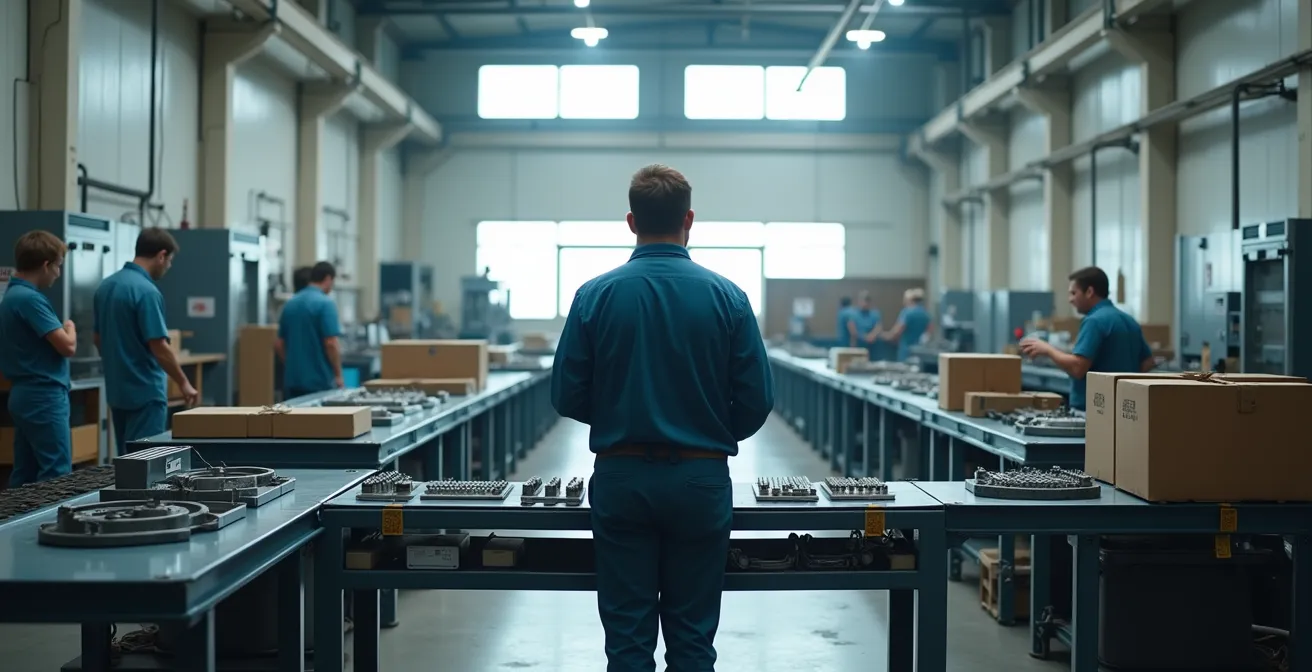
The persistent friction from ill-fitting standard parts is not just an annoyance; it’s a quantifiable drain on profitability hidden within your assembly line.
- Adapting off-the-shelf components introduces non-value-added labour, creating a “hidden factory” that inflates operational costs.
- A strategic pivot to bespoke parts is a financial decision, pinpointed by a multi-factor break-even analysis that includes labour savings and reduced downtime.
Recommendation: Instead of accepting rework as a cost of doing business, implement a time-and-motion study on a single problematic standard part to uncover its true Total Cost of Ownership (TCO).
As a technical director, you’re constantly battling production bottlenecks. A common source of this friction lies in components that are *almost* right. Standard, off-the-shelf parts promise speed and convenience, but they often deliver compromises. Your assembly team spends valuable time adapting, shimming, and forcing brackets that don’t quite align, or reworking jigs that cause non-conformance down the line. This is the daily reality of relying on one-size-fits-all solutions for precision applications.
The conventional wisdom suggests a simple trade-off: off-the-shelf is cheap and fast, while bespoke is expensive and slow. This view, however, fails to account for the significant “hidden factory” costs associated with adapting standard parts—the un-tracked labour, the accumulated delays, and the subtle compromises in final product quality. These small, persistent inefficiencies can aggregate into tens of thousands of pounds in lost productivity annually, a cost rarely captured by the component’s sticker price.
But what if the decision to go bespoke wasn’t a matter of last resort, but a calculated operational strategy? The key is to shift the perspective from simply solving a “fit” problem to unlocking a quantifiable efficiency lever. The true question isn’t whether a custom part is better, but *at what precise point* does its Total Cost of Ownership (TCO) become lower than its off-the-shelf counterpart? This requires a more sophisticated analysis, one that moves beyond part cost to include labour, cycle time, and supply chain resilience.
This article provides the engineering-led frameworks to make that determination. We will dissect the hidden costs of standardisation, provide a template for creating an effective functional specification, and define the financial and technical tipping points for switching to a bespoke component strategy. It’s time to move from reactive problem-solving to proactive, data-driven optimisation.
To navigate this strategic shift, this guide breaks down the critical decision points an engineering leader must address. The following sections provide a clear roadmap, from quantifying the hidden costs of standard parts to implementing a future-proof digital inventory.
Summary: A Technical Director’s Guide to Bespoke Component Strategy
- Why adapting standard brackets adds £20,000/year in labour costs?
- How to write a functional specification for a bespoke part manufacturer?
- 3D printing vs CNC machining: which is faster for validating custom jigs?
- The IP ownership trap when outsourcing bespoke design work
- When to pivot from standard parts to bespoke: the volume break-even point
- How to bridge the gap between a 3D print and a 500-unit pilot run?
- How to identify which 10% of your spare parts are suitable for 3D printing?
- Digital Inventory: 3D Printing Spare Parts to Eliminate Long Lead Times
Why adapting standard brackets adds £20,000/year in labour costs?
The £20,000 figure is not hyperbole; it represents the “hidden factory”—the collection of non-value-added activities your team performs to make standard parts work. Every minute spent filing a bracket, drilling a new hole, or forcing a fit is a direct labour cost that erodes your margin. These small, repetitive tasks are often dismissed as “part of the job,” but when quantified, their cumulative impact is staggering. This is where the principles of a time-and-motion study become a powerful diagnostic tool for a technical director.
The process begins with observation. By documenting the complete workflow for assembling a product with a problematic standard part, you can isolate the exact moments of inefficiency. This includes redundant movements, double handling, and any activity that does not directly contribute to the final assembly. Predetermined time studies reveal the massive potential here; operations without performance control systems can be vastly inefficient, while focused improvements can yield dramatic results. In fact, time-motion analyses show that performance can jump from 60% of normal to 120% with the right systems in place, a clear indicator of how much efficiency is being left on the table.
By breaking down the process into discrete elements and calculating a standard time, you establish a baseline. This data transforms a vague frustration (“this part is awkward”) into a hard financial metric (“this part costs us an extra 90 seconds of labour per unit”). Multiplying this by your production volume reveals the true annual cost of that “convenient” off-the-shelf component. This is the financial ammunition needed to justify a move to bespoke.
Case Study: Cycle Time Reduction in Electronics Manufacturing
A company producing electronic components was facing a production bottleneck with a cycle time of 120 seconds per unit. By analysing their process, they identified two key areas for improvement. First, they optimised their CNC program, which directly resulted in a 30% reduction in machining time. Second, they automated part loading and unloading. These changes, focused on eliminating wasted time and movement, reduced the total cycle time to 90 seconds, boosted their Overall Equipment Effectiveness (OEE) by 15%, and cut production costs by a significant 10%. This demonstrates how targeting specific inefficient steps, much like those caused by ill-fitting standard parts, leads to major operational gains.
Ultimately, a bespoke component engineered for perfect fit is a direct application of Design for Assembly (DFA) principles. It eliminates the need for on-the-fly modifications, turning that “hidden factory” cost into a tangible saving that drops directly to your bottom line. The initial investment in a custom part is amortised not just by its function, but by the labour hours it saves on every single unit produced.
How to write a functional specification for a bespoke part manufacturer?
Once you’ve quantified the cost of inaction, the next step is to articulate your precise needs to a manufacturing partner. A well-written functional specification is the cornerstone of a successful bespoke component project. It is not merely a drawing; it is a comprehensive document that serves as a legal and technical contract, eliminating ambiguity and ensuring the final part performs exactly as intended. For a technical director, mastering this document is key to de-risking the outsourcing process and unlocking the full potential of custom manufacturing.
The core of an effective specification is the clear separation between what is critical and what is flexible. You must define the non-negotiable Critical-to-Quality (CTQ) parameters—the features essential for the part’s function. This includes interfacing surfaces with tight tolerances, material properties like hardness or chemical resistance, and key performance metrics such as load-bearing capacity. These are the elements that directly impact product performance and safety.
Equally important is identifying parameters where flexibility is acceptable, as this is where a skilled manufacturing partner can optimise for cost. For example, the surface finish on a non-visible, non-interfacing area might be flexible, or slight variations in the overall size (envelope) might be permissible as long as mating points are exact. Clearly communicating this distinction allows the manufacturer to propose more cost-effective production methods or materials without compromising the part’s core function. An effective specification acts as a roadmap for achieving these efficiencies, with some manufacturers reporting that a well-defined custom process can lead to significant savings compared to standard approaches.

The table below provides a practical framework for categorising these parameters. Using this structure in your functional specification ensures your manufacturer understands precisely where to focus their precision and where they have room to innovate for cost reduction, a process that is clearly illustrated in this detailed breakdown of parameter types.
| Parameter Type | Non-Negotiable CTQ | Flexible for Cost Optimization |
|---|---|---|
| Dimensions | Interfacing surfaces, mating tolerances | Overall envelope size variations |
| Materials | Hardness, chemical resistance | Color, surface texture on non-visible areas |
| Performance | Load-bearing capacity, fatigue life | Weight reduction options |
| Manufacturing | Critical hole positions, thread specifications | Production method flexibility |
A functional specification is more than a request; it’s the start of a technical dialogue. It empowers your partner to act as a consultant, bringing their manufacturing expertise to bear on your design challenges. This collaborative approach ensures the final part is not only a perfect fit for your assembly but is also optimised for efficient and reliable production.
3D printing vs CNC machining: which is faster for validating custom jigs?
For custom jigs and fixtures, the validation phase is critical. The choice between 3D printing and CNC machining is not about which technology is “better,” but which is the right tool for the specific validation goal at hand. The primary driver of this decision is speed versus fidelity. A technical director must weigh the need for rapid iteration against the need for material-accurate performance testing to create the most efficient validation workflow.
3D printing, particularly Fused Deposition Modeling (FDM), offers unparalleled speed for initial validation. When the primary goal is to check form, fit, and ergonomics, a 3D print can be in an engineer’s hands in hours, not days. This allows for multiple design iterations in a short period. Is the handle comfortable for the operator? Do the locating pins align with the workpiece? These are questions that a low-cost plastic prototype can answer effectively, enabling your team to fail fast and cheap before committing to a more expensive manufacturing process.
However, when the validation goal shifts to performance under load, CNC machining becomes essential. A 3D-printed jig cannot replicate the strength, stiffness, and durability of a metal part. If the jig is expected to withstand clamping forces or resist wear over thousands of cycles, a CNC-machined prototype from the final production material (or a close equivalent) is the only way to conduct meaningful strength and tolerance validation. Attempting to test a plastic FDM part for a high-load application will provide misleading data and create risk down the line. The true “time-to-hand” must also be considered, including any post-processing time for either method.
The most effective strategy is often a hybrid approach. Use low-cost 3D prints for the initial rapid iterations to perfect the geometry and ergonomics. Once the design is 90% confirmed, commit to a CNC-machined prototype for final sign-off and real-world performance testing. This two-stage process leverages the speed of 3D printing and the fidelity of CNC machining, minimizing both time and cost to arrive at a fully validated design.
The IP ownership trap when outsourcing bespoke design work
Engaging a third-party manufacturer for bespoke components introduces a critical risk that many technical directors overlook: the intellectual property (IP) ownership trap. Failing to clearly define IP ownership in your contract can leave you tethered to a single supplier, unable to move your production elsewhere or even make modifications to a design you paid to develop. Protecting your IP is not just a legal formality; it is a strategic necessity for maintaining supply chain resilience and operational control.
The most common trap is ambiguity around “Foreground IP”—the new designs, drawings, and process knowledge created during your project. Without an explicit clause stating that all Foreground IP is the property of your company, the manufacturer may legally own the design they created for you. This could prevent you from taking the design to a more competitive or reliable manufacturer in the future. It’s crucial to differentiate this from “Background IP,” which is the pre-existing intellectual property of each party that remains their own.
Furthermore, you must distinguish between ownership of the design files and ownership of the tooling. Owning the CAD files gives you portability and the freedom to get quotes from other suppliers. Owning the physical tooling (like molds or dies) gives you control over production but can lock you into a specific facility if the tooling is not easily transferable. A robust contract should grant you ownership of both and include a “Right to Transfer” clause. This clause guarantees the seamless transfer of all design data, quality plans, and tooling specifications should you ever need to switch suppliers, preventing them from holding your production hostage.
As the engineering team at M3 Design highlights, maintaining control is about more than just business leverage; it’s about quality and safety. Their perspective underscores the importance of being the ultimate authority on your own product:
You maintain control over the design and its manufacturing, which can make it easier to comply with safety and regulatory requirements. You’re not at the mercy of a supplier who can change the part design at any time as they see fit.
– M3 Design Engineering Team, When to Use Custom Vs. Off-the-Shelf Parts in Product Development
By proactively addressing IP ownership, you are not creating an adversarial relationship with your supplier. Instead, you are establishing clear, professional boundaries that protect your long-term operational flexibility. It ensures that your investment in a custom component translates into a lasting asset for your company, not a liability that ties your hands.
When to pivot from standard parts to bespoke: the volume break-even point
The decision to switch from a standard part to a bespoke component is fundamentally a financial one. A technical director must be able to present a data-driven case that justifies the upfront investment in custom design and tooling. The key to this is a multi-factor break-even analysis that goes far beyond comparing the per-unit cost of the parts. It must incorporate the total cost savings generated by the superior performance of the bespoke component.
The first factor is the labour savings identified in your time-and-motion study. If a standard part adds 60 seconds of rework per unit and your loaded labour rate is £30/hour, that’s £0.50 of hidden cost in every single product. A bespoke part that eliminates this rework provides a direct, quantifiable saving that accelerates the payback period of the initial investment.
The second factor is the reduction in material waste and rejects. Ill-fitting standard parts are a common cause of non-conformance, leading to scrapped assemblies and wasted materials. A bespoke component designed for perfect fit improves first-pass yield, reducing the cost of quality. For example, some manufacturers have achieved a 30% reduction in material waste through part optimisation alone. Furthermore, a custom part designed for your specific assembly can eliminate costly rework and, as one analysis puts it, significantly reduce installation time through precision fit.

The break-even calculation is therefore: Break-Even Volume = Upfront Bespoke Costs / (Per-Unit Savings from Labour + Per-Unit Savings from Reduced Waste). Upfront costs include design, prototyping, and tooling. The per-unit savings are the sum of all the efficiencies gained by switching. This formula provides the minimum production volume at which the bespoke part becomes more profitable than the standard one. Often, this volume is surprisingly low, especially for complex assemblies or high-labour-cost environments.
This analysis transforms the conversation from “a bespoke part is too expensive” to “we can’t afford to keep using this standard part beyond 5,000 units.” It provides a clear, financial tipping point that guides strategic decision-making and aligns engineering initiatives with the company’s financial goals.
How to bridge the gap between a 3D print and a 500-unit pilot run?
Successfully moving from a single 3D-printed prototype to a 500-unit pilot run requires a deliberate intermediate step: bridge tooling. Attempting to jump directly from a plastic prototype to mass production tooling is a high-risk gamble. Bridge tooling, typically using lower-cost aluminum injection molds instead of hardened steel, serves as a crucial validation phase for both the part design and the manufacturing process at a medium volume.
The process starts after the design has been validated for form and fit using 3D prints. The next step is to create an aluminum mold, which is significantly cheaper and faster to produce than a final steel production tool. This mold is then used to produce the first samples for a First Article Inspection (FAI). The FAI is a rigorous quality control process where every dimension, feature, and material property of the part is checked against the functional specification. This is the first time you are validating the *molding process* itself, not just the part geometry.
Once the FAI samples are approved, you can proceed with the 500-unit pilot run. This batch is not for sale; its purpose is to test the part in your real-world assembly environment at scale. Your assembly team can provide invaluable quantitative feedback on Design for Assembly (DFA) improvements. Does the part feed smoothly into automated equipment? Does its design cause any unforeseen ergonomic issues for operators over hundreds of repetitions? This feedback is critical for making final design tweaks before committing to expensive, difficult-to-change steel tooling.
This phased approach de-risks the transition to mass production. It allows you to catch design flaws, process issues, and assembly line incompatibilities at a stage where changes are still relatively inexpensive. As the following table shows, each manufacturing method has a distinct “sweet spot” in terms of cost and volume. Bridge tooling perfectly fills the critical gap between initial prototyping and full-scale production, a gap clearly defined in data provided by industry platforms like Jiga.
| Method | Unit Cost | Lead Time | Best For |
|---|---|---|---|
| 3D Printing (FDM) | $5-50 | 1-3 days | Initial validation, 1-10 units |
| 3D Printing (SLS/SLA) | $20-200 | 3-5 days | Functional testing, 10-50 units |
| Aluminum Molds | $2-20 | 2-3 weeks | Pilot runs, 100-5000 units |
| Steel Production Tools | $0.50-5 | 6-8 weeks | Mass production, 5000+ units |
By investing in bridge tooling, you ensure that when you finally give the green light for steel production tools, you are doing so with a high degree of confidence that the part is fully optimized for both performance and manufacturability.
How to identify which 10% of your spare parts are suitable for 3D printing?
For any established assembly plant, the warehouse is filled with spare parts, many of which are expensive, have long lead times, or are nearing obsolescence. Additive manufacturing offers a powerful solution, but printing every spare part is neither feasible nor desirable. The strategic challenge is to identify the critical 10% of your inventory where on-demand 3D printing provides the highest return on investment. This requires a systematic, data-driven approach, not guesswork.
A highly effective method is to use a scoring matrix to evaluate each part against three key criteria: Supply Problem (SP), Criticality (C), and Low-Risk Properties (L). This “SP-C-L” framework moves the decision from a subjective feeling to an objective score. Each part is rated on a scale of 1-5 for each category.
Supply Problem (SP): How difficult is this part to procure? A score of 5 would be for an obsolete part with a single, unreliable supplier and a 6-month lead time. A score of 1 would be for a commodity part available overnight from multiple vendors. Criticality (C): What is the impact of this part failing? A score of 5 indicates that its failure causes immediate line-down stoppage, a safety hazard, or a major production bottleneck. A score of 1 means its failure is a minor inconvenience with an easy workaround. Low-Risk Properties (L): Is the part technically suitable for 3D printing? A score of 5 would be a complex, non-load-bearing plastic enclosure. A score of 1 would be a high-precision, case-hardened steel gear that is a poor candidate for current additive technologies.
By summing the scores, you create a priority list. Parts scoring 12 or higher (out of 15) are your prime candidates for an immediate 3D printing conversion strategy. These are the parts that are causing you the most pain (high SP and C) and are the easiest to produce (high L). Starting with these “quick wins”—such as jigs, fixtures, ergonomic handles, and protective covers—builds momentum and demonstrates the value of a digital inventory strategy.
Your Action Plan: Implementing the SP-C-L Scoring Matrix
- Score Supply Problem (1-5): Quantify the pain of procurement based on lead times, obsolescence risk, and single-supplier dependency.
- Score Criticality (1-5): Assess the operational impact of a part failure, including downtime cost, safety implications, and production bottlenecks.
- Score Low-Risk Properties (1-5): Evaluate the part’s technical suitability for printing, favouring non-load bearing applications, plastic materials, and complex geometries.
- Target High Scorers: Aggregate the scores and target all parts scoring 12 or more points for immediate conversion to your digital inventory.
- Start with Quick Wins: Prioritise the implementation of jigs, fixtures, ergonomic handles, and protective enclosures to demonstrate rapid ROI.
This structured approach ensures your resources are focused on the spare parts that will deliver the most significant benefits in terms of cost reduction, downtime avoidance, and increased operational resilience.
Key Takeaways
- The “hidden factory” costs of adapting standard parts (rework, delays) are a significant but often unmeasured drain on profitability.
- A multi-factor break-even analysis, including labour and waste savings, provides the data-driven tipping point for when a bespoke part becomes more profitable.
- Protecting your Intellectual Property through clear contractual clauses on design file and tooling ownership is critical for long-term supply chain resilience.
Digital Inventory: 3D Printing Spare Parts to Eliminate Long Lead Times
The logical endpoint of a bespoke component strategy is the creation of a digital inventory. This is the revolutionary concept of storing parts as validated digital files (digital twins) rather than physical objects in a warehouse. When a spare part is needed, it is simply printed on-demand, directly on-site or at a local service bureau. This approach fundamentally transforms supply chain logistics, moving from a “just in case” model of physical warehousing to a “just in time” model of digital production.
The primary benefit is the elimination of long lead times. For a technical director, machine downtime waiting for a spare part from an overseas supplier is a major source of lost revenue. A digital inventory reduces that lead time from weeks or months to mere hours. This dramatically improves Overall Equipment Effectiveness (OEE) and production line resilience. It also eliminates the risk of part obsolescence; as long as you have the file and a capable printer, the part can be produced indefinitely.
Implementing a digital inventory requires a robust “scan-to-certified-print” workflow. For legacy parts without existing CAD files, the process begins with 3D scanning to create a precise digital twin. The most critical step, however, is validation. You must establish a rigorous testing protocol to ensure the printed part’s material properties—such as tensile strength, heat resistance, and dimensional accuracy—meet or exceed those of the original OEM part. This documentation is essential for compliance and liability, especially in regulated industries.
The financial case for a digital inventory is compelling. While there is an upfront investment in scanning, file validation, and potentially printing hardware, the savings are substantial. Warehousing costs are slashed, shipping fees are eliminated, and the financial impact of machine downtime is drastically minimized. Ultimately, this approach which is grounded in custom solutions often delivers a lower total cost of ownership by minimizing downtime and enhancing overall efficiency. It represents the ultimate expression of precision engineering: the right part, with the right properties, in the right place, at the exact moment it is needed.
To begin transforming your production line and eliminating the hidden costs of “good enough,” the first step is to apply these frameworks to your most problematic components. A detailed analysis of a single part’s Total Cost of Ownership can provide the clear, data-driven case needed to pioneer a more efficient, resilient, and profitable manufacturing strategy.
Frequently Asked Questions on Bespoke Component Strategy
What’s the difference between owning design files vs. tooling?
Design file ownership gives you portability to switch manufacturers, while tooling ownership provides production control but may lock you to specific facilities. The ideal contract grants you clear ownership and transfer rights to both.
How do Background vs Foreground IP clauses work?
Background IP is your pre-existing intellectual property that remains yours, while Foreground IP is new IP created during the project. Your contract must explicitly state that all Foreground IP developed for you becomes your property upon completion.
What should a Right to Transfer clause include?
It should guarantee the seamless and complete transfer of all design data, CAD files, quality plans, and tooling specifications if you decide to switch manufacturers, ensuring a smooth transition without being held hostage by the incumbent supplier.
How do we handle liability for 3D printed replacement parts?
Liability is managed through rigorous process control. You must establish material testing protocols, performance validation procedures against original specifications, and maintain comprehensive documentation to demonstrate that the printed part meets or exceeds OEM standards.
What’s the typical ROI timeline for digital inventory?
While it varies by application, most companies that target high-impact parts (high cost, long lead time) see a positive return on investment within 12-18 months, driven primarily by reduced warehousing costs, eliminated shipping, and minimized machine downtime.
Which industries benefit most from digital spare parts?
The aerospace, automotive, medical device, and heavy machinery sectors typically see the greatest benefits. These industries are characterized by high-value, low-volume, or often obsolete spare parts where traditional supply chains are slow and expensive.