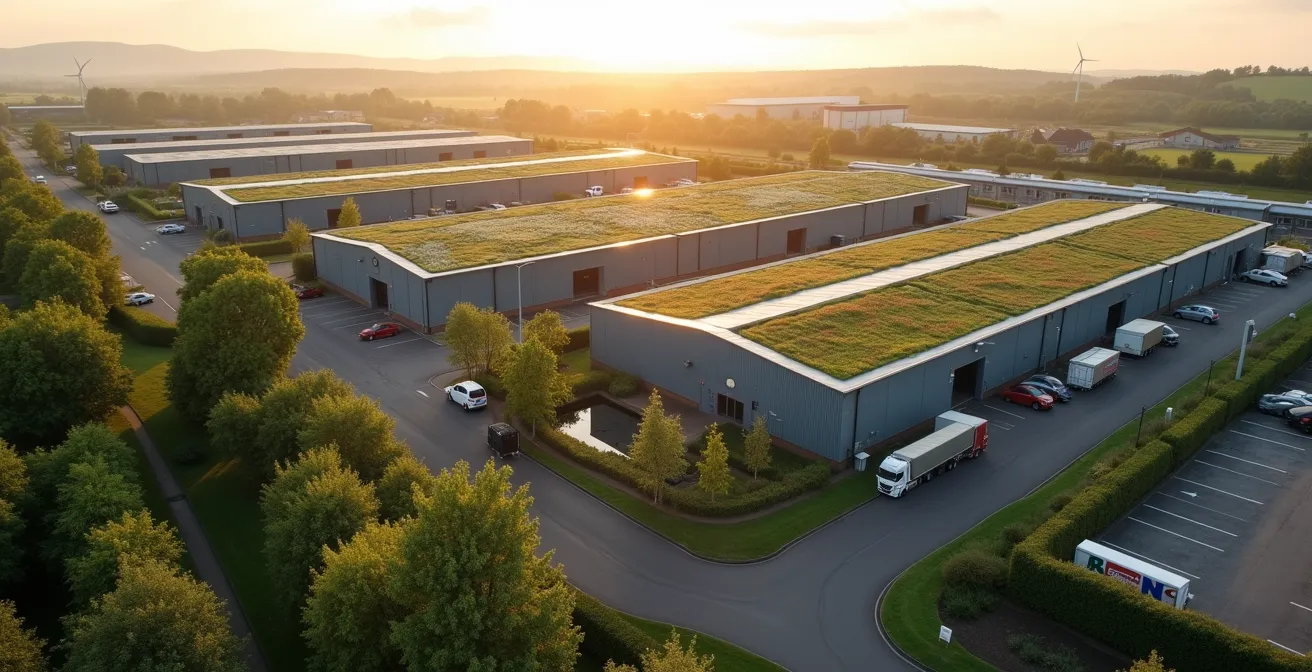
Biodiversity Net Gain is not a simple 10% uplift; it’s a 30-year legal and financial commitment where maintenance failures can invalidate your entire project’s planning permission.
- Local councils are increasingly delaying or rejecting projects with weak BNG strategies, seeing them as long-term risks.
- Strategic on-site solutions, when planned correctly, can be significantly cheaper and faster to implement than purchasing expensive off-site credits.
Recommendation: Treat BNG as a long-term asset management task from day one, focusing on a legally sound, fully-funded 30-year maintenance plan to secure compliance.
For any developer with an industrial site in the UK, the phrase “Biodiversity Net Gain” (BNG) has quickly shifted from environmental jargon to a critical planning hurdle. The new mandatory rules, requiring most developments to deliver a 10% increase in biodiversity, are now in full force. The common advice focuses on hitting that magic number, either by planting on-site or buying credits elsewhere. But this view is dangerously simplistic. It overlooks the profound, long-term implications of the legislation, a fact underlined by the UK’s ongoing environmental challenges, where reports reveal an average 19% decline in UK species since 1970.
The real challenge isn’t just achieving a 10% gain; it’s proving you can maintain it for 30 years. This is not a one-time cost but a multi-decade liability. Viewing BNG as just another box-ticking exercise is a recipe for future compliance breaches, financial penalties, and even the invalidation of planning permissions years down the line. The platitudes about “going green” miss the point entirely. The crucial question is not *if* you should do BNG, but *how* you structure it to be a resilient, compliant, and financially viable asset for the next three decades.
This guide moves beyond the basics. We will treat BNG not as an ecological ideal, but as a risk management challenge. We will dissect why councils are rejecting plans, compare the true lifecycle costs of on-site versus off-site solutions, and expose the maintenance clauses that could derail your project. By understanding these hidden risks and strategic opportunities, you can transform this regulatory burden into a manageable and even valuable component of your industrial site’s long-term strategy.
This article provides a comprehensive overview for navigating the complexities of Biodiversity Net Gain for industrial developments. The following sections break down the key strategic considerations, from initial planning to long-term management.
Summary: Navigating the New Landscape of Biodiversity Net Gain
- Why local councils are rejecting industrial expansions on biodiversity grounds?
- How to install a wildflower roof on an industrial unit to gain credits?
- Onsite mitigation vs Offsite credits: which is cheaper for small sites?
- The maintenance clause that could invalidate your biodiversity credits after 5 years
- How a nature trail on your perimeter fence improves community engagement?
- Permeable paving vs tarmac: which offers better long-term ROI for car parks?
- How to design products for easy disassembly to meet Right to Repair rules?
- How to Cut Maintenance Costs by 20% with Sustainable Industrial Landscaping?
Why local councils are rejecting industrial expansions on biodiversity grounds?
Local Planning Authorities (LPAs) are no longer just ticking a box for BNG. They are scrutinising applications with a new level of diligence, primarily because they are liable for ensuring the 30-year maintenance agreements hold up. A poorly conceived BNG plan represents a significant long-term risk to the council, leading to a more cautious and rejection-prone approach. The impact is already being felt across the industry, with a recent survey revealing that an alarming 94% of respondents experienced planning delays due to BNG-related requirements.
The core issue is credibility. Councils are wary of “greenwashing” – ambitious on-site habitat plans that look good on paper but lack a viable long-term management and funding strategy. This scepticism is backed by government-level analysis. As the Parliamentary Office of Science and Technology notes, there are significant concerns about the effectiveness of habitats created on development sites, suggesting greater gains are more likely when habitats are created in strategic conservation areas. This puts the onus on developers to prove their on-site plans are not just an afterthought but a robust, ecologically sound, and financially secure commitment.
Rejections often stem from a few key weaknesses in an application. These include vague maintenance schedules, insufficient evidence of funding for the 30-year term, and habitat designs that are not resilient or suitable for an industrial context. An LPA will favour a simple, robust plan with guaranteed funding over a complex, ambitious one with questionable longevity. For developers, this means the quality and legal soundness of the 30-year management plan is now just as important as the initial biodiversity metric calculation.
How to install a wildflower roof on an industrial unit to gain credits?
For industrial sites with limited ground space, the roof is often the most valuable real estate for on-site BNG. A biodiverse or “wildflower” green roof can generate a significant number of BNG units, transforming an unused surface into a qualifying habitat. However, not all green roofs are created equal. To satisfy the BNG metric and be accepted by an LPA, the design must meet specific criteria that go far beyond a simple sedum mat.
The goal is to create a complex, varied habitat. This means moving away from monoculture green roofs and towards systems with varied substrate depths, a high percentage of native UK wildflower species, and additional ecological features. A well-designed system can create a high-distinctiveness habitat, which scores very highly on the Biodiversity Metric. The illustration below shows a cross-section of such a system, highlighting the different layers and features that contribute to its ecological value.

As the visual demonstrates, a qualifying roof is an engineered ecosystem. Key specifications include ensuring the substrate depth varies (e.g., between 80-150mm) to support different plant species, incorporating features like log piles or sandy patches to provide niches for invertebrates, and achieving a high percentage of vegetation cover with native species. Simply installing a standard green roof system is unlikely to meet the “good” or “excellent” condition criteria needed for a meaningful BNG score. The design must be deliberate and documented from the outset using the official Biodiversity Metric to calculate its value accurately before any investment is made.
Onsite mitigation vs Offsite credits: which is cheaper for small sites?
The default assumption for many developers, particularly on space-constrained industrial sites, is that achieving BNG on-site is impractical and that purchasing off-site credits is the only viable path. While statutory credits offer a straightforward, albeit expensive, solution (with prices for credits starting at £42,000 per unit), this overlooks the significant cost-effectiveness of strategic on-site mitigation, especially for smaller developments.
The key is “strategic” implementation. Rather than attempting a large-scale habitat creation, small sites can achieve substantial BNG gains through a series of well-planned, high-impact interventions. These can include biodiverse green roofs, living walls, permeable paving solutions, and integrating small habitat pockets into unused corners of the site. When planned using a BNG calculation tool from the very beginning, these interventions can deliver the required uplift at a fraction of the cost of off-site credits.
The right approach can yield surprisingly effective results, turning what seems like a compliance burden into a manageable project cost.
Case Study: Cost-Effective BNG on Small Developments
An analysis of over 500 planning applications using the Joe’s Blooms BNG Tool provided compelling evidence for the viability of on-site solutions. The study showed that 41.6% of small site BNG applications were completed in under 24 hours, with many taking as little as 45 minutes to find a compliant solution. One specific project highlighted in the analysis was able to achieve an impressive 30.64% Habitat Biodiversity Unit gain almost entirely through cost-effective on-site enhancements. This demonstrates that with proper digital tools and early-stage planning, on-site BNG is not only possible but often the most economical option for small industrial sites.
Ultimately, the decision is a financial trade-off. Off-site credits offer certainty but at a high premium. On-site mitigation requires more upfront planning and design integration but can result in a far lower total project cost and adds a tangible green asset to the property itself. For small site developers, exploring the full potential of on-site options before defaulting to off-site credits is a critical step in managing BNG costs effectively.
The maintenance clause that could invalidate your biodiversity credits after 5 years
The single greatest, and most overlooked, risk in the BNG legislation is the 30-year maintenance requirement. Achieving the 10% uplift is only the first step; developers are legally bound to manage and maintain that habitat for three decades. A failure to do so can lead to enforcement action from the LPA and, in a worst-case scenario, the invalidation of the credits that underpin the original planning permission. This transforms BNG from a planning condition into a long-term financial liability.
This legal obligation is iron-clad and remains with the developer even if day-to-day maintenance is outsourced. As legal experts in the field clarify, this is a core part of the framework.
Developers will be responsible for the on-site BNG and will need to provide management and maintenance obligations to the LPA covering a period of at least 30 years. Even if a third party is appointed, the developer will remain liable to the LPA under the terms of the planning obligation.
– Penningtons Law, Mandatory biodiversity net gain legal analysis
This means that from the very start, a developer must have a fully costed, legally sound, and practical plan to fund and execute this maintenance. This isn’t just about mowing a wildflower meadow; it involves monitoring, reporting, and potential remedial actions to ensure the habitat remains in its target condition. Forgetting to budget for this 30-year operational cost is a common and costly mistake. The documentation submitted to the LPA must be meticulous to avoid future challenges.
Your 30-Year BNG Compliance Checklist: Key Documents
- Management Plan: Draft a detailed habitat management and monitoring plan that specifies actions, targets, and schedules for the full 30-year period.
- Legal Agreement: Secure a Section 106 agreement or a formal conservation covenant with the Local Planning Authority, legally binding you to the management plan.
- Funding Evidence: Collate and submit definitive proof of funding arrangements, such as an upfront lump sum, an escrow account, or a conservation bond, to cover all 30 years of maintenance costs.
- Reporting Framework: Establish the annual reporting metrics and a clear schedule for submitting monitoring reports to the LPA to demonstrate ongoing compliance.
- Succession Plan: Formalise the handover process and legal liabilities within the legal agreement to ensure the obligation is transferred correctly upon any future sale of the site.
How a nature trail on your perimeter fence improves community engagement?
While BNG is a regulatory requirement, it also presents an opportunity to generate significant goodwill and turn a compliance element into a tangible community asset. For many industrial sites, the perimeter fence is a sterile, unwelcoming boundary. By reimagining this space, developers can create valuable biodiversity habitats while simultaneously improving their relationship with the local community.
Creating a “biodiversity corridor” or nature trail along the site’s edge can achieve multiple goals. Integrating features like green walls, insect hotels, native wildflower verges, and small-scale Sustainable Drainage Systems (SuDS) can generate BNG units in an area that is otherwise unproductive. According to guidance from Natural England, even these small, linear habitats can act as vital “stepping-stones” for wildlife, connecting larger green spaces within the locality.
Beyond the BNG score, the real value lies in community engagement. A well-designed perimeter trail, accessible to the public, transforms the site from a closed-off industrial block into a local amenity. It provides walking routes, educational opportunities for schools, and a visible demonstration of the company’s commitment to the local environment. This can be a powerful tool for building brand reputation and fostering positive relationships, which can be invaluable during future planning applications or community consultations.
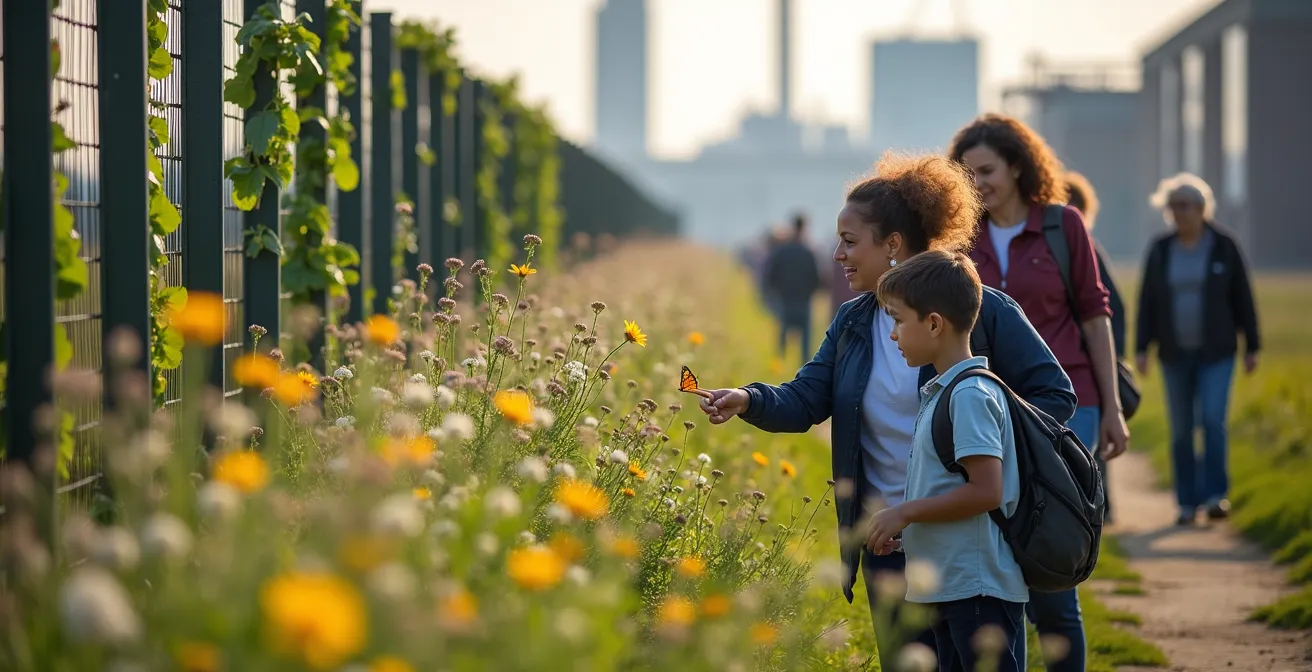
This approach, often termed “assetisation of biodiversity”, shifts the perspective from cost to value. Instead of sinking money into off-site credits that offer no local benefit, investing in an on-site, publicly accessible feature creates a lasting positive legacy. It’s a strategic choice that delivers on legal obligations while building social capital.
Permeable paving vs tarmac: which offers better long-term ROI for car parks?
Car parks and hardstanding areas represent one of the biggest challenges for BNG on industrial sites, as they typically have a biodiversity value of zero. The traditional choice, impermeable tarmac, actively works against BNG goals and often requires separate, costly drainage systems (SuDS) to manage surface water runoff. However, choosing a permeable paving system offers a strategic alternative with a significantly better long-term return on investment (ROI) when viewed through the lens of a 30-year lifecycle.
While the upfront installation cost of some permeable systems can be higher than tarmac, the whole-life cost is often lower. Permeable paving integrates drainage, potentially eliminating the need for separate swales or attenuation tanks, thus saving both space and money. Furthermore, certain permeable systems can be designed to incorporate vegetation, allowing a car park to move from a zero-value habitat to one that actively generates BNG units. This can reduce the amount of mitigation required elsewhere on the site.
The financial and environmental benefits compound over the 30-year BNG management period. Tarmac requires periodic, costly resealing and contributes to the urban heat island effect, increasing cooling costs for adjacent buildings. In contrast, permeable paving has lower maintenance needs and can help mitigate local temperatures. When all factors are considered—BNG unit value, integrated SuDS, lower maintenance, and reduced heat island effect—the long-term ROI becomes clear.
| Factor | Tarmac | Permeable Paving with BNG |
|---|---|---|
| BNG Units Generated | Zero | Positive (varies by system) |
| Maintenance Frequency | Resealing every 5-7 years | Annual inspection only |
| SUDS Compliance | Requires separate drainage | Integrated drainage |
| Heat Island Effect | Increases cooling costs | Reduces ambient temperature |
| 30-Year Total Cost | Higher (with drainage fees) | Lower (with BNG value) |
The data from this 30-year lifecycle cost analysis shows that selecting the right surface material is a critical strategic decision. It directly impacts BNG calculations, long-term capital expenditure, and site resilience.
How to design products for easy disassembly to meet Right to Repair rules?
At first glance, product design principles like “Right to Repair” and designing for disassembly may seem unrelated to BNG land management. However, for an industrial site, operational strategy and land use are deeply intertwined. Adopting circular economy principles within your site’s operations can directly support your BNG strategy by optimising space and creating new opportunities for habitat creation. Thinking about how your facility handles materials and waste can unlock land for biodiversity.
For example, a facility designed for efficient disassembly and repair reduces the need for extensive raw material storage and large waste-holding areas. This smaller operational footprint frees up valuable land that can be dedicated to on-site habitat creation, reducing the need to purchase expensive off-site BNG credits. Instead of a sprawling scrap yard, you might have space for a native woodland buffer or a wildflower meadow, both of which generate high-value BNG units.
The synergy goes further. Materials salvaged from disassembly processes can be repurposed to create BNG-qualifying features. Old concrete or rubble can be used to build hibernacula for reptiles and amphibians, while waste wood can create log piles for invertebrates. Integrating these circular principles into your site’s masterplan is a sophisticated strategy for achieving compliance. This holistic approach connects your core business operations with your environmental obligations, creating a more efficient, sustainable, and cost-effective site. It allows you to meet regulations like Right to Repair and BNG not as separate challenges, but as parts of a unified site strategy.
Key Takeaways
- BNG compliance is a 30-year legal liability; the maintenance plan is as critical as the initial 10% gain.
- Strategic on-site solutions like biodiverse roofs and permeable paving often provide a better long-term ROI than buying off-site credits.
- Leveraging BNG opportunities to create community assets like nature trails can build significant brand and social value.
How to Cut Maintenance Costs by 20% with Sustainable Industrial Landscaping?
A common misconception is that creating habitats for BNG inevitably leads to high, long-term maintenance costs. While poorly designed schemes can become a financial drain, a strategic shift towards sustainable, nature-based landscaping can significantly cut maintenance expenditure while delivering superior biodiversity outcomes. The key is to choose habitats that are largely self-sustaining and require minimal intervention once established.
Traditional industrial landscaping often involves manicured lawns and ornamental shrubs, which require frequent mowing, watering, and pruning—a high-maintenance, low-biodiversity model. In contrast, BNG-focused habitats like native wildflower meadows, scrubland, or young woodland are designed to thrive with minimal human input. For instance, research from projects like London’s biodiverse green roofs shows they become crucial habitats for rare species while only requiring an annual cut, a fraction of the effort needed for traditional lawns.
This “low-intensity, high-impact” approach is the most cost-effective way to manage a 30-year liability. Habitats such as native scrub or developing woodland have very high BNG scores due to their distinctiveness and complexity, yet their maintenance costs are extremely low after the initial establishment phase. They do not require fertilisers, pesticides, or frequent cutting. By selecting the right mix of low-maintenance habitats, a developer can design a BNG plan that not only meets the 10% uplift but also actively reduces the site’s overall annual landscaping budget by 20% or more compared to conventional methods. This transforms the BNG requirement from a cost centre into a driver of operational efficiency.
The choice of habitat dictates the 30-year cost. Prioritising self-sustaining, native ecosystems over high-input decorative landscaping is the fundamental principle for turning BNG into a long-term financial saving.
To successfully navigate the complexities of Biodiversity Net Gain, your first step should be to commission a preliminary BNG assessment at the pre-planning stage. This early analysis will identify the most cost-effective route to compliance for your specific site, preventing costly redesigns and planning delays down the line.