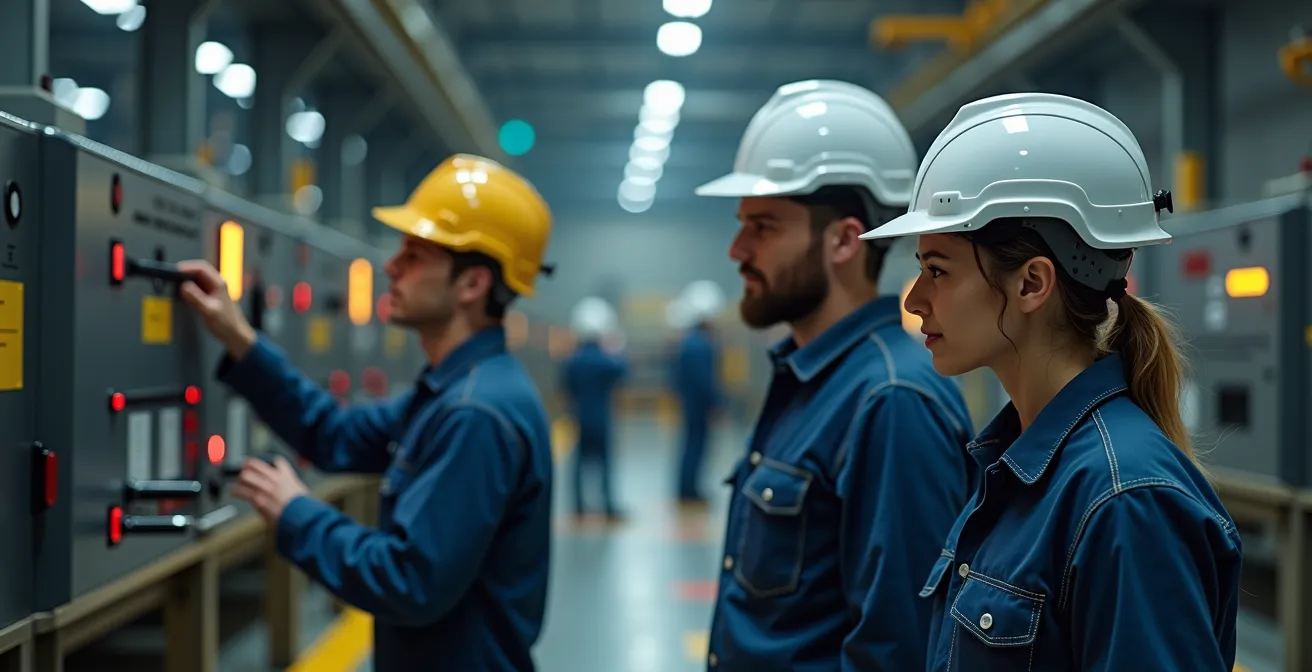
The true power of Smart PPE isn’t in alerting you to an incident—it’s in creating a data ecosystem that prevents it from ever happening.
- Proactive safety zones and automated vehicle controls can eliminate entire classes of collisions before human error occurs.
- Continuous data monitoring transforms safety audits from periodic “snapshots” into a 24/7 “movie,” revealing systemic risks invisible to manual inspections.
Recommendation: Identify your single highest-risk operational blind spot (e.g., a high-traffic pedestrian crossing) and launch a focused pilot program to quantify the immediate safety gains.
For any Environment, Health, and Safety (EHS) director in heavy manufacturing, the dreaded phone call is always the same: an incident has occurred in an operational blind spot. A lone worker in a confined space, a close call between a forklift and a pedestrian, a failure in critical equipment. The traditional response involves radios that crackle in dead zones and safety audits built on clipboards and static checklists. These tools provide a snapshot in time, a fractured view of a dynamic, high-risk environment.
But what if the goal wasn’t just to respond faster? What if you could engineer the risk out of the system entirely? This is the fundamental shift offered by connected worker technology. It’s not about adding more gadgets; it’s about transforming your entire safety framework from a reactive model to a predictive one. By harnessing a continuous stream of operational data, Smart PPE and IoT sensors provide the insights needed to see the “near-misses” that were previously invisible and address systemic failures before they lead to catastrophic outcomes.
This isn’t about replacing human oversight, but augmenting it with infallible, data-driven awareness. The focus moves from incident reports to proactive risk engineering. This article will deconstruct the core pillars of a successful connected worker strategy, moving beyond the hype to provide a practical roadmap for implementation. We will explore how to guarantee connectivity in the most challenging environments, automate critical safety protocols, navigate the complexities of data privacy, and manage the logistical demands of a truly smart safety ecosystem.
This guide breaks down the essential components for building a data-driven safety culture. Explore the sections below to understand the key technologies and strategies that turn passive safety policies into active, life-saving systems.
Summary: A Deep Dive into Connected Worker Safety Systems
- Why standard radios fail to protect lone workers in dead zones?
- How to use geofencing to automatically stop forklifts in pedestrian zones?
- Active RFID vs GPS: which works reliably inside a steel warehouse?
- The GDPR trap: collecting worker health data without legal consent
- How to manage battery charging for a fleet of 500 smart helmets?
- How to implement digital near-miss reporting that workers actually use?
- How to calculate the ‘Safe Stock’ level for critical respiratory gear?
- Beyond the Clipboard: Why 60% of UK Manufacturing Safety Audits Fail HSE Inspections?
Why standard radios fail to protect lone workers in dead zones?
The classic image of a lone worker with a two-way radio provides a false sense of security. In complex industrial environments like steel mills or chemical plants, traditional communication methods are fundamentally flawed. Radio signals, including cellular and Wi-Fi, are easily blocked by concrete walls, metal racking, and complex machinery, creating vast communication dead zones. In these zones, a radio is nothing more than dead weight. More critically, a standard radio cannot provide the single most important piece of information in an emergency: the worker’s precise location.
This is where the concept of a resilient data ecosystem becomes vital. Modern connected worker solutions are not reliant on a single network type. Instead, they employ a multi-layered approach to ensure constant connectivity. For vast, open areas with weak cellular signal, LoRaWAN (Long Range Wide Area Network) provides low-power connectivity over several kilometers. Within dense indoor structures, a mesh network topology allows each smart device to act as a repeater, routing data around obstacles and effectively eliminating dead zones.

As this visualization suggests, connectivity is not a single point-to-point beam but a web of overlapping signals ensuring redundancy. To handle intermittent cloud connection, edge computing gateways process data locally, triggering alarms and safety protocols instantly without relying on an external network. This architecture guarantees that a man-down alert is not only sent but is also accompanied by precise location data, turning a desperate search into a direct rescue operation.
How to use geofencing to automatically stop forklifts in pedestrian zones?
The interaction between heavy machinery and pedestrian workers remains one of the highest sources of risk in manufacturing and logistics, with OSHA data showing 24 fatalities and hundreds of injuries from forklift-related accidents in 2024 alone. Traditional methods like painted lines and warning signs rely on human vigilance, which is notoriously fallible. Geofencing transforms these passive suggestions into active, automated safety protocols that engineer out the possibility of human error.
A sophisticated geofencing system doesn’t just create a single “stop” barrier. It establishes a series of dynamic, intelligent zones around high-risk areas. By equipping forklifts and workers with tags (e.g., Ultra-Wideband), the system maintains constant spatial awareness. This allows for a tiered response that enhances safety without unnecessarily disrupting workflow. A vehicle approaching a pedestrian-only zone first enters a ‘Warning Zone’, triggering audible and visual alerts for both the driver and the pedestrian. If it continues, it enters a ‘Slowdown Zone’, where the system automatically reduces the forklift’s speed to a safe crawl. Only upon entering the final ‘Stop Zone’ does the system command a complete halt.
Case Study: ELOshield’s Multi-Zone Collision Avoidance
ELOshield’s system demonstrates the power of this layered approach. Using ultra-wideband (UWB) technology, it creates customizable warning and protection zones with detection ranges of up to 80 feet. These zones can be shaped asymmetrically to fit complex layouts. When a forklift enters the Warning Zone, alerts are activated. Critically, upon entering the tighter Protection Zone, the vehicle is automatically slowed to walking speed. This system works reliably through obstacles like pallets and racking, preventing collisions that a human operator might never see coming.
This multi-zone strategy provides a predictable and controlled safety net, far superior to a simple binary stop system that could cause load instability or abrupt work stoppages. The table below outlines how these response strategies are typically implemented.
| Zone Type | Detection Range | System Response | Safety Impact |
|---|---|---|---|
| Warning Zone | 30-40 feet | Audio/visual alerts, haptic feedback | Awareness without disruption |
| Slowdown Zone | 15-30 feet | Automatic speed reduction to 3mph | Controlled deceleration prevents load instability |
| Stop Zone | 0-15 feet | Complete vehicle stop with override option | Emergency collision prevention |
Active RFID vs GPS: which works reliably inside a steel warehouse?
The simple answer is: neither works reliably on its own. GPS is fundamentally unusable for precision tracking inside a steel warehouse. The dense metal structure, from the roofing to the racking, effectively creates a Faraday cage that blocks weak satellite signals. While Active RFID is an improvement, it is susceptible to signal reflection (multipath interference) and offers an accuracy of only 1-3 meters, which is insufficient for preventing a high-speed collision between a forklift and a pedestrian emerging from behind a rack.
For mission-critical collision avoidance and lone worker safety inside challenging indoor environments, Ultra-Wideband (UWB) has emerged as the gold standard. Unlike narrower-band technologies, UWB uses short pulses across a wide spectrum of frequencies, making it highly resistant to multipath interference. This technology delivers detection accuracy within 10cm even in steel-heavy environments, providing the sub-second certainty needed to trigger automated safety responses.
UWB uses AI-enhanced sensors and vehicle tags to deliver 360° real-time awareness. Unlike systems that rely on wearables, cameras, or complex infrastructure, it detects what operators can’t see — from stray pallets to unexpected pedestrian movement.
– Litum RTLS, Collision Warning System for Forklift Safety
Choosing the right technology requires a clear-eyed assessment of operational needs against technical capabilities. A hybrid approach often provides the best balance of cost and performance, using UWB for high-risk collision avoidance zones and more affordable RFID for general asset tracking in less critical areas.
Your Action Plan: Selecting Indoor Positioning Technology
- Assess accuracy requirements: Define if you need collision avoidance (10cm precision, requiring UWB) or general location awareness (1-3m, allowing for RFID).
- Evaluate infrastructure density: Acknowledge that high metal content environments like steel warehouses eliminate GPS and heavily favor UWB’s resistance to multipath interference.
- Calculate total cost of ownership: Go beyond tag price to include infrastructure (anchors), maintenance contracts, and the system’s ability to scale with your facility.
- Test for interference: Before full deployment, conduct a pilot in your most challenging area to test the chosen technology against real-world multipath interference from metal structures.
- Consider hybrid approaches: Map your facility to identify zones. Use high-precision UWB for critical pedestrian/vehicle interaction points and supplement with RFID for broader, less critical asset tracking.
The GDPR trap: collecting worker health data without legal consent
One of the biggest hurdles for EHS directors considering smart PPE is the fear of violating data privacy regulations like GDPR. Many incorrectly assume that they need “explicit consent” from workers to collect any health-related data, such as heart rate or body temperature from a smart vest. This is a misunderstanding that paralyzes many safety initiatives. Under GDPR, consent is actually one of the weakest legal bases for processing employee data due to the inherent power imbalance in an employer-employee relationship.
The correct legal basis for processing data for safety purposes often falls under “Legal Obligation” or “Legitimate Interest.” An employer has a legal obligation under health and safety law to provide a safe workplace. Monitoring the vital signs of a worker in a hazardous environment (e.g., extreme heat) is not a “nice-to-have”; it’s a necessary part of fulfilling that duty. To rely on Legitimate Interest, an employer must conduct a documented Legitimate Interest Assessment (LIA) that balances the company’s interest in safety against the worker’s right to privacy. In safety-critical roles, the balance almost always tips in favor of proactive safety monitoring.

The key to compliance is implementing “Data Protection by Design.” This means the technology is built to minimize data collection. A smart helmet, for example, should process data locally on the device (at the “edge”). It only transmits data to a central server when a pre-defined safety threshold is breached—such as a fall detection or a high-G impact. This way, you are not continuously streaming sensitive personal data, but only acting on specific, actionable safety events.
Understanding the different legal bases is crucial for building a compliant and effective connected worker program. The following table clarifies their application in a workplace context.
| Legal Basis | Application | Requirements | Limitations |
|---|---|---|---|
| Legal Obligation | H&S compliance, COSHH monitoring | Specific law must require processing | Only data necessary for compliance |
| Legitimate Interest | Workplace safety, accident prevention | Documented LIA balancing test | Cannot override fundamental rights |
| Vital Interests | Emergency medical situations | Life-threatening situation | Very limited scope |
| Explicit Consent | Optional wellness programs | Clear, specific, withdrawable | Power imbalance makes it problematic |
How to manage battery charging for a fleet of 500 smart helmets?
Deploying a large fleet of smart PPE introduces a significant logistical challenge that is often underestimated: battery management. With most devices requiring a recharge every 8-12 hours of continuous use, managing a fleet of 500 smart helmets across multiple shifts can quickly descend into chaos without a clear strategy. Simply providing charging cables and relying on workers to manage their own devices is a recipe for failure, leading to uncharged devices, lost productivity, and, most critically, gaps in safety coverage.
Effective fleet management requires moving beyond simple charging to a holistic device management system. The cornerstone of this strategy is the use of intelligent charging cabinets. These are not just power strips in a locker. These cabinets automate device check-in and check-out, assigning a fully charged device to each worker at the start of their shift. While a device is charging, the cabinet runs automated diagnostics, checks firmware versions, and flags any hardware issues for maintenance. This turns charging downtime into productive maintenance time.
Furthermore, a sophisticated strategy includes a calculated Total Cost of Battery Ownership (TCBO). This calculation must account for not only the chargers but also the cost of spare batteries, replacement cycles, and the labor involved in managing the fleet. A common best practice is to maintain a spare battery inventory of at least 30% to cover charging rotations and peak usage. For ultimate efficiency, systems with hot-swappable batteries are ideal, as they eliminate device downtime entirely—a worker can simply swap a depleted battery for a fresh one in seconds without removing the helmet or vest.
How to implement digital near-miss reporting that workers actually use?
One of the most powerful sources of predictive safety data is the near-miss report. Yet, in most organizations, reporting rates are abysmally low. Workers often fear that reporting a near-miss will lead to blame, extra paperwork, or that their report will simply disappear into a bureaucratic black hole with no action taken. To build a system that workers actually use, you must dismantle these barriers and create a culture of proactive, blame-free reporting.
The key is to make reporting effortless and transparent. Modern digital reporting tools, accessible via a worker’s mobile device or smart-PPE-integrated button, are the first step. These apps should allow for anonymous reporting to remove the fear of reprisal. They should also simplify data capture, allowing workers to quickly snap a photo or record a short video of the hazard. The system can then automatically add crucial metadata like GPS location, date, and time, eliminating the need for manual forms.
However, technology is only half the solution. The cultural component is paramount. To encourage participation, organizations should shift from individual accountability to team-based recognition. Gamification and rewards for the team with the most proactive reports can foster healthy competition. Most importantly, you must create a transparent feedback loop. When a worker submits a report, they should be able to track its status—from “received” to “under review” to “action taken.” Seeing tangible changes made as a result of their report is the single most powerful motivator for future engagement.
Case Study: The Norwalk Fire Department’s Proactive Culture Shift
The Norwalk Fire Department provides a compelling example of the financial and safety impact of a strong reporting culture. By implementing a comprehensive risk reduction program centered on blame-free reporting and transparent feedback, they achieved a remarkable 27% annual decrease in workers’ compensation costs. Claims plummeted from $919,000 to just $255,000, demonstrating that a culture where workers feel safe to report issues is not just a safer culture—it’s a more financially sound one.
How to calculate the ‘Safe Stock’ level for critical respiratory gear?
For critical PPE like respiratory filters or chemical-resistant gloves, running out is not an option. Yet, many organizations rely on historical averages or simple “gut feel” to determine inventory levels. This leads to either excessive, costly overstocking or, far worse, dangerous stockouts during a period of high demand. Calculating a true ‘Safe Stock’ level requires a data-driven approach that connected technology is uniquely positioned to provide.
The classic safety stock formula is `(Maximum Daily Use × Maximum Lead Time) – (Average Daily Use × Average Lead Time)`. The problem with this formula in a traditional setting is that the inputs are often wild guesses. “Maximum Daily Use” is an unknown, and “Average Daily Use” is based on past purchase orders, not actual consumption. IoT-enabled smart storage systems completely change this dynamic.

By placing critical gear in smart cabinets or on sensor-equipped shelving, you can track consumption in real time. Every time a filter is removed, the system logs it. This provides precise, granular data on actual daily usage patterns, replacing guesswork with facts. You can see which teams or tasks consume gear fastest and identify spikes in demand. With this real-time data, the safe stock calculation becomes a dynamic, accurate process. The system can even automate re-ordering when inventory hits a pre-determined threshold, ensuring that lead times are always accounted for and a stockout is virtually impossible.
Key Takeaways
- The greatest value of connected worker technology lies in its ability to provide continuous data, turning safety from a periodic “snapshot” into a 24/7 “movie” of your operations.
- Proactive risk engineering, through tools like automated geofencing and real-time alerts, is fundamentally more effective than reacting to incidents after they occur.
- Data privacy compliance is not a barrier but a design principle. Using “Data Protection by Design” and the correct legal bases (like Legitimate Interest) makes implementation legally sound.
Beyond the Clipboard: Why 60% of UK Manufacturing Safety Audits Fail HSE Inspections?
The statistic that a majority of safety audits fail to meet regulatory standards is a damning indictment of traditional, paper-based systems. These failures are rarely due to a lack of effort, but rather a fundamental flaw in the methodology. A manual audit, conducted quarterly or annually, is merely a “snapshot” of a facility’s safety at a single moment in time. It’s a staged photograph that cannot capture the dynamic, ever-changing reality of a high-risk industrial environment, as the £21.6 billion in costs from UK workplace injuries and ill health demonstrates.
This “snapshot” approach is why audits fail. An inspector might miss a recurring issue that doesn’t happen on the day of their visit, or they may be presented with a perfectly compliant-looking facility that was tidied up just for their arrival. Connected worker platforms destroy this paradigm by providing a continuous, unblinking stream of data—a 24/7 movie of your operations.
Traditional audits fail because they provide ‘snapshot data’ (a moment in time), whereas connected worker platforms provide ‘continuous data’ (a 24/7 movie). This continuous insight reveals systemic risks and trends that are invisible to periodic inspections.
– Industrial Safety Expert, Analysis of HSE Inspection Failures
When an HSE inspector arrives, you are no longer just showing them a binder of checklists. You are presenting a dashboard with trend analysis showing a decrease in speeding events from your forklift fleet. You can provide automated compliance reports demonstrating that every worker entering a confined space was properly certified and monitored. This continuous data stream serves as irrefutable proof of proactive risk management. It allows you to identify and correct weak signals and leading indicators long before they become a line item on a failed audit, transforming the inspection process from a moment of anxiety into a demonstration of excellence.
To move from a culture of reactive audits to a predictive safety ecosystem, the first step is a strategic one. Identify your single highest-risk operational blind spot and pilot a connected worker solution to generate the hard data that proves its value. This is how you begin the journey to a zero-injury workplace.