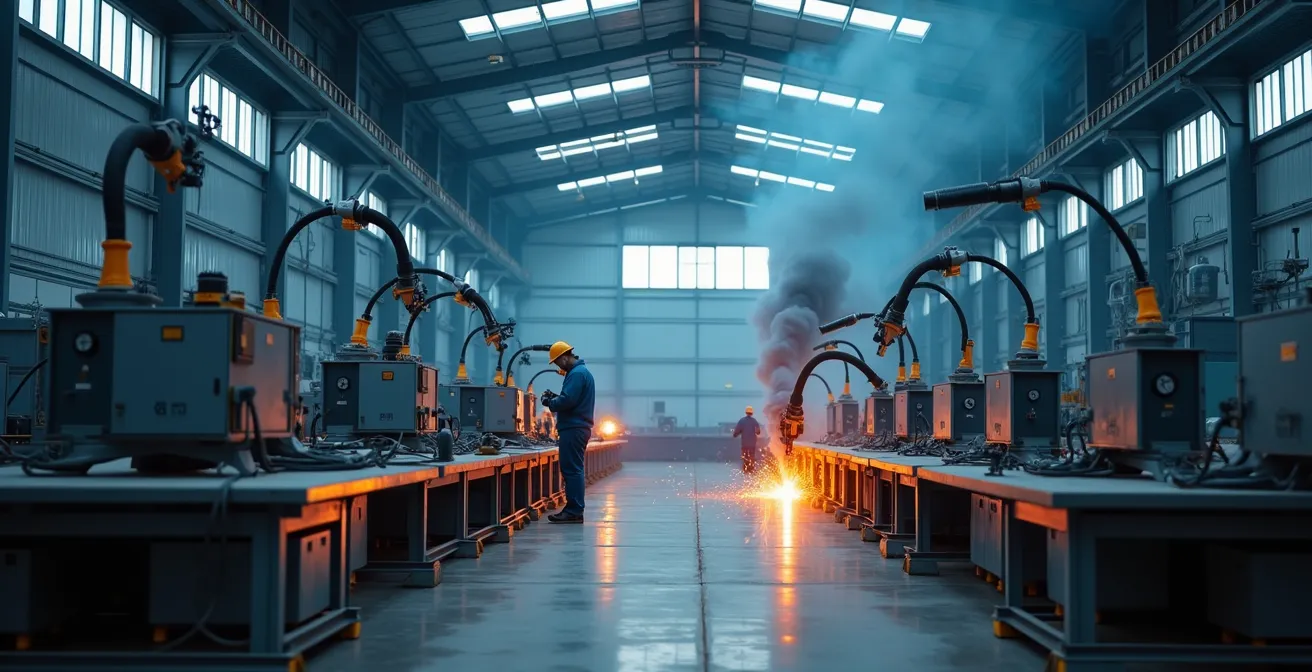
The HSE’s reclassification of mild steel fumes as a Group 1 carcinogen means your existing ventilation is likely non-compliant and headed for a failed LEV test.
- Effective fume capture depends on precise positioning and airflow velocity, not just having an extractor nearby.
- Recirculating filtered air is illegal under COSHH unless you can prove leak-free, H14-grade HEPA filtration.
Recommendation: Shift your focus from simply “having ventilation” to actively auditing your system for the critical, often-overlooked failure points that lead to non-compliance and endanger your staff.
As a fabrication shop manager, the thought of an upcoming LEV (Local Exhaust Ventilation) test from the Health and Safety Executive (HSE) can be a source of significant anxiety. You’ve invested in extraction arms, maybe a downdraft bench, and you believe you’re doing the right thing. The common wisdom is to “provide good ventilation,” and on the surface, your workshop seems to comply. You see the equipment running, and you assume your workers are protected and your legal obligations are met.
But what if that assumption is dangerously wrong? The ground has shifted dramatically. The simple presence of extraction equipment is no longer enough. Since the reclassification of mild steel welding fumes as a human carcinogen, HSE inspectors and LEV testers are no longer just ticking boxes. They are scrutinizing systems for their proven effectiveness—their ability to capture the invisible poison at the source before it ever reaches a welder’s lungs. The real key to compliance and safety isn’t in the equipment you own, but in mastering the science of capture and eliminating the systemic failure points that render even the most expensive systems useless.
This article will guide you through the new reality of welding fume extraction. We won’t just repeat the generic advice. Instead, we’ll break down the specific technical reasons why systems fail their LEV tests, from incorrect positioning and flawed filtration to the wider impact of fugitive emissions on your entire facility. You will learn what HSE inspectors are really looking for, enabling you to move from a position of hoping for compliance to a state of ensuring it.
To navigate these critical compliance issues, this guide is structured to address the most pressing questions and failure points in your LEV system. Explore the sections below to understand the new risks and the practical steps to protect your workers and your business.
Summary: A Manager’s Guide to Welding Fume Compliance and Safety
- Why mild steel welding fumes are now reclassified as a definitive carcinogen?
- How to position extraction arms to capture 95% of fumes at the source?
- On-torch extraction vs Downdraft benches: which hampers the welder least?
- The filtration mistake that makes recirculating filtered air illegal
- How to use Variable Speed Drives (VSD) to link extraction power to torch usage?
- The poor ventilation cause behind your office staff’s chronic headaches
- Why TIG welding warps your battery trays and ruins seal integrity?
- Meeting Part L Regulations: Is Your Industrial HVAC System Legally Compliant?
Why mild steel welding fumes are now reclassified as a definitive carcinogen?
The most significant change in workplace safety for fabricators has been the re-evaluation of welding fume risk. For years, mild steel fumes were considered a nuisance dust. That is no longer the case. In 2017, the International Agency for Research on Cancer (IARC), a branch of the World Health Organization, took a definitive step. Based on overwhelming evidence from multiple studies, they upgraded welding fumes from Group 2B (possibly carcinogenic) to Group 1 (carcinogenic to humans). This places welding fumes in the same risk category as asbestos and benzene.
This reclassification was not a minor adjustment. It was driven by studies showing that welders experienced elevated rates of lung cancer that could not be explained by other factors like smoking. The IARC also classified the ultraviolet (UV) radiation from welding as a Group 1 carcinogen, linking it to ocular melanoma. This scientific consensus triggered a liability cascade for employers. Regulatory bodies globally had no choice but to respond.
In response to these findings, agencies have drastically tightened safety standards. For example, SafeWork Australia responded by reducing the workplace exposure standard for welding fumes from 5 mg/m³ down to just 1 mg/m³. The UK’s HSE has followed suit, issuing safety alerts and making it clear that all welding fume, including from mild steel, requires effective engineering controls (i.e., LEV). The era of relying on general ventilation or open workshop doors is over. The burden of proof is now squarely on the employer to demonstrate that they are effectively capturing this known carcinogen at its source.
How to position extraction arms to capture 95% of fumes at the source?
The single most common failure in LEV performance is incorrect positioning of the capture hood. It’s a problem of physics: the ability of an extractor to capture fumes (its capture velocity) drops exponentially with distance. A hood that is just 30cm too far away may capture less than 50% of the carcinogens, allowing the rest to billow into the welder’s breathing zone and the wider workshop. This is why LEV testers are so focused on technique, not just equipment.
To ensure effective capture, welders must be trained on the “Rule of 15.” This simple guideline, based on the diameter of the capture hood, provides a clear starting point for optimal placement. Studies show that while average use of LEV arms yields about 70% efficiency, perfect positioning can achieve well over 90% capture rates. This is the difference between compliance and a failed test.
The key to effective positioning is to treat the capture hood as a primary welding tool. This means adhering to simple but critical rules:
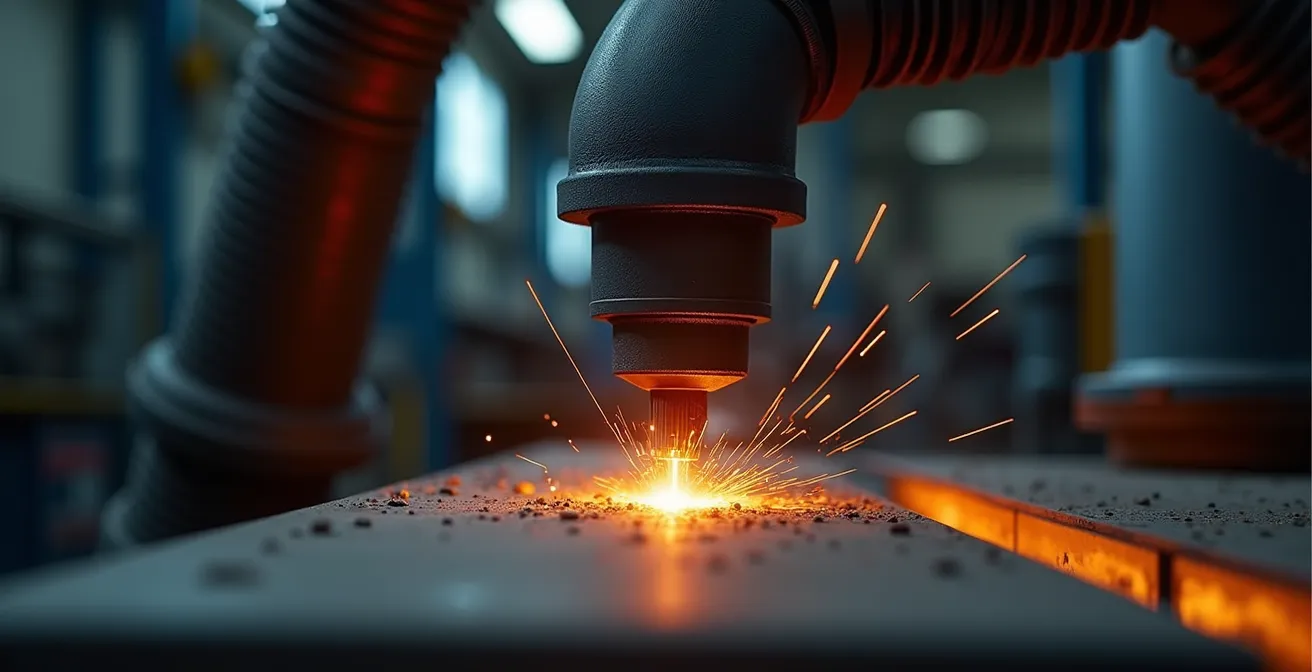
As this image demonstrates, the goal is to position the hood as close as possible without interfering with the work. The optimal setup depends on the welding orientation:
- For flat work: Place the hood behind or to the side of the weld pool, drawing the fume plume away from the welder’s face.
- Positioning distance: The hood should be within one diameter of itself from the weld. For a standard 15cm (6-inch) hood, this means no more than 15cm away.
- Testing capture: A simple smoke pen or even a lighter (used safely) at the weld point can provide instant visual feedback. The smoke should be drawn decisively into the hood. If it drifts lazily, the hood is too far away or the airflow is insufficient.
On-torch extraction vs Downdraft benches: which hampers the welder least?
Choosing the right type of LEV system involves a critical trade-off between capture efficiency, cost, and welder ergonomics. There is no single “best” solution; the ideal choice depends on your specific application. The two most common at-source solutions, on-torch extraction and downdraft benches, present very different profiles for both the manager and the welder.
On-torch systems offer excellent close-proximity capture but can be cumbersome. Downdraft benches are great for small parts but are immobile and consume significant energy. Understanding the total cost of ownership and the impact on workflow is essential.
Case Study: Phoenix Metal Fabrication’s Productivity Gains
A 12-station welding facility found that while their on-torch systems provided good fume capture, the added weight and bulkiness of the torches led to a 30% increase in reported welder fatigue. After switching to mobile extraction arms with articulated counterbalances, they not only maintained over 90% fume capture but also saw a 15% increase in overall productivity. Furthermore, their monthly filter replacement costs plummeted from $2,400 with the high-maintenance on-torch filters to just $890 with the larger, less frequently changed filters in the mobile arm units.
This example highlights that the initial purchase price is only a small part of the equation. A system that hampers the welder will lead to lower productivity, poor morale, and potentially being bypassed altogether, negating the entire investment. The following table provides a high-level comparison of common LEV systems:
| System Type | Initial Cost | Energy Consumption | Filter Replacement | Maintenance Downtime | Best Application |
|---|---|---|---|---|---|
| On-Torch Extraction | $2,000-$4,000/unit | Low (100-200W) | High frequency ($200-400/month) | Minimal (torch swap) | Long straight-run welds |
| Downdraft Bench | $8,000-$15,000/bench | High (3-5kW) | Moderate ($500-800/quarter) | Moderate (2-4 hrs/month) | Small repetitive parts |
| Mobile Extraction Arm | $3,000-$6,000/unit | Moderate (500W-1kW) | Low ($300-500/quarter) | Low (1-2 hrs/month) | Large varied fabrications |
The filtration mistake that makes recirculating filtered air illegal
One of the most critical and misunderstood aspects of LEV compliance is air recirculation. Many systems are designed to return the “cleaned” air to the workshop to save on heating costs. However, the HSE is crystal clear on this point: you cannot recirculate air from a process involving a Group 1 carcinogen unless you can prove the filtration is effective and fail-safe. This is where many businesses unknowingly fall foul of the law.
The problem is not the filter media itself, but systemic failure. A tiny gap in a door seal, an improperly clamped filter, or a cracked gasket can create a bypass path, allowing carcinogenic particles to spew back into the workspace. This renders your expensive filtration system completely ineffective. To legally recirculate air, regulations require a minimum of H14-grade HEPA filtration, which is 99.995% efficient. But this efficiency rating is meaningless if the system housing leaks.
This is why LEV testers focus heavily on filter housing integrity. As the Health and Safety Executive states in its guidance:
COSHH regulations require these systems to be tested at least once every 14 months to ensure optimal performance
– Health and Safety Executive, COSHH Regulation 9 – Maintenance Requirements
This mandatory test includes checking for leaks and ensuring the system performs to its design specification. To stay compliant and ensure your system is actually protecting people, you must have a rigorous inspection protocol.
Your 5-Point Filter Integrity Audit
- Identify Leak Points: Systematically list all potential points of failure where air could bypass the filter. This includes main access door seals, filter frame gaskets, and clamping mechanisms.
- Collect Performance Data: Inventory your current maintenance logs. Record the differential pressure readings across the filter and compare them to the manufacturer’s specifications for a clean and a loaded filter.
- Verify Filtration Coherence: Confirm that the installed filter is a certified H14 HEPA filter. Compare your recorded pressure drop with the manufacturer’s data; a significant deviation can indicate a leak or a blinded filter.
- Conduct Visual Leak Test: The moment of truth. With the system running, use a smoke pen around all identified leak points (door seals, joints, clamps). Any visible smoke being drawn into a seal or escaping from the “clean” side is a sign of a critical bypass failure.
- Create an Action Plan: Based on the audit, create a documented schedule for replacing seals and gaskets. Implement a torque-checking procedure for filter clamps, as this is a common failure point. Log all actions for your COSHH records.
How to use Variable Speed Drives (VSD) to link extraction power to torch usage?
A major hidden cost in any fabrication shop is the energy penalty of running extraction systems at full power, 100% of the time. A typical welder’s “arc-on” time might only be 20-30% of their shift. For the other 70-80%, your powerful fan motor is still running at maximum speed, consuming vast amounts of electricity to extract clean air. This is not only wasteful but also adds significant operational expense.
The solution is intelligent control. A Variable Speed Drive (VSD) is an electronic controller that adjusts a motor’s speed to match the real-time demand. When integrated with an LEV system using arc sensors or current clamps on the welder, a VSD can automatically ramp the extractor fan to full power the instant a welding arc is struck, and then reduce it to a low-power “idle” mode (e.g., 30% speed) when the welding stops. This ensures 100% capture when it’s needed, and massive energy savings when it’s not.

The financial case for VSDs is compelling. Studies show that VSDs can achieve over 50% energy savings in fan applications, with payback periods often under two years. In a multi-station workshop, this can translate to thousands of pounds saved annually. For instance, a welding facility that implemented arc-sensing VSD controls on its main collector saw its energy consumption for the system fall by 65%. The system also provided valuable data on motor power draw, which allowed their maintenance team to predict filter blockages before they became critical failures that would have failed an LEV test.
By linking extraction power directly to welding activity, you transform your LEV system from a dumb, constant-power consumer into a smart, responsive safety tool. It reduces operational costs, lowers the carbon footprint of your facility, and even reduces ambient noise levels during idle periods, creating a better working environment for everyone.
The poor ventilation cause behind your office staff’s chronic headaches
The danger of ineffective LEV isn’t confined to the workshop floor. When an extraction system fails to capture fumes at the source, they become fugitive emissions. These microscopic particles of metal, gases, and toxic compounds don’t just disappear; they drift, carried by air currents, throughout your entire building. This often overlooked pathway is a common cause of “sick building syndrome” symptoms, such as chronic headaches, dizziness, and respiratory irritation among office staff.
The root cause is a pressure imbalance. If your workshop is at a neutral or positive air pressure relative to adjacent offices, every time a door is opened, contaminated air will flow from the workshop into the “clean” office area. The HSE’s primary recommendation is always to capture contaminants at the source, preventing them from ever becoming fugitive emissions. When this fails, the only way to protect the rest of the building is through a containment strategy.
This involves designing your building’s HVAC and ventilation to work in concert, creating a negative pressure environment in the workshop. This ensures that airflow is always *into* the workshop from other areas, not out of it. Achieving this requires a strategic approach:
- Establish a Pressure Differential: The workshop should be maintained at a negative pressure of -5 to -10 Pascals relative to the office. This can be measured with a simple differential pressure monitor.
- Create Airlocks: Use vestibules or double-door systems between the workshop and office spaces to buffer pressure changes and minimize air exchange.
- Seal All Penetrations: Meticulously seal any gaps in the walls between zones, including those around cables, pipes, and ductwork.
- Test Regularly: Quarterly tests using a smoke pencil at the bottom of doors between zones can provide a quick visual confirmation that air is flowing in the correct direction (i.e., from the office into the workshop).
Why TIG welding warps your battery trays and ruins seal integrity?
While process-specific challenges like heat input from TIG welding causing warpage on delicate components like battery trays are a real concern for product quality, an even more immediate threat to your entire operation is failing a mandatory LEV test. A warped part can be reworked or scrapped; a failed LEV test can lead to an immediate prohibition notice from the HSE, shutting down production entirely. The financial and reputational damage from a compliance failure far outweighs the cost of a few non-conforming parts.
LEV testers approach your facility with a specific checklist, looking for common points of failure that indicate a system is not performing as designed. Their assessment is objective and based on measurable data, not on whether the system “looks” right. Understanding these failure points is the key to proactive preparation.
Analysis of LEV test failures across the industry reveals a consistent pattern of issues. A system is only as strong as its weakest link, and testers are experts at finding that link. Here are the most frequent reasons a system fails its 14-monthly inspection:
| Failure Point | Frequency | Detection Method | Typical Fix | Cost Impact |
|---|---|---|---|---|
| Insufficient airflow | 35% | Anemometer testing | Clean/replace filters | $500-2,000 |
| Damaged ducting | 25% | Visual + smoke test | Repair/replace sections | $1,000-5,000 |
| Incomplete logs | 20% | Documentation review | Implement tracking system | $200-500 |
| Filter bypass | 15% | Differential pressure test | Replace seals/gaskets | $300-1,000 |
| Control failures | 5% | Functional testing | Repair controls/sensors | $500-3,000 |
As the table shows, the most common failures are related to maintenance (blocked filters) and physical damage (ducts). These are often missed during day-to-day operations but are immediately obvious to a trained inspector with the right tools. A proactive internal audit focusing on these points can prevent a costly official failure.
Key takeaways
- The reclassification of mild steel fume as a Group 1 carcinogen legally mandates the use of effective, well-maintained LEV systems.
- True system effectiveness lies in the details: precise capture hood positioning, proven H14 HEPA filtration for recirculation, and regular integrity checks.
- Failing to control fumes at the source creates fugitive emissions that can impact the health of all employees, including office staff.
Meeting Part L Regulations: Is Your Industrial HVAC System Legally Compliant?
While regulations like Part L of the Building Regulations govern a building’s overall energy efficiency, a far more financially dangerous area of legal non-compliance for a fabrication shop lies in its process ventilation. An HSE prohibition notice for a faulty LEV system carries immediate and severe consequences that dwarf the penalties associated with general HVAC inefficiency. The cost of non-compliance with COSHH regulations is not just a potential fine; it’s a cascade of direct and indirect costs that can threaten the viability of your business.
The financial risk of inaction grows over time. The cancer risk for welders increases with the length of their employment, making the employer’s liability cumulative. A single successful compensation claim can run into hundreds of thousands of pounds. When viewed through this lens, investing in a fully compliant and effective LEV system is not a cost center; it is a critical form of insurance for your business.
The apathetic “it won’t happen to me” approach is a gamble against heavily stacked odds. The costs of a single enforcement action, production shutdown, or civil liability claim can easily exceed the total cost of a compliant system over a decade. A simple cost-benefit analysis makes the business case for compliance undeniable.
| Cost Category | Compliant System | Non-Compliance Risk |
|---|---|---|
| Initial CapEx | $15,000-30,000 | $0 |
| Annual OpEx (filters/energy) | $3,000-5,000 | $0 |
| LEV Testing (annual) | $1,500-2,500 | $0 |
| Regulatory Fines | $0 | $10,000-50,000/violation |
| Insurance Premium Increase | $0 | 15-30% annual increase |
| Production Shutdown | $0 | $5,000-20,000/day |
| Employee Compensation Claims | $0 | $50,000-500,000/claim |
| 5-Year Total (worst case) | $45,000-62,500 | $200,000-2,000,000+ |
The path to compliance and a safe workplace requires a proactive, informed approach. Stop seeing LEV as a grudge purchase and start treating it as a critical production asset. The first step is to conduct a thorough, honest audit of your current systems against the standards outlined here. Evaluate your extraction now to protect your workers and your business from the severe consequences of non-compliance.