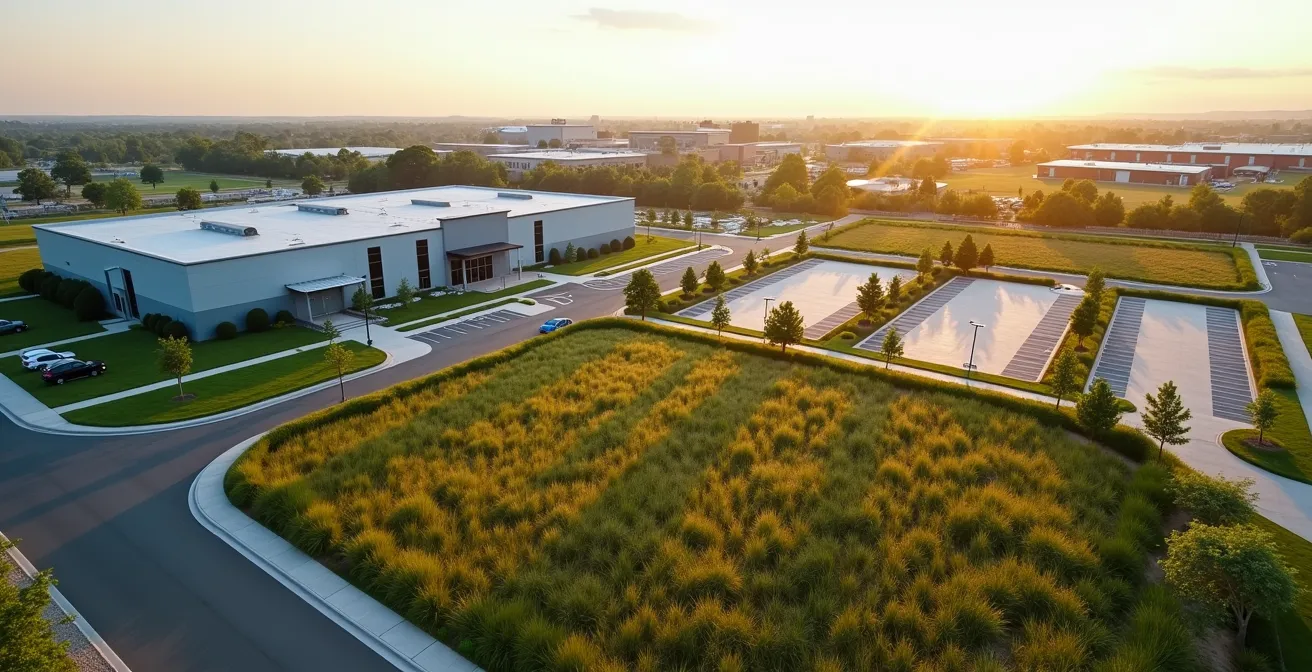
Sustainable landscaping is the most overlooked lever for reducing OPEX and mitigating financial risk on UK industrial sites.
- It directly slashes recurring costs like mowing, irrigation, and repairs by replacing high-maintenance ornamental features with resilient, engineered ecologies.
- It provides critical cost-avoidance by managing surface water to prevent flood damage, reducing insurance liabilities, and ensuring compliance with new planning laws like Biodiversity Net Gain.
Recommendation: Audit your site’s grounds not as a decorative cost centre, but as a performing financial asset with a quantifiable ROI.
As a facility manager for a UK industrial park, you know the relentless pressure of the groundskeeping budget. That line item for mowing, watering, and general upkeep seems to only ever expand, a constant drain on operational expenditure (OPEX). The conventional wisdom suggests a tidy lawn and ornamental shrubs are the cost of doing business—a neat, green, and expensive necessity. Common advice revolves around marginal gains: mow less frequently, fix leaks, and hope for a mild season.
But this approach fundamentally misunderstands the role of the land itself. It treats your site’s landscape as a decorative problem to be managed, rather than a high-performance system to be engineered. What if the real key to slashing maintenance costs wasn’t just trimming the edges, but completely redesigning the engine? What if the manicured lawn was the problem, not the solution? This isn’t about being “green” for its own sake; it’s about being financially astute.
This guide reframes sustainable landscaping as a strategic financial tool. We will move beyond the platitudes to demonstrate how treating your landscape as a functional asset can deliver significant, measurable cost reductions and enhance operational resilience. We’ll break down the real return on investment (ROI) of replacing costly lawns, analyse the long-term value of smart water management, and explain how to turn new environmental regulations from a burden into a financial catalyst. It’s time to stop maintaining a cost centre and start investing in a profitable asset.
To help you navigate these strategic shifts, this article breaks down the key financial and operational levers at your disposal. Explore the following sections to build a robust business case for transforming your site’s grounds into a low-cost, high-value asset.
Summary: A Facility Manager’s Guide to Cost-Saving Industrial Landscaping
- Why maintaining 1 acre of ornamental lawn costs £5,000 more per year?
- How to select drought-resistant UK native plants for industrial verges?
- Permeable paving vs tarmac: which offers better long-term ROI for car parks?
- The drainage error that voids industrial insurance policies during heavy rainfall
- How to retrofit rainwater harvesting systems to supply site washrooms?
- Why local councils are rejecting industrial expansions on biodiversity grounds?
- How to calculate the carbon footprint of a product from cradle to gate?
- Biodiversity Net Gain 2024: How Industrial Sites Can Meet New UK Planning Rules?
Why maintaining 1 acre of ornamental lawn costs £5,000 more per year?
The traditional ornamental lawn is the single largest financial liability in most industrial landscapes. Its pristine appearance comes at a steep, recurring price. The costs extend far beyond simple mowing; they encompass a cycle of intensive inputs including fertilisation, pest control, aeration, and, most significantly, irrigation. In a commercial setting, these activities require specialised equipment, man-hours, and significant water consumption, driving up your operational expenditure relentlessly. For a facility manager under pressure to reduce overheads, this high-maintenance model is simply unsustainable from a financial perspective.
The alternative, a native wildflower meadow, transforms this liability into an asset. While the initial setup cost may be higher to properly prepare the soil and seed the area, the long-term operational savings are dramatic. Native meadows are adapted to the local climate and soil, eliminating the need for fertilisers and pesticides. Their water requirements are minimal once established, and an analysis by the EPA shows native landscapes might cost only one-fifth that of a conventional turf lawn over a 10-year period. Maintenance is reduced to a single annual cut, drastically lowering labour and fuel costs.
This shift from a high-input lawn to a low-input meadow directly impacts the bottom line. The financial argument is not based on abstract environmental benefits but on hard numbers and a clear return on investment. Furthermore, a switch to sustainable landscaping practices can yield significant savings on utilities; a study found that businesses switching to sustainable landscaping can save between 20-50% on their water bills annually.
The following comparison breaks down the 5-year total cost of ownership for a traditional lawn versus a native meadow, illustrating a clear and compelling business case for change.
| Cost Category | Traditional Lawn (1 acre) | Native Meadow (1 acre) | Savings |
|---|---|---|---|
| Initial Setup (Year 1) | £8,000 | £12,000 | -£4,000 |
| Annual Maintenance (Years 2-5) | £6,000/year | £800/year | £5,200/year |
| Total 5-Year Cost | £32,000 | £15,200 | £16,800 |
| Break-even Point | Year 2-3 | ||
How to select drought-resistant UK native plants for industrial verges?
Selecting the right plants is the cornerstone of creating a low-maintenance, resilient industrial landscape. The goal is to establish an “engineered ecology”—a plant community that thrives with minimal human intervention. Forget delicate ornamentals; the focus must be on UK native species that are naturally adapted to the challenging conditions of an industrial site, such as compacted soil, exposure, and intermittent water supply. These plants have evolved over millennia to survive and flourish in the British climate, making them inherently drought-resistant and hardy.
The process begins with a site analysis, not a catalogue. Assess the specific microclimates across your property. A south-facing embankment will have different requirements than the shaded perimeter of a warehouse. Is the soil heavy clay or free-draining gravel? Answering these questions allows for a targeted planting strategy that works with nature, not against it. This approach dramatically reduces the long-term cost of plant replacement and ongoing care.
To ensure success, consider creating “plant guilds”—combinations of species that support each other. For example, combine deep-rooted perennials that break up compacted soil with nitrogen-fixing groundcovers like clover that naturally fertilise the area. This creates a self-sustaining ecosystem that improves soil health over time, further reducing the need for external inputs. When sourcing plants, always use certified suppliers who can provide provenance certification. This is not only a mark of quality but is also becoming a critical requirement for planning applications and demonstrating Biodiversity Net Gain compliance.
The visual appeal of these hardy natives should not be underestimated. They offer a changing tapestry of textures and colours throughout the seasons, creating a landscape that is both beautiful and functional.

As this image demonstrates, the resilience of native species like Purple Coneflower is rooted in their adaptation to tough environments. A practical selection guide for different site conditions includes:
- Compacted Clay Mix: Use deep-rooted perennials like Wild Geranium and native sedges that can penetrate heavy soil.
- Dry South-Facing Embankment: Select drought-tolerant species such as Black-Eyed Susan and Purple Coneflower.
- Shaded Building Perimeter: Choose shade-tolerant natives like native ferns and woodland wildflowers.
Permeable paving vs tarmac: which offers better long-term ROI for car parks?
The vast expanses of tarmac in industrial car parks represent a significant, often unrecognised, financial risk. Tarmac is an impermeable surface, meaning it prevents rainwater from soaking into the ground. Instead, it funnels huge volumes of water directly into drainage systems during a downpour. This not only puts immense strain on existing infrastructure, potentially leading to localised flooding, but also means you are paying to dispose of a resource—rainwater—that could be managed on-site. Many water companies in the UK levy significant surface water drainage charges on businesses based on the impermeable area of their site.
Permeable paving offers a financially superior alternative by engineering a solution directly into the car park surface. These systems allow rainwater to filter through the paving into a sub-base below, where it can be slowly released into the ground or stored for reuse. This approach generates a compelling long-term Return on Investment (ROI) through several mechanisms. Firstly, it can drastically reduce or even eliminate surface water drainage charges. Secondly, by managing water at the source, it reduces the required size and cost of underground drainage infrastructure (a major CAPEX saving on new builds or expansions). Thirdly, it mitigates the risk of on-site flooding, a critical factor for business continuity and insurance premiums.
While the initial installation cost (capex) of permeable paving can be higher than traditional tarmac, its lower operational expenditure (opex) and cost-avoidance benefits typically result in a much stronger long-term ROI. Tarmac requires frequent repairs for cracks and potholes, whereas permeable systems primarily need periodic sweeping to keep the surface clear. As seen in international examples, financial incentives can further sweeten the deal. In cities like Toronto and Ottawa, green infrastructure such as bioswales or permeable surfaces can qualify for rebates or reduced fees, a model increasingly being explored by UK councils.
Your 10-Year ROI Calculation Checklist: Permeable Paving
- Calculate CAPEX: Compare the total installation costs for permeable paving systems versus traditional tarmac for your specified area.
- Track OPEX: Inventory the projected annual costs for jet washing/sweeping for permeable surfaces against the historical costs of crack/pothole repairs for tarmac.
- Factor Avoided Costs: Quantify the potential reduction in capital expenditure on underground drainage infrastructure and attenuation tanks.
- Quantify Co-benefits: Estimate potential energy savings from the reduced Urban Heat Island effect, which can lower building cooling loads in summer.
- Include Incentives: Contact your local water company to confirm the exact reduction in surface water drainage charges your site would receive.
The drainage error that voids industrial insurance policies during heavy rainfall
The single most critical drainage error that can jeopardise an industrial site during heavy rainfall is not a catastrophic failure, but simple, cumulative neglect. Insurance policies for commercial properties almost universally contain clauses related to “preventative maintenance” or “duty of care.” If a flood occurs and it can be demonstrated that the site’s drainage systems—gutters, drains, culverts, and swales—were blocked with debris, silt, or overgrown vegetation, the insurer can argue that the owner failed to take reasonable steps to prevent the loss. This can lead to a claim being reduced or, in the worst-case scenario, voided entirely, leaving the business to foot the entire bill for damages and operational downtime.
For a facility manager, this transforms landscape maintenance from a matter of aesthetics into a critical risk management function. The financial exposure from a single, non-insured flood event can dwarf a decade’s worth of groundskeeping budgets. Proactive landscape design is the most effective form of insurance. Integrating features like bioswales—vegetated channels designed to slow and filter stormwater—near runoff sources like car parks and downspouts actively reduces the load on traditional drainage systems. Maintaining proper grading to ensure water is always directed away from building foundations is another fundamental but often overlooked task.
Documenting maintenance is as important as the work itself. A detailed log, complete with dated photographs of cleared drains and inspected outfalls, provides irrefutable evidence of proactive management. This documentation is your first line of defence in the event of a claim. As experts in the field note, the link between landscape and financial protection is direct and undeniable.
Flood-mitigating landscape features protect buildings, walkways, and underground structures that reduce long-term repair and insurance costs
– Strathmore Landscape Management, Climate-Resilient Landscaping Report
To ensure your site is compliant and protected, a rigorous inspection and maintenance schedule is non-negotiable. Key actions include quarterly inspections of all drainage systems for blockages, the use of rain sensors on any irrigation systems to prevent overwatering during wet periods, and regular reviews of your insurance policy’s specific clauses on preventative duties.
How to retrofit rainwater harvesting systems to supply site washrooms?
Retrofitting a rainwater harvesting system is a pragmatic investment that turns a free, natural resource into a measurable reduction in your site’s utility bills. For an industrial facility, large roof areas provide a vast collection surface, making these systems particularly effective. The concept is simple: capture the water that falls on your buildings, filter it, store it, and use it to offset your consumption of mains water. The most logical and financially rewarding application is often for non-potable uses like flushing toilets in site washrooms, which can account for a significant portion of a facility’s water usage.
Implementing a retrofit project can be staged to match budget and ambition. The journey can begin with a simple, low-cost “Bronze” tier system, where water butts are connected to downspouts to collect water for landscape irrigation. This provides immediate, albeit small, savings and serves as a proof-of-concept. A “Silver” tier system involves larger storage tanks and a basic pump, allowing the collected water to be used for tasks like vehicle or equipment washing. This delivers a more substantial ROI with a payback period of just a few years.

The ultimate goal for maximum financial return is the “Gold” tier: a fully integrated system. This involves larger, often underground, storage tanks, a more sophisticated filtration system to remove particulates, and plumbing to connect the stored water directly to the cisterns of the site’s toilets. While the initial CAPEX is higher, the system continuously and automatically reduces your reliance on metered water, leading to the fastest payback period for a large-scale installation. The key is to see this not as an environmental project, but as an infrastructure investment with a clear financial return.
The table below outlines typical scenarios, providing a clear pathway for facility managers to plan and budget for a phased implementation based on cost and expected returns.
| System Level | Application | Estimated Cost | Payback Period |
|---|---|---|---|
| Bronze | Simple water butt for landscape irrigation | £500-£1,500 | 1-2 years |
| Silver | Intermediate system for vehicle washing/greywater | £3,000-£8,000 | 2-4 years |
| Gold | Fully integrated system supplying toilets | £10,000-£25,000 | 3-5 years |
Why local councils are rejecting industrial expansions on biodiversity grounds?
For decades, planning applications for industrial expansions were primarily judged on economic impact, traffic, and noise. Today, a new factor has become a primary gatekeeper: biodiversity. Across the UK, local councils are increasingly rejecting or delaying planning permissions for industrial developments that fail to demonstrate a positive impact on the local ecosystem. This is not arbitrary; it is driven by national legislation and a fundamental shift in planning policy. The old model of simply offsetting habitat loss by paying a fee is no longer sufficient. Councils now demand that developments actively enhance the biological value of a site.
This presents a significant financial risk for any business planning to expand. A rejected application can lead to costly delays, expensive redesigns, and a loss of competitive advantage. The root cause of these rejections is often a landscape plan rooted in the 20th century: vast swathes of sterile ornamental lawn, non-native decorative shrubs, and impermeable tarmac. These “green deserts” offer virtually no value for local wildlife and are viewed by planning authorities as a net loss for the environment. They signal a failure to engage with modern environmental responsibilities.
Conversely, a proactive, sustainable landscape strategy transforms this risk into an opportunity. By integrating biodiversity-enhancing features from the outset—such as native wildflower meadows, SUDS (Sustainable Urban Drainage Systems) ponds, and belts of native woodland—a development can demonstrate a clear commitment to ecological improvement. This approach turns the landscape from a planning liability into a powerful argument in favour of the project. Leading businesses are already capturing this value, turning under-utilised corporate land into productive, biologically diverse areas that provide a host of benefits and a tangible return on investment.
By treating the landscape as an integral part of the planning strategy, facility managers can de-risk the expansion process. A well-designed, biodiverse landscape is no longer a “nice-to-have” but a critical component of a successful planning application, saving potentially hundreds of thousands of pounds in avoided delays and consultancy fees.
How to calculate the carbon footprint of a product from cradle to gate?
While a detailed “cradle to gate” Life Cycle Assessment (LCA) for a specific product is a complex task, the operational carbon footprint of the facility where it is made is a major and more easily managed component. As a facility manager, your grounds management strategy has a direct and measurable impact on your site’s overall emissions profile. Every litre of petrol used in a mower, every kilowatt-hour of electricity used to pump irrigation water, and the energy consumed by HVAC systems all contribute to the “gate” portion of your product’s carbon footprint. Reducing these inputs is a direct path to lowering your overall carbon score.
Sustainable landscape practices offer a portfolio of carbon reduction opportunities. The most significant is often the shift from fossil-fuel-powered equipment to electric alternatives. Modern electric and robotic mowers not only eliminate direct emissions but can also reduce labour hours by up to 40% on suitable terrain. This delivers savings in both carbon and OPEX. Similarly, replacing high-maintenance lawns with native plantings that require only one annual cut drastically reduces the fuel and labour associated with weekly mowing.
Energy consumption related to water and building climate control can also be tackled. Installing smart irrigation sensors ensures water is used only when necessary, reducing the energy consumed by water pumps. Furthermore, green roofs are a powerful tool for insulation. By adding a living layer to your roof, you can significantly reduce the building’s heat gain in the summer and heat loss in the winter, easing the load on HVAC systems. In some cases, green roofs can see up to 50% of installation costs recouped through energy savings alone.
To make this tangible, every action can be translated into a carbon saving. By tracking the reduction in fuel, electricity, and gas usage resulting from these landscape changes, you can calculate the equivalent reduction in kilograms of CO2 (kgCO2e) using official government conversion factors. This provides a quantifiable, reportable metric demonstrating your commitment to sustainability—a key factor for corporate reporting and customer perception.
Key Takeaways
- Traditional ornamental lawns are a significant financial liability, costing thousands more per acre in annual maintenance than resilient native meadows.
- Engineered ecologies using native plants, permeable surfaces, and rainwater harvesting actively reduce operational risks like flooding and drought, protecting the asset.
- New UK regulations like Biodiversity Net Gain should be viewed as a financial opportunity to justify cost-saving landscape upgrades, not just a compliance hurdle.
Biodiversity Net Gain 2024: How Industrial Sites Can Meet New UK Planning Rules?
The introduction of mandatory Biodiversity Net Gain (BNG) in 2024 has fundamentally changed the rules for development in the UK. Under the Environment Act, nearly all new developments, including industrial expansions, must now demonstrate a 10% minimum increase in biodiversity value compared to the site’s pre-development state. This is a non-negotiable, legally binding condition of planning permission. For facility managers, understanding how to meet this requirement efficiently is no longer an option—it is a critical operational necessity to enable site growth.
Meeting BNG is not about simply planting a few trees. It is a metric-driven process. The “biodiversity value” of a site is calculated using a formal government metric, which assigns scores to different habitat types. A high-maintenance, species-poor ornamental lawn scores very low. In contrast, a native wildflower meadow, a pond, or a patch of woodland scores very high. The strategy is therefore clear: replace low-scoring, high-maintenance habitats with high-scoring, low-maintenance ones. This aligns perfectly with the cost-saving principles of sustainable landscaping, creating a powerful synergy where compliance drives profitability.
This creates a “menu” of interventions for facility managers to choose from, each with a different cost, maintenance load, and BNG value. Installing a small pond or wetland area, for example, offers exceptionally high biodiversity value and can be integrated with your site’s sustainable drainage strategy. Converting just one acre of lawn to a native meadow can generate a significant uplift in BNG units while simultaneously slashing maintenance costs. Even smaller interventions like installing bee hotels, bird boxes, and planting native hedgerows contribute to the overall score. The key is to be strategic, choosing the interventions that provide the most BNG “bang for your buck.”
The following table provides a simplified “BNG Value Menu” to help guide decision-making, showing how different landscape interventions stack up in terms of ecological value and implementation cost.
| Intervention Type | Biodiversity Value | Implementation Cost | Maintenance Requirements |
|---|---|---|---|
| Creating a pond | High Value | £5,000-£15,000 | Annual inspection |
| Converting lawn to meadow | Medium-High Value | £2,000-£5,000/acre | Annual cut |
| Installing bee hotels/bird boxes | Medium Value | £500-£2,000 | Seasonal cleaning |
| Native shrub planting | Medium Value | £3,000-£8,000 | Minimal after establishment |
| Non-native ornamental shrubs | Low Value | £2,000-£5,000 | Regular pruning/fertilizing |
By shifting your perspective from short-term aesthetics to long-term asset performance, you can transform your grounds from a costly burden into a resilient, compliant, and financially productive system. The next logical step is to conduct a strategic audit of your current landscape, identifying the highest-cost areas and the biggest opportunities for BNG-aligned upgrades.