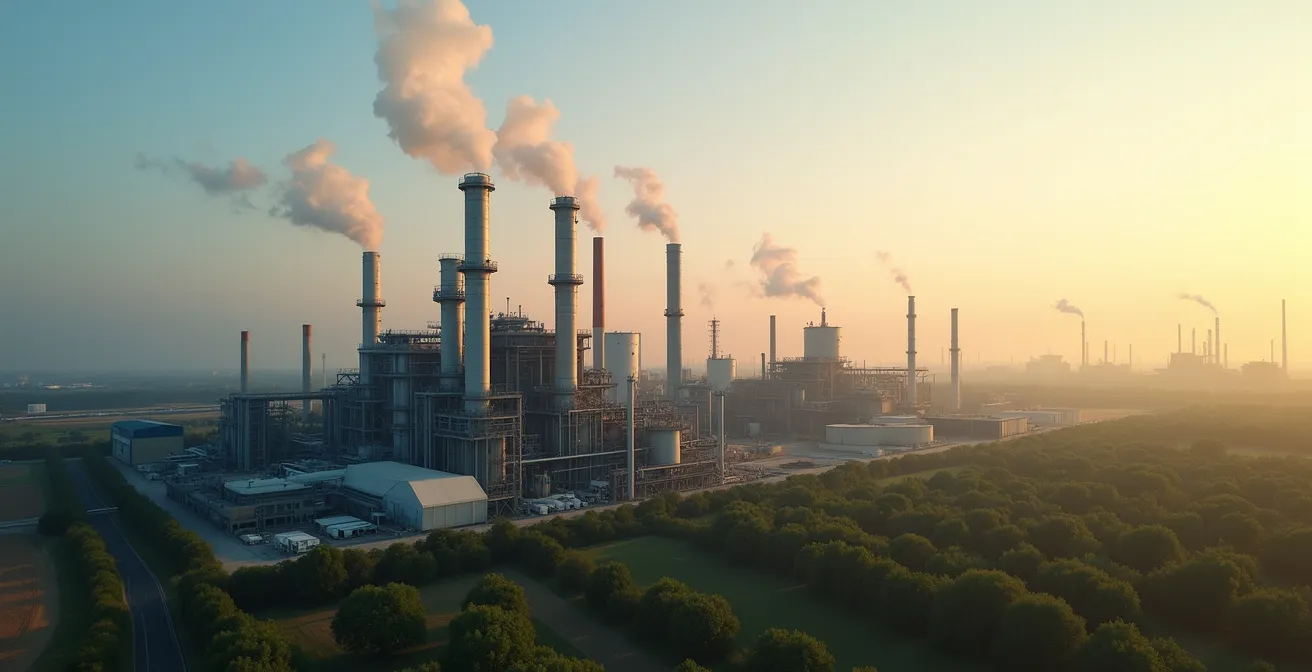
Contrary to common belief, the greatest financial threat from an environmental breach is not the Environment Agency fine itself, but the cascade of hidden costs that follow.
- Reputational damage and loss of stakeholder trust often have a far greater long-term financial impact than the initial penalty.
- Proactive compliance, using technologies like CEMS and robust bunding, significantly enhances operational resilience and reduces the risk of costly production halts.
Recommendation: Shift your site’s posture from reactive problem-solving to proactive risk management; view environmental compliance as a strategic investment, not just an operational cost.
For any site director in the UK’s chemical or processing sectors, the prospect of a visit from the Environment Agency (EA) can be a source of considerable anxiety. The focus is often on the immediate, tangible threat: the hefty fines that can be levied for breaching discharge limits or other environmental permits. The conventional wisdom is to implement just enough monitoring and control to stay on the right side of the law. This approach, while common, is dangerously short-sighted and fundamentally misunderstands the modern risk landscape.
The conversation around compliance has evolved. Merely avoiding penalties is a low bar that leaves a company exposed to a far wider array of threats. The true cost of an environmental incident extends into legal battles, soaring insurance premiums, shareholder revolts, and crippling reputational damage that can take years to repair. In an era where Environmental, Social, and Governance (ESG) performance is a key metric for investors and customers, a reactive stance is a significant liability.
But what if the framework for compliance could be flipped? What if, instead of a cost centre to be minimised, it was treated as a strategic investment in operational resilience and long-term profitability? The key is not simply to ask “How do we avoid a fine?” but “How do we build a system so robust that fines become a non-issue, and our environmental performance becomes a competitive advantage?” This article will deconstruct the core areas of industrial pollution control, moving beyond the platitudes to provide a director-level calculus for making smarter, more strategic compliance decisions.
To navigate these complex challenges, this guide breaks down the critical areas of concern for any industrial site. We will explore the true costs of non-compliance, evaluate the technology to prevent it, and outline the strategic decisions necessary to meet new UK regulations, providing a clear roadmap for action.
Summary: A Strategic Guide to Industrial Environmental Compliance
- Why Exceeding Discharge Limits Costs More Than Just a Fine?
- How to Retrofit Scrubbers to Existing Stacks Without Halting Production?
- Biofilters vs Thermal Oxidisers: Which Is Cost-Effective for VOC Removal?
- The Bunding Mistake That Leads to Groundwater Contamination Lawsuits
- When to Install Continuous Emissions Monitoring Systems (CEMS) to Stay Compliant
- Why Local Councils Are Rejecting Industrial Expansions on Biodiversity Grounds?
- The Hidden Carbon Cost of Aluminium Facades That Designers Overlook
- Biodiversity Net Gain 2024: How Industrial Sites Can Meet New UK Planning Rules?
Why Exceeding Discharge Limits Costs More Than Just a Fine?
The figure on an Environment Agency penalty notice is only the entry point to a much larger financial and operational crisis. While a direct fine is painful, it represents just the tip of the iceberg. The real damage unfolds across multiple fronts, creating a “full spectrum cost” that can destabilise an entire operation. The pressure to conform to higher standards is immense, as noted by industry analysts. As one BCG research team states in their Global ESG Due Diligence Study:
Companies are under enormous pressure to take responsibility for the environmental, social, and governance (ESG) impacts of their operations
– BCG Research Team, Global ESG Due Diligence Study
This pressure materialises in tangible ways. A significant breach immediately triggers a loss of confidence from investors, customers, and the local community, which constitutes a severe reputational cost. This can lead to lost contracts and difficulty in attracting talent. Legal fees for defending the company in court, alongside potential civil claims from affected parties, can quickly eclipse the original fine. Furthermore, insurers will invariably raise premiums for sites with a poor compliance record, adding a recurring operational cost. In the most severe cases, regulatory frameworks like the EU’s Corporate Sustainability Due Diligence Directive are setting the stage for penalties that could reach up to 5% of a company’s global turnover. This transforms a compliance failure from an operational headache into an existential business threat.
How to Retrofit Scrubbers to Existing Stacks Without Halting Production?
One of the biggest deterrents to upgrading air pollution control systems is the fear of extended operational downtime. For a processing plant, shutting down production for weeks to install a new scrubber system is a non-starter. However, modern retrofitting techniques have evolved significantly to minimise this disruption, shifting the bulk of the work away from the live operational environment. The key lies in prefabrication and modular construction. Instead of building the system piece by piece on-site, large components of the scrubber are manufactured and pre-assembled off-site in a controlled environment. This allows for quality control and reduces on-site welding and fabrication to a minimum.
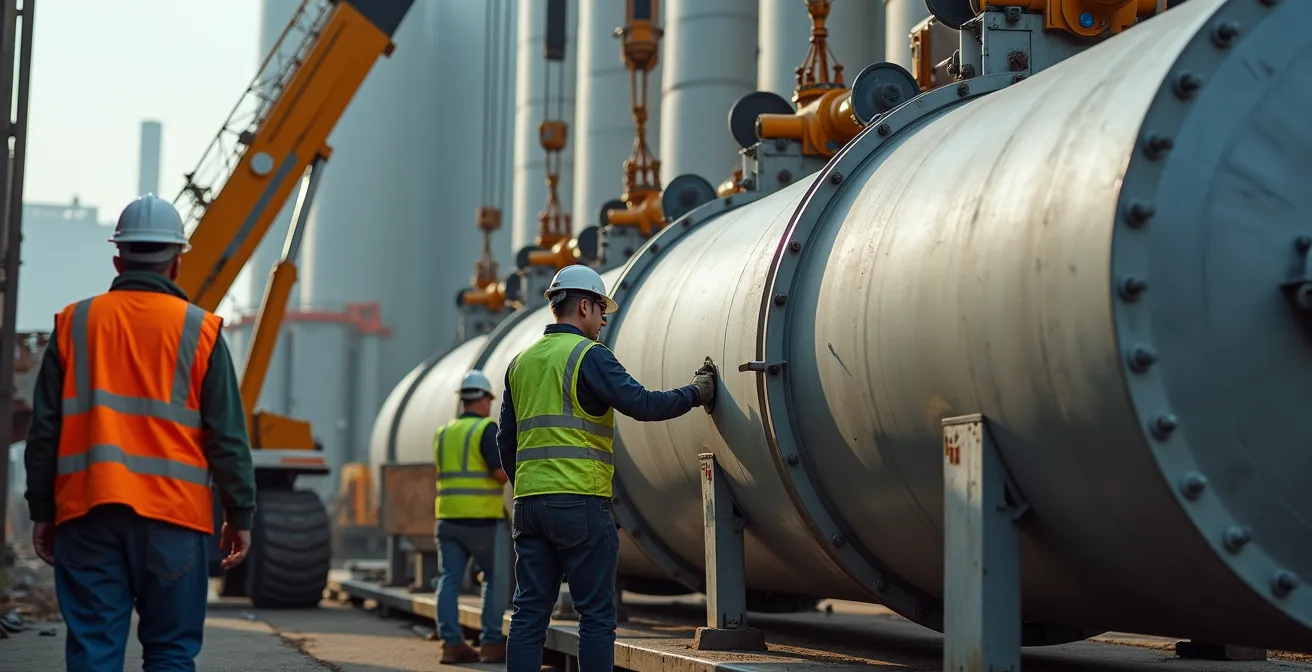
As the illustration shows, these prefabricated modules are then transported to the site for final assembly and integration. This process transforms a lengthy construction project into a more predictable, crane-and-bolt assembly job. According to Alfa Laval, this approach can drastically shorten the most disruptive phases of the project, with total downtime being reduced to just 2-4 weeks in many cases through careful planning. Real-world applications, such as the PureSOx scrubber retrofit on Spliethoff vessels, demonstrate that initial installations provide crucial lessons. In that case, the team learned to better integrate circulation pumps into the new, larger funnel, streamlining subsequent retrofits. This iterative improvement is central to making upgrades a manageable, planned process rather than a catastrophic shutdown.
Biofilters vs Thermal Oxidisers: Which Is Cost-Effective for VOC Removal?
When dealing with Volatile Organic Compounds (VOCs), site directors face a critical choice between different abatement technologies, each with a distinct cost profile. The two main contenders are often biological systems, like biofilters, and combustion systems, like Regenerative Thermal Oxidizers (RTOs). The decision is not merely about technical performance but about the Total Cost of Ownership (TCO), balancing upfront capital expenditure (CapEx) against long-term operating expenditure (OpEx). A biofilter typically represents the lowest CapEx, using microorganisms to break down pollutants. It requires no fuel and has minimal energy consumption, making its OpEx very low. However, its primary limitation is a lower destruction efficiency, generally in the 70-90% range, which may not be sufficient for stricter permit limits.
In contrast, an RTO offers extremely high destruction efficiency, often exceeding 99%. This comes at the cost of a high initial CapEx. Yet, their design is a masterpiece of energy efficiency. By using ceramic media to capture and reuse heat from the combustion process, a modern RTO can achieve thermal efficiencies of up to 97%. This means that once at operating temperature, it may require very little or no auxiliary fuel, making its OpEx surprisingly low. This strategic trade-off is central to the decision-making process, as detailed in the following comparison based on an analysis by Ceco Environmental.
| Technology | VOC Destruction Efficiency | Heat Recovery | Capital Cost | Operating Cost |
|---|---|---|---|---|
| Regenerative Thermal Oxidizers (RTOs) | 98-99%+ | Up to 97% | High | Low (energy efficient) |
| Catalytic Oxidizers | 95-99% | Lower than RTOs | Lower than RTOs | Higher over time |
| Biofilters | 70-90% | None | Lowest | Low (no fuel required) |
The choice is therefore strategic: for sites with high VOC concentrations and stringent abatement targets, the high CapEx of an RTO is a sound investment that pays off through reliability and low running costs. For sites with lower VOC loads and less demanding limits, a biofilter can be a highly cost-effective solution.
The Bunding Mistake That Leads to Groundwater Contamination Lawsuits
Secondary containment, or bunding, is one of the most fundamental yet frequently mismanaged aspects of site safety and environmental protection. The concept is simple: create an impermeable barrier around a primary storage tank (or tanks) capable of holding the contents in case of a leak. However, a series of common, preventable mistakes can render a bund completely ineffective, paving the way for catastrophic ground and water pollution. Industrial water pollution is a major global issue, with some reports suggesting that the tech sector alone contributes to approximately 20% of the world’s total. A failed bund is a direct route to becoming part of this statistic.
The most common mistake is a simple miscalculation of volume. Regulations, such as the Control of Pollution (Oil Storage) Regulations 2001 in England, typically require the bund to hold 110% of the capacity of the largest single tank within it. As sites evolve and tanks are added or replaced, a failure to re-evaluate and upgrade the bund capacity is a compliance time bomb. Another critical error is sealant incompatibility. The concrete of a bund may be sound, but if the sealant or lining is not resistant to the specific chemicals being stored, a leak will quickly compromise the containment. Finally, poor management of rainwater accumulation can lead to a bund being already partially full when a leak occurs, causing an overflow. A strict test-and-discharge protocol for rainwater is not optional; it’s essential.
Your Action Plan: Critical Bunding Compliance Checklist
- Capacity Verification: Confirm your bund’s capacity meets the 110% requirement for the largest tank and document the calculation.
- Sealant Compatibility: Annually test and verify that the bund’s concrete sealant is fully compatible with all chemicals stored within the containment area.
- Rainwater Protocol: Implement and enforce a strict test-and-discharge protocol for any accumulated rainwater to ensure full containment capacity is always available.
- Change Management: Document every tank addition or upgrade and immediately recalculate the required bund capacity, scheduling upgrades as needed.
- Leak Detection: Install modern leak detection systems with alarms at critical points within the bund to provide early warning of a primary containment failure.
When to Install Continuous Emissions Monitoring Systems (CEMS) to Stay Compliant
For many industrial sites, environmental compliance has historically been a reactive process involving periodic “spot” testing of emissions. This approach provides only a snapshot in time and leaves a facility blind to fluctuations that may occur between tests, potentially leading to undetected breaches of permit limits. The strategic shift towards proactive compliance involves adopting Continuous Emissions Monitoring Systems (CEMS). As the name implies, a CEMS is an automated system that provides a real-time, continuous data stream on the concentration of pollutants being discharged from a stack. This move from periodic reports to a live dashboard is a fundamental change in operational oversight.

So, when does installing a CEMS become necessary? The primary driver is regulation. Many EA permits for larger or more pollutive processes (such as those under the Industrial Emissions Directive) explicitly mandate the use of CEMS for specific pollutants like NOx, SO2, or particulates. Beyond regulatory mandate, a CEMS becomes a strategic imperative when a process has highly variable emissions. If feedstock changes, production cycles, or start-up/shutdown procedures create emission spikes, a CEMS is the only way to truly understand and control them. It provides the data needed to optimise processes, providing an early warning of equipment malfunction before it leads to a breach. As the US EPA notes, a CEMS provides a direct measurement of a pollutant, such as a Nitrogen Oxides (NOx) CEMS monitoring the effluent from a process stack, ensuring compliance with a specific NOx limit. This continuous feedback loop transforms compliance from guesswork into data-driven management.
Why Local Councils Are Rejecting Industrial Expansions on Biodiversity Grounds?
In the past, planning applications for industrial expansions were primarily judged on economic benefit and traditional environmental metrics like noise or air pollution. Today, a new and powerful factor has entered the equation: biodiversity. Across the UK, local councils are increasingly scrutinising, and in some cases rejecting, development proposals based on their negative impact on local ecosystems. This isn’t an isolated trend; it’s the local manifestation of a massive global shift in corporate accountability. The importance of ESG factors in business decisions is skyrocketing.
The core reason for this change is mounting pressure from both legislation and public opinion. New laws, like the Biodiversity Net Gain (BNG) requirement under the Environment Act 2021, have given councils a solid legal framework to demand that developers not only minimise harm but actively improve biodiversity. This shift is amplified by a heightened awareness from investors and stakeholders. A company’s treatment of the natural environment is now a key indicator of its overall governance and long-term viability. KPMG’s 2024 global study on the topic is revealing, showing a 71% increase in the importance of ESG during transaction due diligence. Councils are responding to this. They know that approving a project that degrades local biodiversity can lead to significant public backlash and is increasingly seen as poor long-term planning.
Therefore, a planning application that treats biodiversity as an afterthought is now dead on arrival. A site director must present a credible, detailed plan for how an expansion will coexist with and, ideally, enhance the local environment. This is no longer a “nice to have” but a fundamental prerequisite for growth.
Key Takeaways
- Holistic Cost Analysis: Effective risk management requires looking beyond direct fines to the “full spectrum cost,” including reputational damage, legal fees, and increased operational expenses.
- Lifecycle Investment View: Technology choices (e.g., RTOs vs. biofilters) must be evaluated based on Total Cost of Ownership, balancing upfront capital against long-term operational efficiency and compliance certainty.
- Proactive Data-Driven Control: Shifting from periodic spot-checks to continuous monitoring with systems like CEMS is essential for managing process variability and preventing breaches before they occur.
The Hidden Carbon Cost of Aluminium Facades That Designers Overlook
While an industrial site’s primary environmental focus is on its process emissions, the carbon footprint of its physical infrastructure is a rapidly growing area of scrutiny. A building’s facade, for example, is often chosen for aesthetics and durability, but its “embodied carbon”—the total greenhouse gas emissions generated to produce and transport the material—is a significant and often overlooked liability. Aluminium is a case in point. It is lightweight, durable, and recyclable, making it a popular choice. However, the primary production of aluminium from bauxite ore is an incredibly energy-intensive process, giving it one of the highest embodied carbon footprints of any common building material.
This hidden cost is becoming increasingly important as regulations and corporate climate goals tighten. Overlooking the lifecycle carbon of building materials is a strategic error. A holistic carbon assessment must evaluate not only the operational energy efficiency a material provides but also the upfront carbon cost of its creation and the end-of-life scenario. While recycled aluminium has a fraction of the embodied carbon of primary aluminium, supply chains often lack transparency, making it difficult to verify the true recycled content. This creates a reputational risk for companies making green claims based on material choices alone.
The facade is a metaphor for a broader principle: every operational and capital decision has a carbon dimension. As companies are pushed to decarbonise their entire value chain, a failure to account for the embodied carbon in capital projects will become a major compliance and reputational blind spot. The focus must expand from what a factory emits to what it is built from.
Biodiversity Net Gain 2024: How Industrial Sites Can Meet New UK Planning Rules?
Since early 2024, Biodiversity Net Gain (BNG) has become a mandatory part of the planning process in England. This legislation requires most new developments, including industrial expansions, to demonstrate that they will leave the natural environment in a measurably better state than it was before. Specifically, a development must achieve a minimum 10% increase in biodiversity value. For a site director, this introduces a new, non-negotiable compliance hurdle that requires a clear strategy. Simply promising to plant a few trees is no longer sufficient; a quantifiable, long-term plan is required.
There are three primary pathways to achieve BNG compliance, each with distinct benefits and challenges. The choice depends on the site’s specific constraints, budget, and corporate strategy.
| Strategy | Benefits | Challenges | Cost Level |
|---|---|---|---|
| On-Site BNG | Direct control, visible commitment, PR value | Space limitations, 30-year maintenance burden | Medium |
| Off-Site BNG | Simplicity, handled by experts, greater ecological impact | Less control, reputational distance from the project | Medium |
| Statutory Credits | Fastest route, guaranteed compliance | Most expensive, viewed as a last resort, offers no PR benefit | High |
The on-site option, such as creating wildflower meadows or wetlands within the site’s boundary, offers the best public relations value but requires a long-term commitment to land management. The off-site option involves paying a landowner or habitat bank to deliver the biodiversity gains elsewhere, offering flexibility and ecological scale. The final option, purchasing statutory credits from the government, is the quickest but most expensive route, and is generally seen as a last resort. Proactive companies are finding ways to “stack” these environmental efforts, where upgrading to cleaner technologies not only reduces their carbon footprint but also frees up land or resources that can be dedicated to BNG, turning a regulatory burden into a multi-benefit investment. Choosing the right path is a key strategic decision that will impact project timelines, budgets, and corporate reputation for years to come.
The era of treating environmental compliance as a simple box-ticking exercise is over. To thrive, site directors must now act as strategic risk managers, embedding proactive environmental performance into the core of their operational and financial planning. The next step is to initiate a comprehensive audit of your site’s environmental liabilities to build this proactive compliance strategy and secure your facility’s future.