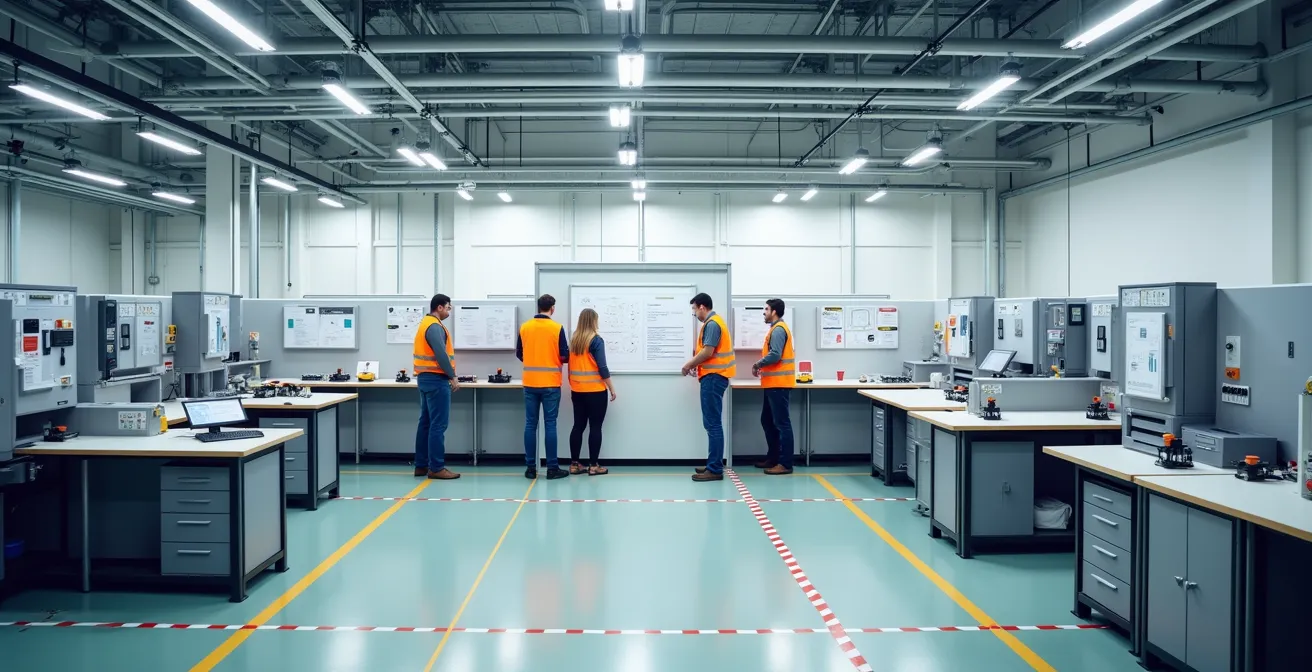
Improving manufacturing output doesn’t require high CAPEX; it requires a systematic focus on eliminating the hidden operational friction your team faces daily.
- True Kaizen starts by addressing staff fears and frustrations, not by imposing new tools from the top down.
- Simple, visual, and co-created SOPs, combined with low-cost mistake-proofing (Poka-Yoke), deliver a higher ROI than complex software or machinery.
Recommendation: Start with a Gemba walk focused on a single part’s journey through your process. This simple act makes invisible waste tangible and gives you a data-driven starting point for improvement, all without spending a penny.
As a General Manager in a UK manufacturing SME, the pressure is constant: increase output, improve quality, and cut costs. All this, while navigating volatile supply chains and rising energy prices. The typical advice often feels out of reach—invest in automation, implement a complex digital system, or hire expensive consultants. You hear the buzzwords like Lean, Six Sigma, and Kaizen, but they often seem like abstract philosophies better suited to giant automotive plants than your busy shop floor.
The common approach is to look for a silver bullet, a piece of technology or a new software suite that promises to solve everything. But what if the biggest gains aren’t found in a capital expenditure request? What if the key to unlocking significant improvements in output and quality is already present within your factory walls, hidden in plain sight? This is the core principle of genuine Kaizen. It’s not about buying new things; it’s about relentlessly improving what you already have.
This article provides a different perspective. It’s a no-nonsense, logical guide for managers who have more ambition than budget. We will dismantle the idea that improvement is expensive. Instead, we’ll focus on the zero-CAPEX levers you can pull right now. The secret isn’t in complicated tools, but in developing a clear-eyed view of your own processes and methodically removing the process friction that slows your team down every single day. It’s about empowering your people, making waste visible, and building unstoppable improvement momentum with sticky notes and logic, not purchase orders.
This guide offers a structured roadmap to implementing Kaizen principles that deliver real, measurable results. We will explore each critical stage, from the psychological foundations of change to the practicalities of shop-floor layout, providing actionable steps you can take immediately.
Summary: A No-CAPEX Guide to Kaizen Implementation
- Why your staff resist new standards and how to win them over?
- How to write Standard Operating Procedures (SOPs) that operators actually read?
- Six Sigma vs Lean: which is the right first step for a chaotic factory?
- The management mistake that causes improvements to fade after 3 months
- How to conduct a Gemba walk that reveals the truth about production?
- Why moving parts more than 50m between stations is killing your margin?
- Why rework and warranty claims cost 10x more than prevention?
- Lean Layouts: Eliminating the 7 Wastes Through Strategic Spatial Planning
Why your staff resist new standards and how to win them over?
Before you introduce any new process, you must understand a fundamental truth: your team doesn’t resist change, they resist being changed. The number one barrier to continuous improvement isn’t technology or budget; it’s fear. Staff fear that “efficiency” is a code word for “redundancy.” They worry that new standards will mean more monitoring, that their hard-earned skills will become obsolete, or that they will be blamed for problems the new process uncovers. Ignoring this is the fastest way to guarantee failure.
Winning them over isn’t about a single motivational speech. It requires building genuine psychological safety. This means creating an environment where suggesting an idea, or pointing out a problem, is a celebrated act, not a punishable offense. The Toyota Production System, the origin of Kaizen, is built on this foundation. As their own UK-based seminars demonstrate, Kaizen is a system that humanises the workplace. This is confirmed by Toyota Manufacturing UK’s approach, which empowers every individual to find and solve problems.
Kaizen humanises the workplace, empowering individual members to identify areas for improvement and suggest practical solutions.
– Toyota Manufacturing UK
To make this practical, you must confront the fears head-on. A powerful, low-tech method is the “Fear & Opportunity Matrix.” On a large whiteboard, you map their legitimate fears (e.g., “This will make my job harder”) and collaboratively brainstorm the tangible opportunities that the improvement creates (e.g., “This will eliminate the daily frustration of looking for tool X”). This simple act of visualising and converting fears into shared opportunities is the first and most critical step in building improvement momentum.
How to write Standard Operating Procedures (SOPs) that operators actually read?
You’ve spent hours writing detailed Standard Operating Procedures. You print them, put them in a binder at the workstation, and they gather dust. Why? Because traditional, text-heavy SOPs are written for auditors, not for the people doing the work. They are often dense, difficult to follow in a busy production environment, and fail to capture the nuanced skill of an experienced operator. For an SOP to be effective, it must be more useful than asking the person next to you.
The solution is to stop thinking of SOPs as static documents and start treating them as dynamic, visual communication tools. The most effective, high-engagement procedures are co-created with the operators themselves. This approach achieves two critical goals: it accurately captures the best way to do the job, and it creates instant ownership from the team. Using a simple smartphone to record a veteran operator demonstrating a technique can be transformed into a powerful, QR-code-linked video SOP with zero capital expense.

As the visual above suggests, the process of creating documentation can itself be a collaborative and engaging activity. Moving away from text documents towards visual guides dramatically increases adoption and adherence. This shift is not just a theory; its effectiveness is clear when comparing different formats.
This table illustrates the stark difference in effectiveness between traditional and modern, operator-centric SOP formats. While text documents offer basic compliance, co-created visual guides lead to superior ownership and safety outcomes.
| SOP Format | Operator Engagement | Implementation Cost | HSE Compliance |
|---|---|---|---|
| Traditional Text Documents | Low (20-30%) | Low | Basic compliance |
| Visual Step-by-Step Cards | Medium (50-60%) | Low-Medium | Good for risk assessment |
| QR-Linked Video OPLs | High (80-90%) | Zero CAPEX | Excellent for HSE training |
| Co-Created SOPs with Operators | Very High (90%+) | Time investment only | Superior compliance & ownership |
Six Sigma vs Lean: which is the right first step for a chaotic factory?
When your factory feels chaotic, it’s tempting to grab for a formal methodology. The two most talked about are Lean and Six Sigma, but choosing the wrong one first can lead to wasted time and frustration. The choice is actually quite simple and can be determined by the nature of your problems. Think of it this way: Lean is for problems you can see, and Six Sigma is for problems you have to find in data. Lean targets the 8 Wastes (like waiting, excess inventory, unnecessary motion). It’s about making the process flow better and faster. Six Sigma is a statistical toolkit for eliminating variation and defects. It’s about making the process more consistent and predictable.
For a typical UK SME with limited resources and a visibly chaotic floor, Lean is almost always the right first step. Why? Because you can get significant wins quickly and with minimal investment. You don’t need certified Black Belts to see that an operator is walking 100 metres to get a tool. You need a stopwatch and a pair of eyes. This approach is more accessible, as government research on UK manufacturing practices highlights that smaller SMEs often struggle with the adoption of more complex best practices.
To decide, ask yourself these simple diagnostic questions. The more your answers lean towards the “Lean” column, the more confident you can be in your starting point:
- Waste vs. Variation: Is your main issue excess inventory (Lean) or inconsistent quality (Six Sigma)?
- Visibility vs. Data: Can you physically see the waste—piles of parts, people walking (Lean)—or is it hidden in quality control spreadsheets (Six Sigma)?
- Time vs. Consistency: Do processes take too long (Lean) or produce unpredictable results (Six Sigma)?
- Tools vs. Defects: Are workers constantly searching for tools (Lean/5S) or constantly fixing defects (Six Sigma)?
- Budget: Is your improvement budget under £5,000 and you can’t dedicate staff to lengthy training? If yes, start with Lean.
The management mistake that causes improvements to fade after 3 months
You’ve run a successful Kaizen event. A process is improved, the team is energised, and metrics are up. Then, three months later, everything has reverted to the old way of working. This is the single most common failure mode in continuous improvement, and it stems from a critical management mistake: treating improvement as a project with an end date. True Kaizen is a continuous process, and the “fade” happens when management focus moves elsewhere and the improvement momentum dies.
The mistake is assuming that your initial enthusiasm is self-sustaining. It’s not. Momentum is a fragile thing that must be actively and visibly maintained. The key is to shift from top-down “projects” to bottom-up “habits.” One of the most effective ways to do this is by empowering autonomous “Kaizen Circles”—small teams of operators who are given the authority and a micro-budget (e.g., £200) to solve the small problems they face every day. This removes the management bottleneck and gives the team the agency to keep the spirit of improvement alive long after the initial workshop.
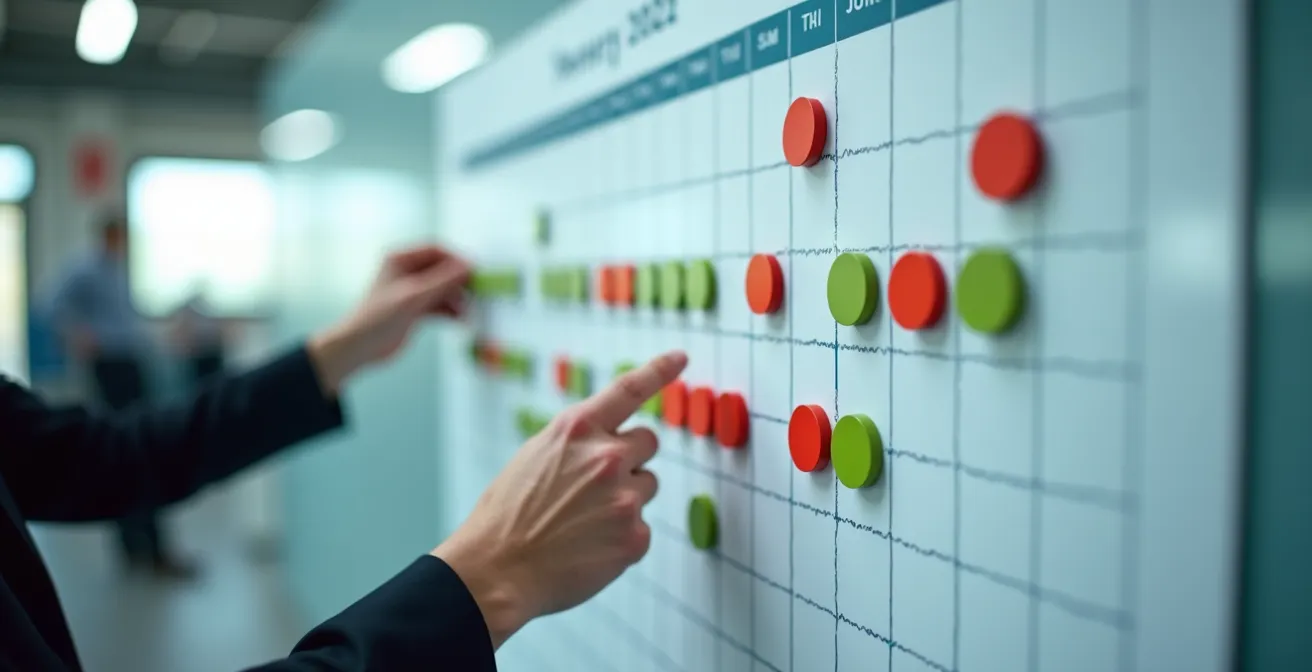
Sustaining this momentum requires making progress visible and celebrating small wins consistently. A “project” has one celebration at the end. A “culture” has many, all the time. This doesn’t need to be expensive. A simple low-cost celebration toolkit can be incredibly effective:
- Daily: Use a green/red visual tracker on a team board. Green for a day where an improvement was made, red for a day with none.
- Weekly: Feature one improvement on the main factory notice board, complete with a photo of the team responsible.
- Monthly: Send a company-wide email highlighting the top 3 improvements, giving full credit to the teams.
- Quarterly: A simple “tea and biscuits” celebration for the team with the highest-impact improvement.
How to conduct a Gemba walk that reveals the truth about production?
A Gemba walk is the act of going to “the real place” where work happens to observe and understand. However, many managers do it wrong. They walk the floor with a clipboard and a group of people, asking leading questions and inadvertently causing operators to put on a “show.” A real Gemba walk is not a performance audit; it is a quiet act of observation designed to achieve operational visibility. Its purpose is to see the process as it truly is, complete with all its frustrations and hidden wastes.
To get to the truth, you must change your approach. Leave the clipboard in the office. Go alone, or with a single trusted operator. Don’t look for people to blame; look for process friction. Your toolkit should be simple and non-intimidating: a small notepad, your smartphone camera, and a stopwatch. Your goal is not to fix things on the spot, but to see. A powerful technique is to follow the “Journey of a Single Part” from raw material to finished good. This narrative focus prevents you from getting distracted and reveals the systemic waste of transportation, waiting, and over-processing.
During your walk, focus on questioning the process, not the person. Use the “5 Whys” technique on a single observation. For example: Why is that pallet on the floor? (Because the shelf is full). Why is the shelf full? (Because we have too much WIP). Why do we have too much WIP? And so on. In the current UK climate, a key focus should be on energy waste. Observing machines left idling or inefficient lighting can reveal significant cost-saving opportunities, a critical issue as Make UK’s latest manufacturing statistics identify energy as a major operational challenge for the £220bn sector.
Why moving parts more than 50m between stations is killing your margin?
Of the seven wastes of Lean, “Transportation” is one of the most deceptive. Moving a part from one station to another doesn’t add any value for the customer, but it adds significant cost and risk to your operation. A part that is moving is a part that could be dropped, damaged, or lost. It represents tied-up capital in the form of Work-in-Progress (WIP). Most managers dramatically underestimate how much movement is happening on their floor and the cumulative cost it represents.
The first step to tackling this is to make the waste visible. A “Spaghetti Diagram” is a brilliantly simple tool for this. You take a layout of your factory floor and trace the path of a single part or a single operator over a period of time. The resulting tangle of lines often looks like a plate of spaghetti and provides a shocking, visual representation of inefficiency. UK factories that have used this simple technique have often identified average part movements of over 150m per part, which they were then able to reduce to under 50m through simple layout optimization, without any capital investment.
The cost of this excessive movement is not just the operator’s time. It’s a cascade of hidden costs that directly erodes your profit margin. Each meter of unnecessary travel adds wear and tear to equipment, increases the risk of quality defects, and ties up capital that could be used elsewhere. When quantified, the financial impact is often staggering.
This breakdown shows how the seemingly small act of moving a part too far accumulates into a significant annual cost. As an analysis of hidden manufacturing costs reveals, these small inefficiencies are a major drain on productivity and profitability.
| Cost Factor | Impact per 100m movement | Annual Cost (250 days) |
|---|---|---|
| Operator Time (@£15/hour) | 2 minutes walking | £12,500 |
| Equipment Wear (trolleys/forklifts) | £0.50 maintenance | £125 |
| Damage Risk (1% rate) | £5 per occurrence | £1,250 |
| WIP Capital Tied Up | Extra 30 min cycle time | £8,750 |
| Energy (forklift/conveyor) | 0.5kWh @ £0.30 | £375 |
| Total Hidden Cost | – | £23,000 per workstation |
Why rework and warranty claims cost 10x more than prevention?
The cost of poor quality is not linear; it’s exponential. This is captured in the “Rule of 10,” a fundamental principle of quality management. It states that the cost to fix a problem increases by a factor of ten at each stage of the production and delivery process. A defect caught and fixed at the workstation where it was made might cost £1 in time and materials. If that same defect is caught at the final inspection, the cost jumps to £10, factoring in rework and schedule disruption. If it’s found by the customer, the cost explodes to £100 or even £1,000, encompassing shipping, admin, warranty claims, and the immeasurable cost of reputation damage.
Investing in prevention is therefore not a cost, but the single highest-return investment a manufacturer can make. The goal is to make it physically impossible for an error to occur, a concept known as Poka-Yoke (mistake-proofing). This doesn’t require expensive sensors or vision systems. The most elegant Poka-Yoke solutions are often incredibly simple, low-tech devices born from shop-floor ingenuity. Think of asymmetrical jigs where a part only fits one way, colour-coded bins that match markers on the assembly station, or simple go/no-go gauges built from scrap material.
| Stage of Detection | Cost to Fix (£) | Hidden Costs |
|---|---|---|
| Prevention (Poka-Yoke) | £1 | None |
| Internal Inspection | £10 | Rework labor |
| Final Quality Check | £100 | Production delays |
| Customer Complaint | £1,000 | Return shipping, admin time |
| Warranty Claim | £10,000+ | Reputation damage, lost sales |
The leverage is enormous. As research from FourJaw Manufacturing Analytics reveals, a 10% productivity uplift across the sector would generate an extra £62 billion in output without any new factories or CAPEX. A significant portion of that lost productivity is tied up in dealing with the cost of poor quality.
Your Action Plan: Auditing for Mistake-Proofing Opportunities
- Points of Contact: Identify all stations where a specific recurring defect is either created or could be caught.
- Collect: Document the current process for that task. What relies purely on operator memory or skill?
- Coherence: Review common Poka-Yoke ideas (like asymmetrical jigs or color-coding). Which low-cost concept directly counters the error you’ve identified?
- Memorability/Emotion: Ask the operator: “What is the most frustrating part of this task?” Use this to find the highest-impact improvement.
- Plan Integration: Select one opportunity and sketch a plan to implement it using scrap materials or basic supplies within one week.
Key Takeaways
- The biggest barrier to improvement is often fear, not technology. Address the human element first.
- The cost of a quality failure at the customer’s end is exponentially higher than the cost of prevention on the line.
- Visual management is your most powerful, low-cost tool. If you can’t see the process, you can’t improve it.
Lean Layouts: Eliminating the 7 Wastes Through Strategic Spatial Planning
The physical layout of your factory floor is not just a collection of workstations; it is a direct reflection of your process. A disorganised, sprawling layout actively creates waste—particularly Transportation, Motion, and Waiting. A Lean layout, on the other hand, is deliberately designed to make value flow smoothly from one step to the next with minimal interruption. Re-thinking your layout is one of the highest-impact, zero-CAPEX activities you can undertake.
The goal is to move from a traditional “process village” layout (e.g., all the drills in one area, all the presses in another) to a product-focused “cellular” layout. A U-shaped cell is a classic Lean structure where all the equipment and materials needed to produce a part or product family are arranged in close proximity. This allows a single operator, or a small team, to manage the entire process flow with minimal walking. It drastically reduces WIP, improves communication, and shrinks lead times.
A key enabler of a Lean layout is a robust Point-of-Use Storage (POUS) strategy. This simply means storing all necessary tools, components, and information exactly where they are needed, eliminating the waste of searching. This can be achieved with no capital investment by building shadow boards from scrap plywood, creating mobile tool carts from repurposed trolleys, and implementing simple two-bin Kanban systems using your existing containers. For UK SMEs, the benefits are particularly compelling; one case study showed that implementing cellular layouts led to a 30% liberation of floor space, a highly valuable asset given the UK’s high commercial property costs.
A strategic layout is the physical foundation of a Lean operation. It’s the framework that either enables or inhibits all your other improvement efforts. By focusing on flow and bringing materials and tools to the point of use, you systematically eliminate the hidden wastes that drain your productivity and margin every single day.
Your journey to a more efficient, less wasteful operation doesn’t start with a budget request. It starts with your next walk to the shop floor. Use these principles to start seeing your factory not for what it is, but for what it could be, and begin unlocking the massive potential that already exists within your walls.