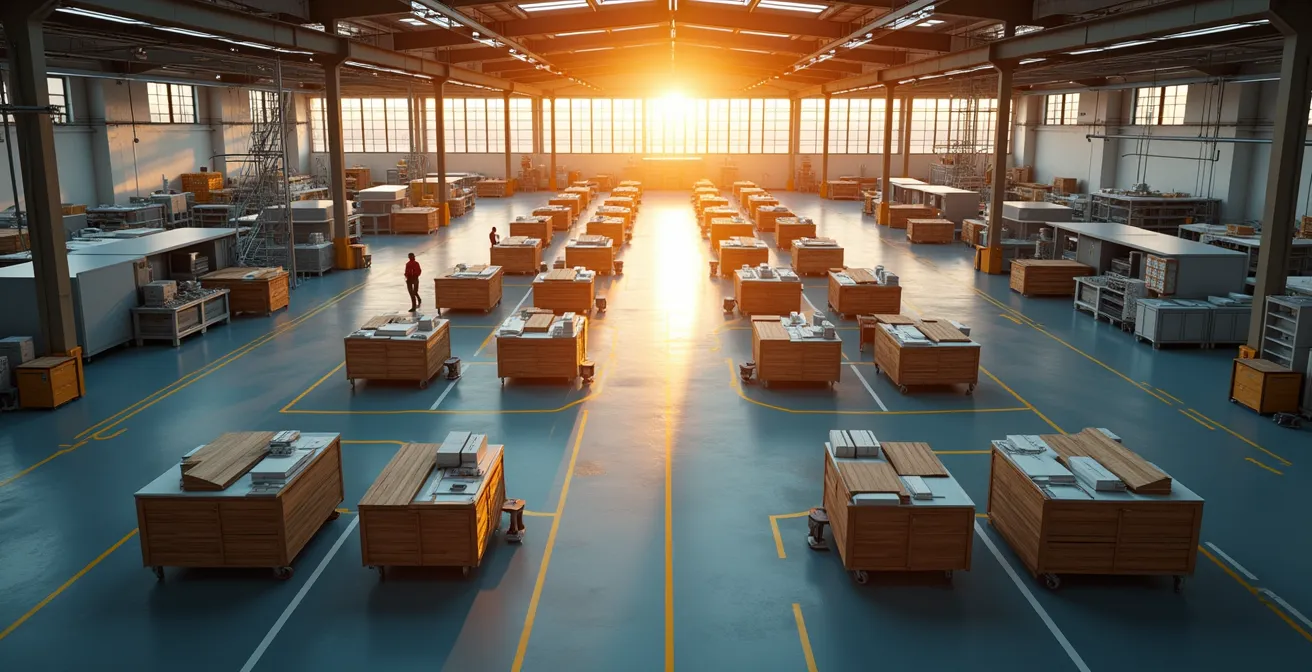
Your factory layout isn’t just a floor plan; it’s the frontline in the war against operational waste, where every inefficient step is a direct attack on your profit margin.
- Unnecessary movement and transportation are not minor inconveniences; they are hidden costs that can represent up to 30% of wasted activity.
- Static, inflexible layouts create bottlenecks and become liabilities during product changeovers, strangling your agility and throughput.
Recommendation: Stop managing space and start weaponizing it. Treat every layout decision as a strategic move to visualize, attack, and eliminate waste from your value stream.
Look at your factory floor. Do you see a coordinated system, or do you see chaos? For many operations managers, the daily reality is a complex web of movement, bottlenecks, and “temporary” storage that has become permanent. You see operators walking excessive distances, forklifts crisscrossing paths, and work-in-progress piling up between stations. This isn’t just inefficiency; it’s a quiet enemy eroding your profitability, second by second. The common response is to look for faster machines or hire more people, treating the symptoms rather than the disease.
The conventional wisdom tells us to “reduce travel distance” or “implement U-shaped cells.” While correct, these are just tactics. They miss the fundamental philosophy that gives them power. The real problem isn’t the distance itself, but the deeply ingrained acceptance of waste as a cost of doing business. What if the true key to unlocking efficiency isn’t just rearranging boxes on a map, but fundamentally shifting your perspective? What if you treated every square meter of your facility as a strategic asset in a relentless war against waste?
This is the core of a Lean layout. It’s not about a one-time fix but about creating a dynamic, living system designed to make waste painfully visible and systematically eliminate it. This guide will provide you with the strategic framework and tactical tools to transform your chaotic factory floor into a high-performance operational battlefield. We will explore how to visualize hidden inefficiencies, choose the right cell design for true one-piece flow, and even execute a complete factory rearrangement over a single weekend without losing a moment of production. It’s time to stop managing chaos and start designing for profit.
To navigate this strategic guide, the following sections will break down the essential elements for transforming your facility. Each part builds on the last, providing a comprehensive roadmap from identifying waste to reclaiming your floor space and boosting efficiency.
Summary: Lean Layouts: A Strategic Guide to Eliminating Operational Waste
- Why moving parts more than 50m between stations is killing your margin?
- How to create a ‘Spaghetti Diagram’ to visualise inefficient operator movement?
- U-shaped cells vs Straight lines: which is better for one-piece flow?
- The fire exit compliance error common in dense production layouts
- How to rearrange a factory floor over a weekend without losing production?
- Why renting external storage costs 3x more than optimising your current height?
- Why static conveyor lines become a liability during product changeovers?
- How to Reclaim 25% of Your Floor Space Through Vertical Industrial Fittings?
Why moving parts more than 50m between stations is killing your margin?
Every step an operator or a part takes that doesn’t add value for the customer is waste. Specifically, it’s the waste of Transportation and Motion. When you see a forklift driving 50 meters across the factory to deliver a sub-assembly, you’re not seeing work; you’re seeing money being burned. This movement adds no features, no quality, and no value to the final product. It only adds cost, time, and risk of damage. This isn’t a minor issue; it’s a systemic drain on your resources. The layout itself becomes a tax on your operations.
The impact is far greater than just the fuel for the forklift or the salary of the operator. Excessive movement creates cascading failures. It extends lead times, increases the amount of Work-in-Progress (WIP) needed to buffer against travel time, and complicates inventory management. It hides defects, as issues discovered at a later station are harder to trace back to their origin. The Lean Enterprise Institute has quantified this problem, showing that inefficient layouts can lead to 15-30% of wasted movement and idle time. Imagine reclaiming that time and reinvesting it into value-adding activities.
The 50-meter rule is a mental model. The real number for your facility might be 20 meters or even 10. The principle is to see any non-essential movement as a liability. The goal of a Lean layout is to position processes, tools, and materials so close together that flow is seamless and nearly instantaneous. As Henry Ford famously stated, machines should be as close as they can possibly be, but not one inch further. Reducing this distance isn’t just an efficiency gain; it’s a direct assault on the hidden costs that are silently killing your margin.
How to create a ‘Spaghetti Diagram’ to visualise inefficient operator movement?
The greatest enemy in a Lean transformation is the invisible waste that has become “the way we’ve always done things.” Inefficient operator movement is a prime example. You can’t fix what you can’t see. The Spaghetti Diagram is a brilliantly simple yet powerful tool designed to make this hidden waste painfully visible. It is a literal map of the path a person, part, or piece of information takes to complete a process. By tracing this path on a scaled floor plan, the tangled, inefficient “spaghetti” of movement is revealed.
Creating one is a low-tech, high-impact exercise. Start with a scaled drawing of your work area. Then, follow an operator for one full work cycle, drawing a continuous line that tracks their every step. Follow them to the tool crib, the parts bin, the supervisor’s desk, and back. The result is often shocking. What felt like a straightforward process is revealed as a chaotic web of backtracking, long-distance walks, and obstacles. This diagram is not just data; it’s a visual indictment of the current layout. It forces the team to confront the reality of their daily struggle against an inefficient environment.
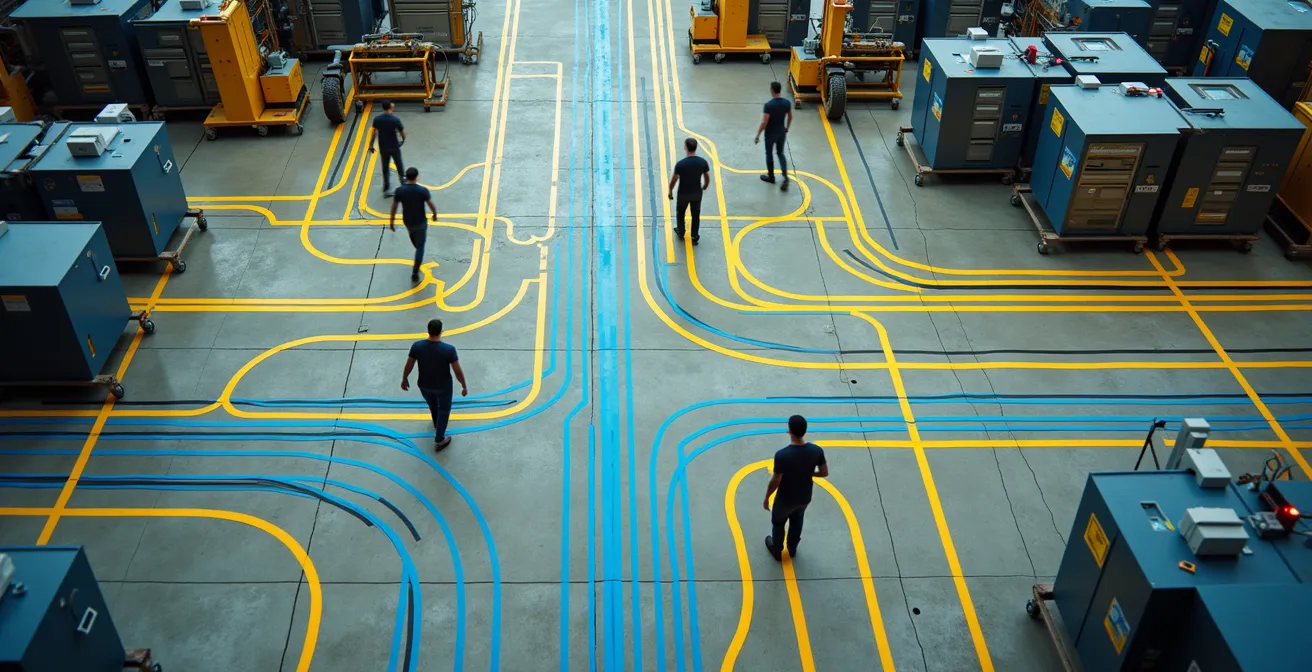
Once the waste is visible, the solution often becomes obvious. You can begin to ask critical questions: Why is this tool stored so far away? Can we move these two processes next to each other? What if the parts were delivered directly to the point of use? The Spaghetti Diagram becomes the catalyst for a layout redesign driven by data, not assumptions. It transforms the abstract concept of “wasted motion” into a concrete problem that the team can solve together, untangling the spaghetti one process at a time.
Your Action Plan for Visualizing Movement Waste
- Identify Points of Contact: List all the stations, storage areas, and personnel an operator or part interacts with during a single process cycle.
- Gather Existing Data: Obtain a to-scale floor plan of the production area. If one doesn’t exist, a simple but accurately measured hand drawing will suffice.
- Observe and Trace Flow: Follow a single operator or part for a complete cycle, drawing a continuous line on the floor plan to map their exact path. Use different colors for different operators or parts.
- Confront the Waste: Analyze the resulting “spaghetti.” Identify the longest paths, areas of frequent backtracking, and crisscrossing routes. These are your primary targets for elimination.
- Develop an Improvement Plan: Brainstorm layout changes that would straighten and shorten the lines. Prioritize moves that deliver the biggest reduction in travel distance and complexity.
U-shaped cells vs Straight lines: which is better for one-piece flow?
The debate between U-shaped cells and traditional straight production lines is central to achieving one-piece flow, a cornerstone of Lean manufacturing. A straight line is intuitive but deeply flawed. It creates distance between operators, hinders communication, and makes it difficult for a single worker to manage multiple machines. The result is often batch production, where work-in-progress piles up between stations, hiding defects and extending lead times. It represents a static, inflexible approach to production.
The U-shaped cell, by contrast, is a strategic weapon for flow. By arranging equipment in a “U,” the entry and exit points are positioned next to each other. This compact design allows a single, multi-skilled operator to work at several stations with minimal walking. It facilitates excellent communication between team members and makes the entire process easily visible to a supervisor. Most importantly, it is the natural enabler of one-piece flow. A part can be handed directly from one station to the next, drastically reducing WIP and shortening the time from raw material to finished good. This flexibility is key; some of the most agile cells even have equipment on casters for easy movement to adapt to changing customer demand or takt time.
However, a U-shaped cell is not a universal solution. It requires multi-skilled, flexible operators and is best suited for products with similar process steps. For high-volume, low-variety production with dedicated, automated equipment, a straight line might still be viable. The choice depends on your strategic goal. If your goal is maximum flexibility, rapid changeover, and the relentless pursuit of one-piece flow, the U-shaped cell is almost always the superior layout.
| Factor | U-shaped Cell | Straight Line |
|---|---|---|
| Space Efficiency | Compact, minimizes floor space | Requires more linear space |
| Operator Movement | Minimal – operator can access multiple stations | More walking between stations |
| Flexibility | High – easy to reconfigure | Low – fixed linear flow |
| Communication | Excellent – operators work closely | Limited – operators spread out |
| Material Flow | Short distances, easy supervision | Longer distances, harder to supervise |
The fire exit compliance error common in dense production layouts
In the drive to optimize every square meter, a dangerous form of waste often emerges: the waste of safety. A common and critical error in dense production layouts is the gradual obstruction of emergency pathways and fire exits. It starts with a single pallet left “just for an hour,” then a new tool cart, and soon the designated clear area is a cluttered obstacle course. This isn’t just a compliance issue; it’s a profound operational failure that puts people’s lives at risk and creates a fragile, chaotic system.
A truly Lean layout integrates safety as a core component of flow, not as an afterthought. Clear, unobstructed pathways are essential for both emergency egress and efficient material handling. When aisles are cluttered, forklift travel becomes slower and more dangerous, operator movement is impeded, and the risk of accidents increases. A blocked fire exit is the ultimate expression of a system that has lost control, prioritizing short-term convenience over fundamental safety and long-term stability. The responsibility extends beyond just exits; as a best practice, machines that produce loud noises or emit dangerous fumes should be isolated or enclosed to protect all workers in the vicinity.
To combat this, safety must be designed into the layout from the start. This means using permanent floor markings to clearly define all pathways, storage areas, and no-go zones around emergency equipment. It involves creating a culture where leaving an item in a clearway is seen as a serious process violation. Workstations should be designed to contain all necessary tools and materials, eliminating the need to spill out into common areas. By treating clear pathways as a non-negotiable element of the production system, you not only ensure compliance but also create a more organized, efficient, and resilient factory floor. Safety and efficiency are not competing goals; they are two sides of the same coin.
How to rearrange a factory floor over a weekend without losing production?
The idea of a “finished” factory layout is a myth. A truly Lean organization sees its layout as a dynamic system, constantly evolving to eliminate waste. As one woodworking factory experienced, this can mean shuffling the entire factory four times in 12 months. The challenge is executing these changes without disrupting production. The answer lies in meticulous planning and treating the move like a military operation, one that can be accomplished in the 48-hour window of a weekend.
This feat is impossible without a detailed action plan. The most effective approach is to treat the move like a chess game. You can’t move the king (your bottleneck machine) without first moving the pawns (smaller, ancillary equipment) out of the way. This requires creating a “waterfall chart” that sequences every single step, from disconnecting utilities to the final placement and reconnection. Every move must be planned to avoid collisions and unnecessary double-handling. Using simple tools like paper cutouts or wooden blocks on a scaled floor plan allows the team to simulate the entire sequence and identify potential problems before a single wrench is turned.
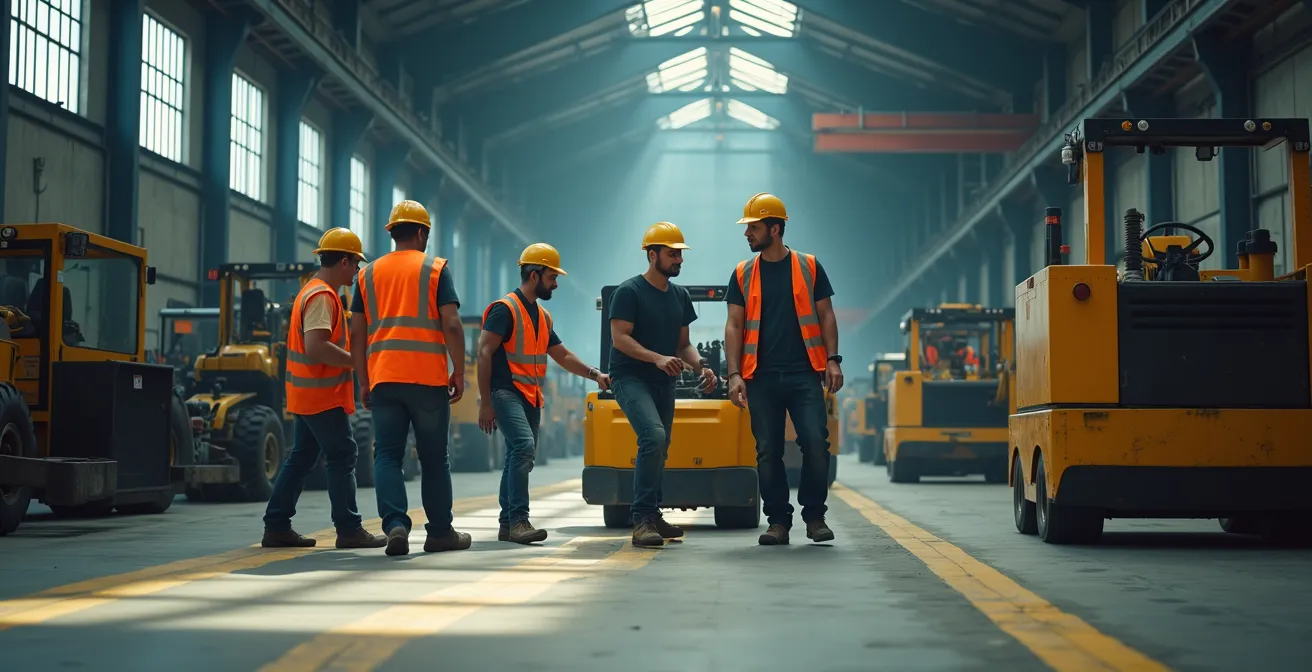
Execution is about preparation. Before the shutdown on Friday afternoon, the new layout should be fully marked on the floor with tape, and all required utility connections (air, power, data) should be staged and ready. The move itself becomes a choreographed sequence of events, with teams assigned to specific tasks. The goal is to have the last machine in place and tested by Sunday evening, ready for a seamless start-up on Monday morning. This ability to rapidly reconfigure is a massive competitive advantage. It allows a company to adapt its physical space to new products, changing demand, and newly identified sources of waste, ensuring the layout is always a weapon, never a constraint.
Why renting external storage costs 3x more than optimising your current height?
Renting off-site storage is often seen as a necessary evil to handle overstock or raw materials. In reality, it is a glaring symptom of a critical failure: the waste of underutilized space. The cost of external storage is not just the monthly rent. It’s a tripartite attack on your margin. First, the direct rental cost. Second, the transportation cost—the labor, fuel, and time spent moving materials back and forth. Third, the administrative overhead—the complexity of managing inventory across multiple locations. This triple-threat makes external storage an incredibly expensive solution to a problem that can often be solved within your own four walls.
The most overlooked asset in any factory is its vertical space. We are conditioned to think in two dimensions—length and width—but the volume of your facility is your true available space. Every cubic meter of air above your machines and aisles is potential storage that you are already paying for through rent or ownership. Failing to use this space is like owning a ten-story building and only using the ground floor. A client in the FMCG sector demonstrated the power of this thinking; by redesigning their packaging area flow and utilizing space more effectively, they achieved a remarkable 25% improvement in space utilization and an 18% drop in downtime.
The solution is to think vertically. As manufacturing experts note, you can dramatically increase the amount of usable space in your factory by using mezzanine floors or installing appropriate industrial shelving and storage racks. Mezzanines can effectively double your usable floor space in key areas, creating room for light assembly, storage, or offices above the main production flow. Vertical racking systems can condense raw materials or finished goods storage into a much smaller footprint. By leveraging height, you attack the root cause of storage-related waste, turning a costly external liability into an optimized internal asset.
Why static conveyor lines become a liability during product changeovers?
Conveyor lines, once the symbol of mass-production efficiency, can become a major liability in a modern, high-mix manufacturing environment. Their very nature is static. They are designed to move a specific product along a fixed path at a set speed. This works beautifully as long as you never need to change anything. However, the moment a product changeover is required, this fixed asset becomes a boat anchor. The entire line must be stopped, cleared, and often reconfigured, leading to significant downtime—the waste of Waiting.
This inflexibility is a direct cause of other forms of waste. Because changeovers are so time-consuming, companies are incentivized to run large batches, leading to the waste of Overproduction and Inventory. The fixed path of the conveyor dictates the factory layout, forcing processes into a rigid, linear sequence that may not be optimal. This is a classic example where poor plant design can cause waste in transportation, as materials and people must conform to the conveyor’s path rather than the most logical flow. The conveyor, meant to improve flow, ends up preventing it.
The Lean alternative is to design for agility. This often means replacing long, monolithic conveyor systems with flexible, cellular layouts. In a manufacturing cell, related resources are grouped together, and materials are moved in small batches or via one-piece flow, often by hand or on small carts. This approach drastically reduces changeover time. Instead of reconfiguring a 100-meter conveyor, you might only need to adjust one or two small machines within a cell. This allows the factory to respond rapidly to changing customer orders, enabling small-batch production and minimizing inventory. The key is to shift from a mindset of static, permanent infrastructure to one of dynamic, reconfigurable flow paths that serve the product, not the other way around.
Key Takeaways
- Waste is the Enemy: Every layout decision must be viewed through the lens of attacking the seven wastes, especially Transportation and Motion.
- Visualize to Eliminate: You cannot eliminate what you cannot see. Tools like Spaghetti Diagrams are essential for making hidden inefficiencies painfully obvious.
- Flow is Paramount: The ultimate goal is one-piece flow. Layouts, whether U-shaped cells or other configurations, are merely tools to achieve this seamless movement of value.
How to Reclaim 25% of Your Floor Space Through Vertical Industrial Fittings?
In the relentless pursuit of efficiency, floor space is gold. A cluttered, sprawling layout is not just disorganized; it’s a direct source of waste. Reclaiming that space is not about tidying up—it’s about fundamentally rethinking how you use the volume of your facility. By implementing smart vertical industrial fittings, it is entirely possible to reclaim 25% or more of your floor space, which can then be repurposed for value-adding activities. This strategic densification can lead to a 25-30% improvement in overall process efficiency, as shorter travel distances and better organization accelerate flow.
The strategy involves a combination of techniques tailored to your specific needs. Vertical storage systems, such as automated storage and retrieval systems (AS/RS) or vertical lift modules (VLMs), can reduce the footprint of your parts storage by up to 60%. They use height to store items densely and deliver them automatically to the operator, eliminating wasted walking and searching time. For larger areas, mezzanine floors are a powerful solution, effectively doubling your usable area by creating a second story for offices, light assembly, or bulk storage above the main factory floor.
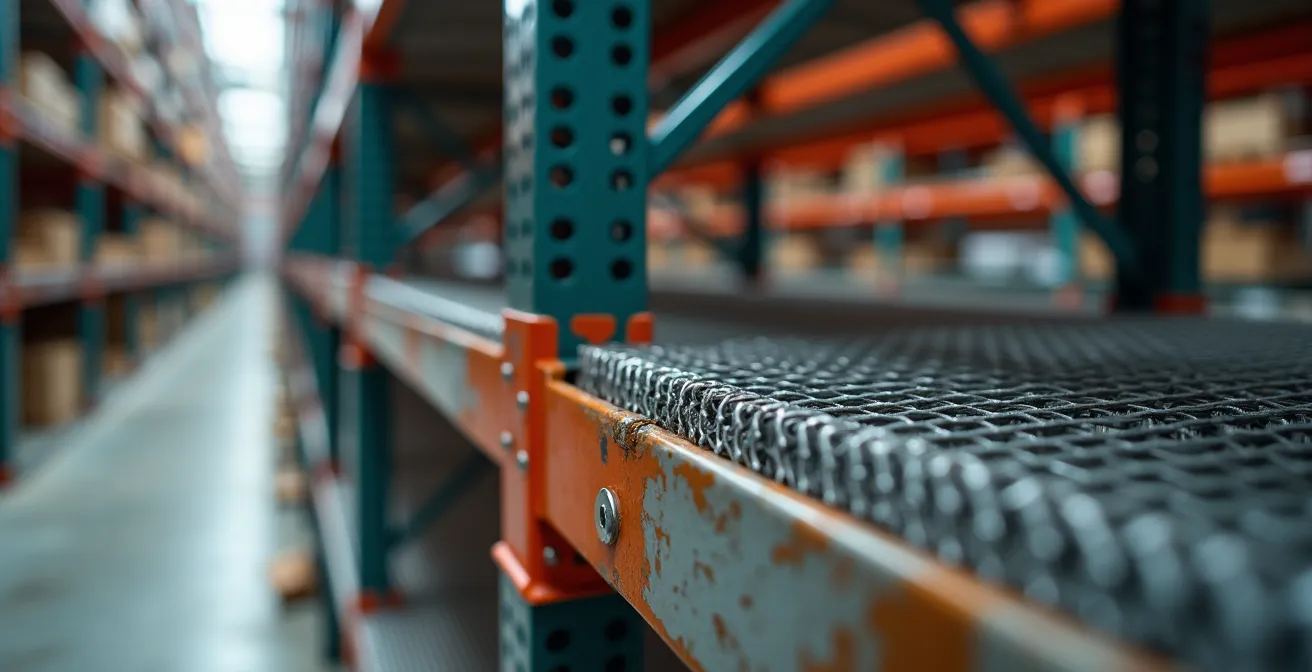
On a more tactical level, modular racking and mobile storage units offer flexible ways to optimize space. Modular racking can be easily configured to fit specific parts and areas, improving density by 30-40%. Mobile storage units, where shelving is placed on tracks, eliminate the need for multiple fixed aisles, compacting storage and freeing up significant floor space. The choice of fitting depends on cost, flexibility, and the type of materials being handled.
| Technique | Space Savings | Implementation Cost | Flexibility |
|---|---|---|---|
| Vertical Storage Systems | Up to 60% floor space | Medium-High | High |
| Mezzanine Floors | Doubles usable area | High | Low |
| Modular Racking | 30-40% improvement | Low-Medium | Very High |
| Mobile Storage Units | 25-35% savings | Medium | High |
Stop accepting waste as a cost of doing business. The principles and tactics outlined here are not theoretical ideals; they are proven strategies for transforming your factory floor into a source of competitive advantage. Start today by choosing one area, one process, and applying these lenses. Make the waste visible, attack it with a better layout, and measure the impact on your bottom line. This is the first step in waging—and winning—the war on waste.