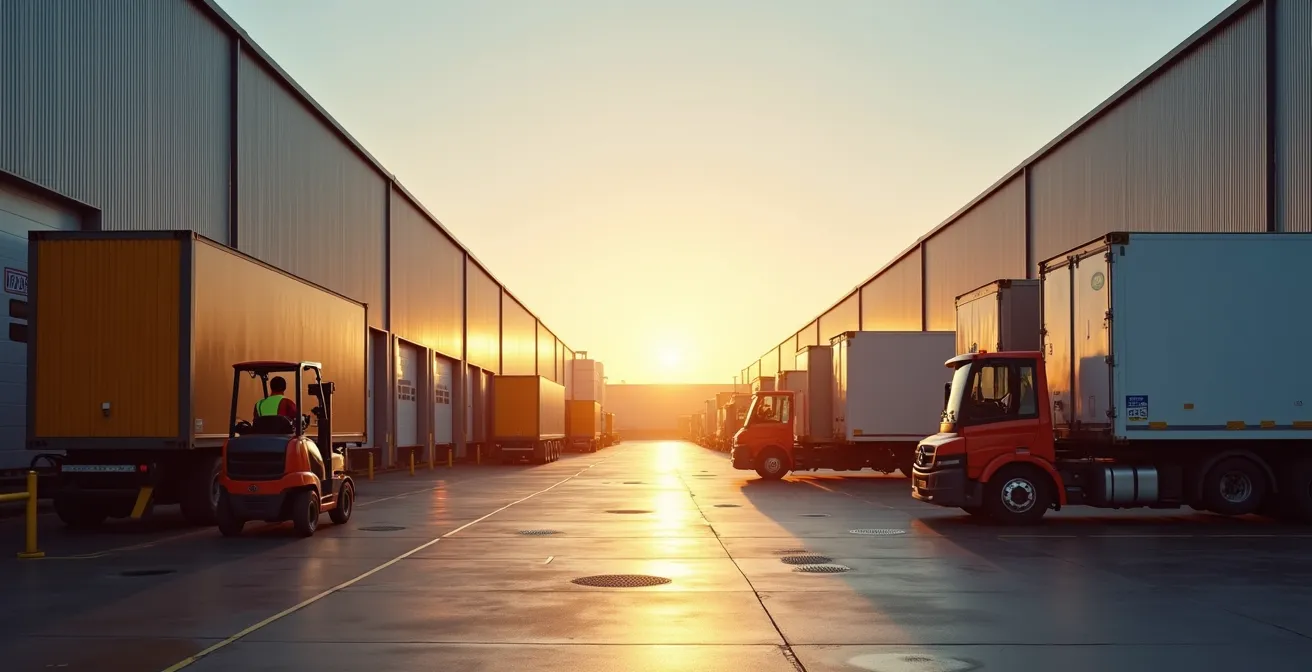
The constant queues at your despatch dock are not a single problem but the result of cascading micro-inefficiencies—hidden ‘time taxes’ that cripple your entire operation.
- Idle loading bays and waiting trucks are symptoms of poor data choreography, not just a lack of space or staff.
- Small errors in processes like labelling have a multiplier effect, causing significant inventory and time loss downstream.
Recommendation: Stop firefighting and start diagnosing. Your primary goal is to identify and eliminate the specific points of systemic friction in your goods-out process, starting with the most costly delays at the dock.
The scene is painfully familiar for any UK logistics manager: a queue of trucks snakes around the yard, drivers are frustrated, and your despatch schedule is slipping by the hour. Inside, your team is working hard, yet the loading bays are periodically, inexplicably, silent. You’re bleeding money in demurrage fees, risking service level agreements, and facing the constant pressure of driver shortages. The standard advice is to throw money at the problem: invest in a new WMS, hire more staff, or completely reorganise the floor plan.
But these are blunt instruments for a surgical problem. The brutal truth is that most despatch bottlenecks are not caused by a single, catastrophic failure. They are the cumulative effect of a dozen small, overlooked inefficiencies – ‘time taxes’ that add up to hours of lost productivity. A misplaced pallet, a five-minute wait for a loading signal, a poorly printed label; each one is a small cut that, together, causes the entire operation to bleed out. This isn’t about working harder; it’s about eliminating the systemic friction that makes hard work ineffective.
This guide moves beyond the platitudes. We will dissect the despatch process from the dock door back to the picking aisles to uncover the real root causes of your delays. We will focus on the tactical, data-driven changes that give you the highest return, transforming your warehouse from a site of chaotic reaction to one of precise, data-driven choreography. It’s time to stop managing bottlenecks and start eliminating them.
This article will guide you through the critical points of failure in a typical UK warehouse and provide actionable strategies to restore flow and velocity to your despatch operations. The following sections break down each challenge and its solution.
Summary: Logistic Flow Management: How to Eliminate Despatch Bottlenecks in UK Warehouses?
- Why your loading bays are idle 40% of the day despite the queues?
- How to implement cross-docking to reduce storage time by 24 hours?
- Zone picking vs Wave picking: which is faster for multi-line orders?
- The labelling error that causes 15% of your inventory to go missing
- When to implement a Vehicle Booking System (VBS) to smooth peak flows
- Why an AS/RS system pays for itself in 3 years despite high CAPEX?
- Why human planners cannot mathematically optimise 500+ SKU combinations?
- Automated Storage Solutions: Solving the UK Warehouse Labour Shortage Crisis
Why your loading bays are idle 40% of the day despite the queues?
The greatest source of waste in any warehouse is an idle asset. When a loading bay is empty while a truck is waiting, you are paying for space, equipment, and a driver’s time, all for nothing. This isn’t a random occurrence; it’s a symptom of poor operational rhythm. The problem is so widespread that recent research reveals 63% of UK truck drivers wait 3+ hours at shipping docks. This standing time is a direct tax on your profitability. The cause is rarely a lazy workforce; it’s a breakdown in the choreography of goods, information, and vehicle movement.
This « asset inertia » stems from a lack of real-time visibility and predictive planning. Goods aren’t staged in time for the truck’s arrival, the wrong truck is directed to a bay prepared for a different load, or communication between the yard and the dock is reliant on manual signals. Each of these micro-delays creates a gap, and these gaps cascade throughout the shift, leading to the paradox of simultaneous queuing and idleness. The visual evidence is often hidden in plain sight, on the very equipment you use.
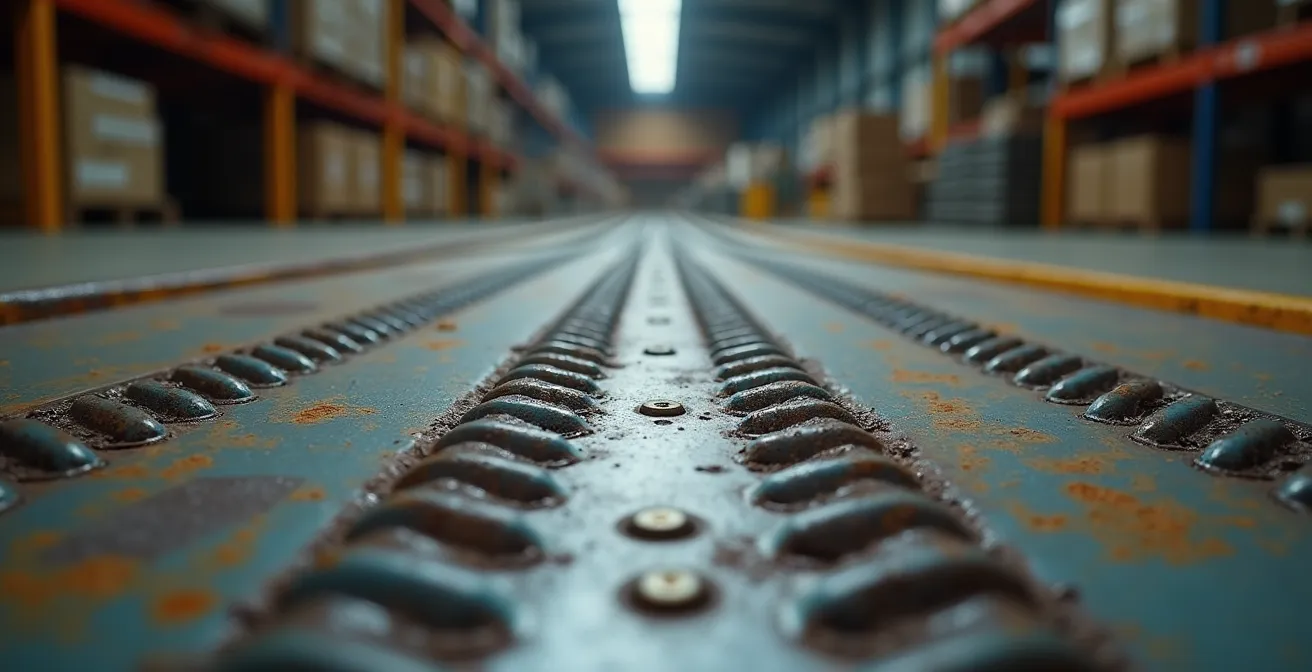
As this image of a dock leveller shows, irregular usage creates distinct patterns of wear and tear. These textures aren’t just cosmetic; they are a physical record of inefficiency—periods of intense, stressful use followed by costly downtime. To fix this, you must smooth out these peaks and troughs by treating the loading bay not as a passive space but as the highly orchestrated endpoint of your entire internal process. The focus must shift from simply loading trucks to optimising the flow velocity of goods through the dock door.
How to implement cross-docking to reduce storage time by 24 hours?
Storage is waste. Every moment a product sits on a shelf, it is costing you money in space, handling, and capital, without adding value. Cross-docking is a philosophy designed to attack this waste head-on. It’s not just a process; it’s a commitment to flow. The goal is to move incoming goods directly from receiving to an outbound truck with minimal, if any, storage time. A successful implementation can effectively eliminate put-away and retrieval labour for a significant portion of your inventory, reducing total storage time from days to mere hours.
The implementation requires a shift in mindset from « store and pick » to « sort and ship. » It begins before the goods even arrive, with tight coordination with suppliers and a WMS configured to identify cross-dockable inventory upon receipt. The physical layout must support this flow, with a dedicated staging area (the « cross-dock ») situated between receiving and shipping bays to facilitate rapid sorting and consolidation. This isn’t just for full pallets; with the right system, individual cases can be sorted into route-specific cages for immediate despatch.
The results can be transformative, especially for businesses with high-velocity SKUs or predictable demand. Danish furniture retailer BoConcept, for instance, overhauled its UK logistics by implementing a streamlined system focused on minimising downtime. By centralising operational monitoring and optimising flow, they achieved a significant reduction in bottlenecks and generated substantial savings, proving that strategic process change delivers tangible financial returns. This approach turns the warehouse from a static holding centre into a dynamic sorting hub, dramatically increasing inventory velocity and asset utilisation.
However, cross-docking is not a universal solution. It demands high levels of supplier compliance, accurate inbound information (ASNs are non-negotiable), and a robust WMS to choreograph the movement. Without this discipline, the cross-dock area can quickly become another bottleneck, defeating the entire purpose.
Zone picking vs Wave picking: which is faster for multi-line orders?
For complex, multi-line orders, the picking method is a primary determinant of your overall despatch speed. The two dominant strategies, zone and wave picking, offer a classic trade-off between simplicity and throughput. Choosing the wrong one for your specific operation creates systemic friction that slows every single order. The right choice depends on your order profile, warehouse layout, and workforce characteristics—particularly relevant in the context of older or constrained UK warehouse facilities.
In zone picking, the warehouse is divided into distinct areas, and pickers are assigned to a single zone. They pick all the SKUs for multiple orders that are located within their zone. The orders are then passed from zone to zone until complete, or consolidated later. This method is simple to learn, which is a major advantage for operations with high staff turnover. Because each picker’s responsibility is contained, error rates are typically lower. In wave picking, by contrast, orders are released in « waves » at specific times. A single picker is responsible for collecting all SKUs for one order across multiple zones. This method creates more complex routes but, when optimised by a WMS, can achieve higher throughput by coordinating picking with truck departure schedules.
The decision requires a clear-eyed analysis of your operational realities. There is no single « best » method; there is only the best method for you. The following table breaks down the key performance differences to guide your decision, with specific considerations for UK logistics managers.
| Metric | Zone Picking | Wave Picking | Best For |
|---|---|---|---|
| Training Time | 1-2 weeks | 3-4 weeks | High-turnover workforce |
| Error Rate | Lower (isolated zones) | Higher (complex sequencing) | Multi-lingual teams |
| Throughput | Moderate | High | Peak demand periods |
| Space Efficiency | Better for older UK warehouses | Requires optimized layout | Constrained facilities |
| Temperature Control | Excellent (zone separation) | Challenging | UK grocery fulfillment |
Ultimately, many advanced operations now use a hybrid model, employing zone picking for standard-flow items and switching to wave picking to handle promotional peaks or high-priority channels. The key is to let your data—order complexity, SKU velocity, and despatch deadlines—drive the strategy, not outdated assumptions.
The labelling error that causes 15% of your inventory to go missing
A missing pallet or a lost case is rarely truly « lost. » It is usually sitting in plain sight, rendered invisible to your systems by a single, critical failure: a labelling error. This is one of the most insidious « time taxes » in logistics. A « no read » from a barcode scanner doesn’t just halt an item; it triggers a cascade of wasteful activities—manual searches, emergency re-labelling, and inventory adjustments. The problem is far more common than most managers admit. In fact, broader data from logistics operations analysis shows that 25% of customer shipments are impacted by late or missing paperwork, a problem category that includes incorrect labelling.
The root causes are often systemic. In the UK, a diverse, multi-lingual workforce can lead to misunderstandings in manual labelling processes if training is not crystal clear and visually-led. Another common failure is the duplication of a Serial Shipping Container Code (SSCC), which can make an entire pallet invisible to a WMS that expects unique identifiers. The error can also originate externally, with suppliers providing non-compliant or poor-quality Advance Shipping Notices (ASNs) and labels. Without a rigorous verification checkpoint at goods-in, these errors are imported directly into your operation.
Solving this requires a zero-tolerance approach to labelling discipline. This is not about blaming workers; it’s about designing a system that makes errors difficult to create and easy to catch. This means moving away from text-heavy instructions and towards highly visual, pictogram-based guides. It means implementing automated checks in your WMS to flag duplicate SSCCs on receipt. And it means calculating the true cost of a « no read »—not just the label, but the labour hours spent searching, the cost of a delayed order, and the potential for an emergency re-order. Making this cost visible to the entire organisation is the first step in justifying investment in more robust solutions like RFID and automated validation checkpoints.
Your Action Plan to Eliminate Labelling Errors
- Visualise Guidance: Create visual labelling guides using pictograms and colour-coding, especially for a multi-lingual workforce.
- Detect Duplicates: Implement duplicate SSCC detection systems within your WMS to prevent pallet invisibility from the moment of receipt.
- Verify at Goods-In: Establish mandatory ASN-to-physical label verification checkpoints to catch supplier errors before they enter your inventory.
- Automate Validation: Deploy smart labels (like RFID) with automated validation checkpoints at key transition points, such as dock doors, to eliminate human error.
- Calculate True Cost: Conduct an audit to determine the true cost of « no reads, » including labour search time and emergency re-order expenses, to build the business case for improvement.
When to implement a Vehicle Booking System (VBS) to smooth peak flows
A Vehicle Booking System (VBS), or dock scheduling software, moves your yard operations from a reactive, first-come-first-served model to a proactive, appointment-based system. It is the core of data-driven choreography for your entire site. Instead of carriers arriving whenever they want, they book a specific time slot for a specific bay. This simple change has a profound impact: it makes arrival times predictable, allowing you to align labour, equipment, and staged goods for the exact moment they are needed. The result is a dramatic reduction in both driver waiting time and dock idle time.
But a VBS is not a necessary investment for every warehouse. The decision to implement should be driven by clear pain points, not just a desire for new technology. The key trigger is when the cost of disorganisation exceeds the cost of the system. If your yard is chaotic, if you are regularly paying demurrage charges, or if your security team is spending more time managing traffic than securing the site, you are ready for a VBS. A UK-based 3PL provider who implemented a custom dock scheduling system saw a 30% reduction in truck turnaround time and the complete elimination of peak-time congestion, proving the ROI is real and rapid when the conditions are right.
The trigger points for implementation are clear and quantifiable. You should seriously consider a VBS when you meet several of the following criteria:
- Your daily vehicle movements consistently exceed 20 trucks per day.
- Demurrage charges appear regularly on your carrier invoices.
- Average driver wait times are consistently exceeding 90 minutes.
- Your labour allocation is reactive (based on who shows up) rather than predictive (based on a schedule).
Modern VBS platforms offer advanced features that are particularly valuable in the UK context, such as automated checks for Clean Air Zone compliance for incoming vehicles. Furthermore, the data generated by the VBS is a goldmine for operational planning, allowing you to accurately forecast labour requirements for the next shift based on the scheduled volume of inbound and outbound goods.
Key takeaways
- The most significant gains in warehouse efficiency come from ruthlessly identifying and eliminating small, cumulative ‘time taxes’ rather than focusing on single large investments.
- Your goal should be ‘flow velocity,’ transforming your warehouse from a static storage facility into a dynamic hub choreographed by real-time data.
- Phased automation, which combines human expertise with machine precision, is the most effective strategy for tackling UK labour shortages while boosting productivity.
Why an AS/RS system pays for itself in 3 years despite high CAPEX?
The high initial capital expenditure (CAPEX) of an Automated Storage and Retrieval System (AS/RS) is the single biggest barrier to adoption. It’s a daunting figure on any budget sheet. However, viewing it purely as a cost is a strategic error. In the current UK market, an AS/RS is an investment in long-term operational resilience and cost reduction. The payback period is often far shorter than finance directors assume, frequently falling within three years when all contributing factors are considered.
The first and most significant factor in the UK is the soaring cost of real estate. With prime UK logistics property rents rising by 12.4% in 2024-2025, space itself has become a luxury. An AS/RS is a density-multiplier. Systems like AutoStore can reduce the physical warehouse footprint required for the same amount of inventory by up to 85%. This either frees up existing space for value-added services or allows businesses to operate in a smaller, cheaper facility, generating massive ongoing savings on rent and rates.

The second major saving comes from energy and labour. An AS/RS like AutoStore is incredibly energy-efficient; ten of its robots use the same amount of energy as a single vacuum cleaner. The compact grid also drastically reduces the volume of air that needs to be heated or cooled. When combined with reduced labour costs and the potential for 24/7 operation, the operational expenditure (OPEX) savings are immense. Finally, UK-specific financial incentives like the former « super-deduction » tax benefit can further accelerate the ROI. The business case isn’t just about picking faster; it’s a holistic financial argument against the ever-increasing costs of space and labour.
Why human planners cannot mathematically optimise 500+ SKU combinations?
Human planners are essential for their strategic oversight and ability to manage exceptions. However, when it comes to optimising the placement (slotting) and picking paths for a catalogue of hundreds or thousands of SKUs, the human brain is simply outmatched. The issue is not a lack of skill; it’s a mathematical principle known as combinatorial explosion. With just 10 SKUs, there are over 3.6 million possible picking sequences. At 500 SKUs, the number of combinations becomes astronomically large, far beyond the capacity of any human or even a simple spreadsheet to analyse effectively.
A human planner will rely on experience and rules of thumb—placing high-velocity items near the despatch area, for example. This is a good starting point, but it fails to account for non-obvious correlations. For example, are SKUs A, B, and C almost always ordered together, even though B and C are low-velocity items? If so, they should be stored together to minimise travel time. A human planner would likely never spot this pattern across thousands of orders, but an AI-powered algorithm can identify it in minutes.
This is where predictive analytics and AI-driven WMS capabilities become a competitive necessity, not a luxury. These systems don’t just look at historical data; they use it to model future demand. Analysis shows that AI-powered systems can predict demand spikes with 95% accuracy. This allows for dynamic slotting, where inventory locations are continuously optimised based on upcoming demand, not just past performance. The role of the planner evolves from manual task allocation to strategic analysis—interpreting the data, managing the system’s parameters, and planning for exceptions. This transition from manual planning to AI-driven optimisation is the only viable path to managing the complexity of modern e-commerce and multi-channel fulfilment.
Automated Storage Solutions: Solving the UK Warehouse Labour Shortage Crisis
The UK logistics sector is facing an unprecedented labour crisis. It’s not a temporary fluctuation; it’s a structural shortage that threatens the viability of any large-scale warehouse operation. The statistics are stark: a recent 2024 industry survey reveals that 76% of UK logistics organizations report significant workforce shortages. For a logistics manager, this means a constant battle to recruit and retain staff, increased wage pressure, and a heavy reliance on temporary workers who may lack the training and consistency to maintain high standards.
In this environment, automation is no longer a choice; it is a survival strategy. Automated storage solutions, from collaborative robots (cobots) to full-scale AS/RS systems, directly address the labour gap. They take on the most physically demanding, repetitive, and least desirable tasks—long-distance travel, heavy lifting, and searching for items. This has a dual benefit: it maintains operational capacity even with fewer workers, and it transforms the nature of the remaining human jobs.
The most successful strategies embrace an « Industry 5.0 » approach, which focuses on combining human expertise with machine precision. Instead of a « lights-out » warehouse, this model creates a collaborative environment. A phased implementation could start with cobots assisting pickers with repetitive tasks, then add IoT sensors for real-time stock monitoring, and eventually scale to Autonomous Guided Vehicles (AGVs) for transport. This approach allows workers to transition from manual handling to more strategic, higher-value roles like quality control, exception management, and system supervision. Case studies of companies adopting this phased approach report productivity increases of up to 300% while simultaneously improving worker retention by creating more engaging roles.
Your next move isn’t to sign a cheque for a new system. It’s to walk your warehouse floor with a critical eye and a stopwatch. Start by mapping the journey of a single order from picking to despatch, documenting every pause, every handover, every moment of standing time. Identify the single biggest ‘time tax’ in your process and make it your mission to eliminate it this week. That is the first step to reclaiming control of your despatch flow.