Achieving Part L compliance for industrial HVAC is less about a single expensive upgrade and more about strategically eliminating system-wide energy losses.
- Focus on recapturing process heat and optimizing ventilation based on actual use rather than fixed schedules.
- Adopt a data-driven approach to maintenance, from filter changes guided by pressure sensors to zonal controls for variable shifts.
Recommendation: Shift your focus from meeting minimums to creating a resilient, efficient system that turns compliance costs into operational savings.
For any facilities manager, the updated Part L (Conservation of Fuel and Power) regulations represent a significant challenge. The pressure to reduce energy consumption and carbon emissions from industrial buildings has never been greater. The standard advice often revolves around major capital expenditures: upgrade the central boiler, improve building insulation, or install a new building management system (BMS). While these steps have their place, they only address part of the energy equation and can miss substantial, more accessible opportunities for savings and compliance.
This narrow focus on primary heating systems overlooks a critical reality of industrial environments. A significant portion of energy waste doesn’t come from the boiler room alone, but from a network of secondary systems and processes. Heat is lost through extraction vents, ventilation runs inefficiently during partial shifts, and air quality issues are patched with energy-intensive solutions rather than addressed at the source. The true path to robust Part L compliance and operational efficiency lies in a more granular, system-wide approach.
Instead of asking “Is my boiler compliant?”, the more strategic question is “Where are my hidden energy loss points?”. By shifting perspective, compliance ceases to be a simple box-ticking exercise and becomes an opportunity for intelligent optimization. This guide will move beyond the obvious, focusing on specific, high-impact areas where facilities managers can make tangible gains in both legal compliance and financial performance.
This article provides a detailed roadmap for facilities managers, exploring key subsystems and strategic decisions that are crucial for genuine Part L compliance. The following sections break down complex challenges into actionable insights.
Summary: Meeting Part L Regulations: Is Your Industrial HVAC System Legally Compliant?
- Why inefficient HVAC will increase your Climate Change Levy (CCL) bill?
- How to recapture 70% of waste heat from your extraction system?
- Centralised AHU vs Decentralised heaters: which is better for variable shift patterns?
- The poor ventilation cause behind your office staff’s chronic headaches
- When to change HEPA filters: relying on pressure drop sensors vs calendar dates
- Biomass boilers vs Industrial Heat Pumps: which makes sense for 5,000m² halls?
- Why solid-state joining uses 80% less energy than arc welding?
- Green Welding: How Solid-State Processes Cut Energy Bills and Fumes?
Why inefficient HVAC will increase your Climate Change Levy (CCL) bill?
The Climate Change Levy (CCL) is a direct tax on the energy used by businesses, making every kilowatt-hour consumed a matter of financial importance. For a facilities manager, understanding the link between HVAC performance and the CCL is not just about environmental responsibility; it’s about managing a significant operational cost. An inefficient HVAC system—one that runs longer than necessary, heats or cools un-optimised spaces, or fails to recover waste energy—directly inflates your energy consumption, and therefore, your CCL liability.
The impact is straightforward: the more kWh of electricity and gas your facility consumes, the higher the CCL charge on your utility bills. This penalty for high consumption is designed to incentivise efficiency. Conversely, businesses that take proactive steps to reduce their energy footprint are rewarded. For energy-intensive industries, this can be managed through a Climate Change Agreement (CCA), which provides a substantial discount on the levy in exchange for meeting agreed-upon energy efficiency targets. An analysis shows that businesses with Climate Change Agreements receive up to a 92% discount on electricity CCL and 89% on gas.
Achieving these targets is impossible without addressing the largest single consumer of energy in most industrial buildings: the HVAC system. Optimising HVAC is the most direct lever you can pull to lower your CCL bill. Measures such as upgrading to high-efficiency components, implementing smart controls, and meticulously monitoring usage are no longer just ‘best practice’—they are essential financial strategies. Documenting these improvements is also critical for CCA reporting and proving compliance with Part L’s stringent energy targets.
How to recapture 70% of waste heat from your extraction system?
In many industrial facilities, heated or cooled air is extracted and exhausted to the outside as a necessary part of ventilation or process fume control. This represents a colossal and continuous energy loss. Every cubic metre of conditioned air vented is a direct financial loss, as new makeup air must be heated or cooled to replace it. Part L regulations explicitly target this type of waste by demanding a balance between necessary ventilation and minimal heat loss. The key to achieving this is heat recovery technology.
Heat recovery ventilation (HRV) systems are designed to capture a substantial portion of the thermal energy from the outgoing airstream and transfer it to the incoming fresh air. Technologies like thermal wheels (rotary heat exchangers) and plate heat exchangers are capable of recapturing 70% or more of the exhaust heat. For a facilities manager, this is a game-changer. It means the energy required to heat fresh intake air in winter can be slashed, directly reducing boiler load and gas consumption.

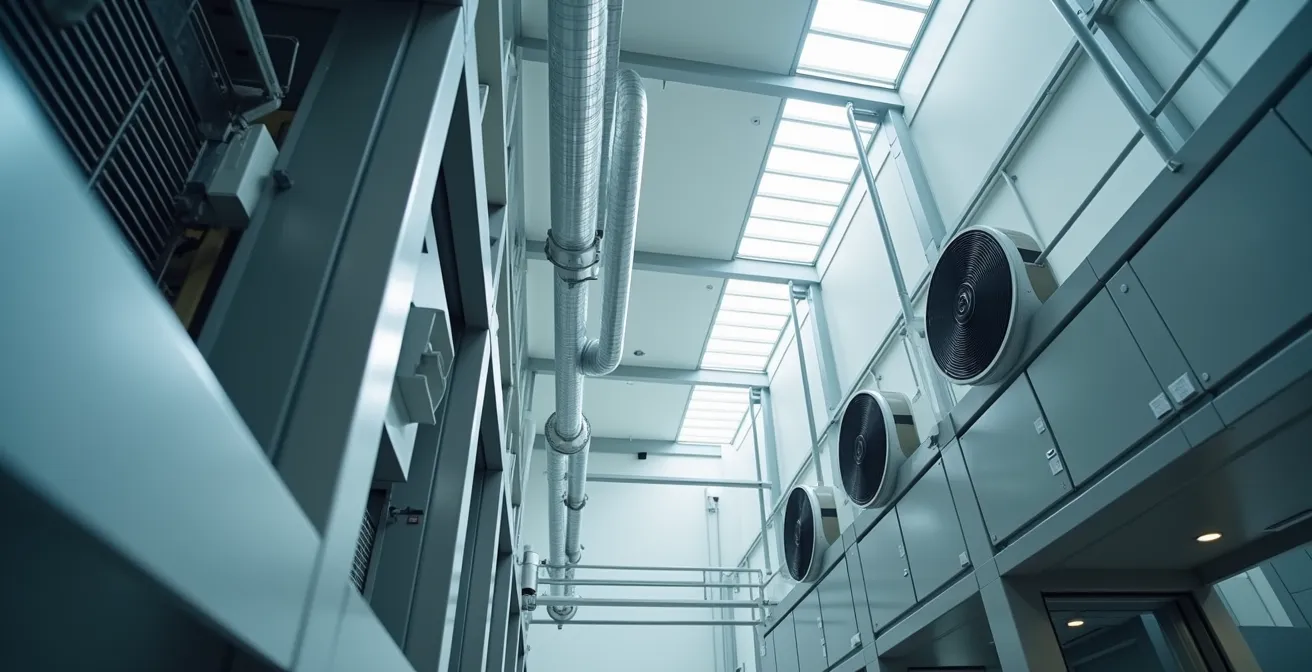
As the image above illustrates, the design of these systems maximises the surface area for thermal transfer. Integrating such a system into your main Air Handling Unit (AHU) or extraction points moves your facility from a position of passive energy loss to active energy recycling. This single measure can be one of the most impactful steps toward meeting Part L’s stringent energy efficiency targets while maintaining or even improving the required ventilation rates for a healthy indoor environment. It’s a foundational component of modern, compliant HVAC design.
Centralised AHU vs Decentralised heaters: which is better for variable shift patterns?
The traditional approach to heating large industrial spaces often involves a large, centralised Air Handling Unit (AHU) that distributes conditioned air throughout the facility. While effective for uniform, 24/7 operations, this model becomes highly inefficient when dealing with variable shift patterns, zonal work, or fluctuating occupancy. Heating an entire 10,000m² hall for a skeleton crew of ten people on a night shift is a clear violation of Part L’s principles of efficient energy use. This is where the debate between centralised and decentralised systems becomes critical.
A centralised AHU can be adapted with a Variable Air Volume (VAV) system, which allows for some degree of zonal control by modulating airflow to different areas. However, this adds complexity and may not offer the granularity needed for highly dynamic operations. Decentralised units—such as localised gas-fired radiant heaters or fan-assisted unit heaters—provide inherent flexibility. They allow for precise heating of only the occupied zones, leaving the rest of the space at a setback temperature. This can lead to significant energy savings, but may complicate integrated heat recovery and overall system management.
The decision requires a careful analysis of operational patterns versus system capabilities. As Mar-Hy Distributors noted in a recent report, this choice has direct financial consequences, stating that poor system selection for the operational reality leads to waste. As they put it:
Non-compliance results in $189 of lost energy savings per thousand square feet annually.
– Mar-Hy Distributors, HVAC Compliance Report 2025
For a facilities manager, the choice is not simply about CapEx versus OpEx. It’s a strategic decision about aligning the HVAC infrastructure with the reality of the facility’s workflow. The following table breaks down the key considerations:
| Aspect | Centralised AHU with VAV | Decentralised Units |
|---|---|---|
| Initial Cost | Higher CapEx | Lower per unit |
| Zonal Control | Requires VAV system | Inherent flexibility |
| Energy Efficiency | 15% annual savings possible | Variable by zone usage |
| Scalability | Complex modifications | Easy unit additions |
| Heat Recovery | Integrated capability | Limited options |
The poor ventilation cause behind your office staff’s chronic headaches
While Part L focuses heavily on energy conservation, it must be balanced with the mandate for adequate ventilation to ensure occupant health and well-being. In office spaces attached to industrial facilities, this balance is often poorly struck. An overzealous approach to sealing a building to prevent heat loss can lead to insufficient fresh air exchange. This, in turn, causes a buildup of indoor pollutants like CO2, volatile organic compounds (VOCs), and airborne particulates, leading to a phenomenon known as Sick Building Syndrome (SBS).
The symptoms of SBS are frequently reported by office staff and include chronic headaches, fatigue, dizziness, and respiratory irritation. These are not just comfort issues; they directly impact productivity, increase absenteeism, and can pose long-term health risks. From a regulatory standpoint, failing to provide adequate ventilation is a compliance failure. It’s essential to recognise that a compliant HVAC system isn’t just energy-efficient; it’s also effective at maintaining a healthy indoor air quality (IAQ). Following established guidelines is key, as proper ventilation following ASHRAE 62.1 standards has been proven to significantly reduce workplace IAQ symptoms.

The solution lies in a well-designed and properly commissioned ventilation system, often incorporating heat recovery to mitigate the energy penalty of introducing fresh air. For a facilities manager, addressing complaints of headaches or stuffiness should trigger an immediate review of ventilation rates and filter effectiveness. Ensuring that diffusers and grilles are clean and airflow is balanced according to the original design specifications is a critical first step. This ensures that your duty of care to employees and your obligations under building regulations are both met.
When to change HEPA filters: relying on pressure drop sensors vs calendar dates
In facilities requiring clean environments, such as food processing, pharmaceuticals, or electronics manufacturing, High-Efficiency Particulate Air (HEPA) filters are a non-negotiable component of the HVAC system. However, their maintenance presents a significant challenge. The traditional method of changing filters based on a fixed calendar schedule—for example, every six or twelve months—is inherently inefficient and often non-compliant with the spirit of Part L.
A new filter offers low resistance to airflow, while a filter at the end of its life is clogged with particulates and requires the AHU fan to work much harder to push the same volume of air through it. This increased fan motor workload translates directly to higher electricity consumption. Changing a filter too early is a waste of money on consumables; changing it too late results in a significant energy penalty and reduced airflow. The optimal strategy is to move from a time-based to a condition-based maintenance schedule, guided by data.
The most effective method is to install pressure drop sensors (or manometers) across each filter bank. These sensors measure the difference in static pressure before and after the filter. As the filter clogs, the pressure differential increases. By setting an alert at the manufacturer-recommended maximum pressure drop, you can identify the precise moment when the energy cost of running the fan outweighs the cost of a new filter. This data-driven approach ensures optimal performance, reduces energy waste, and provides a documented, auditable maintenance record for compliance purposes.
Action plan: Smart HEPA filter management protocol
- Install pressure drop sensors across all critical HEPA filter banks to get real-time data.
- Set alert thresholds in your Building Management System (BMS) at the manufacturer-recommended maximum pressure differentials.
- Integrate sensor data with the BMS to monitor and analyse pressure trends over time, predicting future change-out needs.
- Meticulously document all pressure readings and filter change-outs as part of your compliance and maintenance audit trail.
- Develop a calculation to determine the optimal change point where the cumulative energy cost of higher fan power exceeds the replacement cost of the filter.
Biomass boilers vs Industrial Heat Pumps: which makes sense for 5,000m² halls?
When decommissioning an old gas or oil-fired boiler for a large industrial space, the two leading low-carbon alternatives are biomass boilers and industrial-scale air or ground source heat pumps. Both offer significant carbon savings compared to fossil fuels, but they represent fundamentally different technological paths with distinct implications for Part L compliance, operational management, and future-proofing. The decision for a 5,000m² hall is not trivial and requires a Total Cost of Ownership (TCO) analysis.
Biomass boilers provide high-grade heat suitable for direct replacement of traditional boilers, but they come with significant logistical baggage. They require substantial space for fuel storage, delivery access, and ash handling. While they are considered low-carbon, they still produce localised emissions and their long-term viability may be affected by future air quality regulations and the sustainability of fuel supply chains. Government support for biomass has also become less certain in recent years.
Industrial heat pumps, by contrast, align perfectly with the national strategy of grid decarbonisation and electrification. Their carbon footprint automatically decreases as the grid becomes greener. They have a smaller physical footprint on-site but require significant electrical infrastructure upgrades. Critically, as noted in a Copeland report, the selection is now governed by refrigerant regulations like the AIM Act, which mandates a move to low-Global Warming Potential (GWP) refrigerants. This makes modern heat pumps an excellent choice for ESG reporting and long-term regulatory alignment. The choice is a strategic one, as detailed in this comparison from a recent analysis on HVAC regulations.
| Factor | Biomass Boilers | Industrial Heat Pumps |
|---|---|---|
| Carbon Trajectory | Fixed emissions profile | Decreases with grid decarbonization |
| Space Requirements | Fuel storage, delivery access, ash handling | External units, electrical infrastructure |
| Government Support | Limited incentives | Favored in electrification policies |
| Maintenance Complexity | High – ash removal, fuel handling | Moderate – refrigerant management |
| Future Regulations | Potential restrictions | Aligned with net-zero targets |
Why solid-state joining uses 80% less energy than arc welding?
A truly holistic approach to Part L compliance extends beyond the HVAC system itself and looks at the industrial processes that create the heating and ventilation load in the first place. Welding is a prime example. Traditional arc welding processes are notoriously energy-intensive, melting large volumes of metal and generating significant heat, smoke, and fumes. This process waste has a dual impact: high direct energy consumption and the need for a powerful, energy-hungry extraction and ventilation system to maintain a safe working environment.
Solid-state joining processes, such as friction stir welding or ultrasonic welding, offer a radically different paradigm. Instead of melting the metal, these techniques use friction, pressure, or vibration to join materials while they are still in a solid state. This has profound energy implications. Because the energy is highly localised at the join interface and no phase change (melting) occurs, the total energy input can be drastically lower. While figures vary by application, reductions of up to 80% less energy consumption compared to conventional fusion welding are achievable in many scenarios.
For a facilities manager, the benefit is twofold. First, the direct electricity consumption from the process is dramatically reduced, lowering overall energy bills and the associated CCL. Second, and just as important, the reduction in heat, smoke, and fumes means the demand on the HVAC extraction system is significantly lessened. A smaller fume load requires a smaller extraction system, with smaller fans running for less time, creating a virtuous cycle of energy savings that directly supports Part L targets. This is a clear example of addressing an energy problem at its source, rather than mitigating its effects with more energy.
Key takeaways
- True Part L compliance requires a shift from focusing only on the central plant to optimizing the entire energy ecosystem, including secondary systems and process loads.
- Data is your most powerful tool. Using sensors for condition-based maintenance (e.g., filter changes) instead of fixed schedules eliminates waste and reduces operational costs.
- Addressing energy consumption at the source—by adopting more efficient processes like solid-state welding—can provide greater HVAC savings than simply upgrading the extraction system itself.
Green Welding: How Solid-State Processes Cut Energy Bills and Fumes?
The ultimate goal of an efficient, Part L-compliant HVAC strategy is not just to treat the symptoms of energy waste, but to eliminate the cause. In an industrial setting, this means adopting a philosophy of “source control.” Nowhere is this more relevant than in processes like welding, which can be a primary driver of both direct energy use and indirect HVAC load. Shifting to “green welding” processes like solid-state joining is a powerful demonstration of this principle in action.
By using dramatically less energy and producing minimal fumes, these modern joining techniques fundamentally reduce the problem that the HVAC system is required to solve. This aligns perfectly with the guidance from leading industry bodies. As ASHRAE has long maintained, it is far more effective to control a problem at its origin. In their design guidelines, they make a clear statement on this philosophy:
Source control is far more efficient than building expensive, energy-intensive HVAC extraction systems to mitigate problems.
– ASHRAE, HVAC System Design Guidelines
Implementing this approach has a cascading effect on compliance and cost. A facility that adopts low-fume welding can specify smaller, less expensive AHUs. It can reduce the volume of makeup air that needs to be heated in winter, directly cutting gas consumption. This not only lowers the capital cost of HVAC infrastructure but also delivers continuous operational savings for the life of the building. For a facilities manager, championing such process changes is a strategic move that elevates their role from managing a building to optimizing a complete industrial system, turning a regulatory requirement into a competitive advantage.
To ensure your facility not only meets but exceeds Part L requirements, the next logical step is to conduct a comprehensive audit of these hidden energy loss points. Begin by implementing a data-driven maintenance plan and evaluating your process loads to build a strategic pathway to compliance and efficiency.