
The greatest risk in PPE procurement isn’t overpaying; it’s the catastrophic cost of a single stockout.
- Treating PPE as a low-cost commodity creates hidden vulnerabilities that lead to thousands in operational losses from a single line stoppage.
- A resilient strategy shifts focus from unit price to quantifying the Total Cost of Ownership (TCO) and the Cost of Poor Quality (COPQ).
Recommendation: Stop chasing pennies on gloves and start building a risk-quantification model that treats PPE as a critical operational dependency.
If you’re a procurement manager, the memory of 2020 is likely seared into your professional memory. The frantic search for N95 masks, the exponential price hikes, and the very real threat of production lines grinding to a halt for want of a box of gloves. The common advice that emerged was simple: diversify suppliers and hold more inventory. While not wrong, this advice barely scratches the surface of a truly resilient strategy. It addresses the symptoms, not the underlying disease: treating Personal Protective Equipment as a low-value commodity.
The pandemic didn’t create supply chain fragility; it merely exposed it. For years, the default procurement strategy was to drive down the per-unit cost of PPE, often by relying on a single, low-cost overseas supplier. This approach optimized for budget but maximized risk. The real cost of a stockout—lost production hours, missed deadlines, and contractual penalties—dwarfs any savings achieved on the initial purchase. A single point of failure in your PPE supply chain is an unacceptable operational risk.
But what if the entire framework is wrong? What if the key to a future-proof strategy isn’t just about having more suppliers, but about fundamentally reframing PPE from a consumable expense to a critical operational dependency? This article will provide an expert framework for doing just that. We will move beyond the platitudes and build a robust system based on risk quantification, proactive validation, and strategic market intelligence. We will deconstruct the true cost of failure and provide actionable methods to ensure your production line never stops for lack of a safety glove or a respirator again.
This guide offers a structured approach to building a truly resilient PPE procurement strategy, moving from foundational cost analysis to advanced audit preparation. Below is a summary of the critical areas we will explore to help you fortify your supply chain against future disruptions.
Summary: PPE Procurement Strategy: Avoiding the Supply Chain Bottlenecks That Halt Production
- Why saving pennies on PPE gloves can cost thousands in line stoppages?
- How to calculate the ‘Safe Stock’ level for critical respiratory gear?
- Disposable vs Reusable PPE: comparing the total cost of ownership over 1 year
- The CE mark fraud: how to spot fake safety glasses in your supply delivery?
- When to bulk buy PPE: predicting price spikes in the petrochemical market
- How to retrieve a batch history record in under 5 minutes?
- The bunding mistake that leads to groundwater contamination lawsuits
- Client Audit Preparation: How to Survive a Surprise Inspection from a Major OEM?
Why saving pennies on PPE gloves can cost thousands in line stoppages?
The traditional procurement metric of “cost per unit” is dangerously misleading when applied to critical PPE. A 10-cent saving on a pair of gloves feels like a victory until that glove tears on the assembly line, contaminates a batch, or worse, causes an injury. The factory floor goes silent. That’s the moment the true cost is revealed. This is known as the Cost of Poor Quality (COPQ), a metric that exposes the hidden financial drain of substandard supplies. In manufacturing, research shows that the Cost of Poor Quality typically consumes 15% to 20% of sales revenue.
This cost is composed of internal and external failures. Internal failures include the direct costs of scrap, rework, and re-inspection when a cheap glove fails. But the most significant impact is often the opportunity cost. If your factory has a 10% scrap rate due to quality issues, you are effectively running a “Hidden Factory,” where 10% of your labor, energy, and machine time is spent producing waste. Eliminating these defects is like gaining 10% more capacity without any capital investment.
External failure costs are even more damaging. These include warranty claims, product recalls, and penalties for missed on-time-in-full (OTIF) deliveries. Most critically, they erode customer trust, leading to lost future business. The calculation must therefore shift from “How much do these gloves cost?” to “What is the quantifiable cost to the business if this glove fails?” When a line stoppage costs thousands per hour, the initial savings on the PPE itself become a rounding error.
How to calculate the ‘Safe Stock’ level for critical respiratory gear?
A common reaction to post-pandemic shortages was to simply “buy more stuff.” This is a blunt instrument that can lead to its own problems: exorbitant carrying costs, wasted warehouse space, and the risk of inventory obsolescence, especially for items with an expiry date. The expert approach is not hoarding; it’s calculating a precise “Safe Stock” level based on data and risk assessment. This transforms inventory from a liability into a strategic buffer against volatility.
The fundamental formula for your reorder point is: (Average Daily Usage × Average Lead Time in Days) + Safety Stock. The first part represents your expected demand during a normal replenishment cycle. The second part, the Safety Stock, is your insurance policy. A robust Safety Stock calculation is: (Maximum Daily Usage × Maximum Lead Time) – (Average Daily Usage × Average Lead Time). This formula accounts for the worst-case scenario: a spike in demand coinciding with a delay from your supplier.
This paragraph introduces the concept of strategic inventory zones. To visualize this, consider the layout below which segments stock for optimal management.
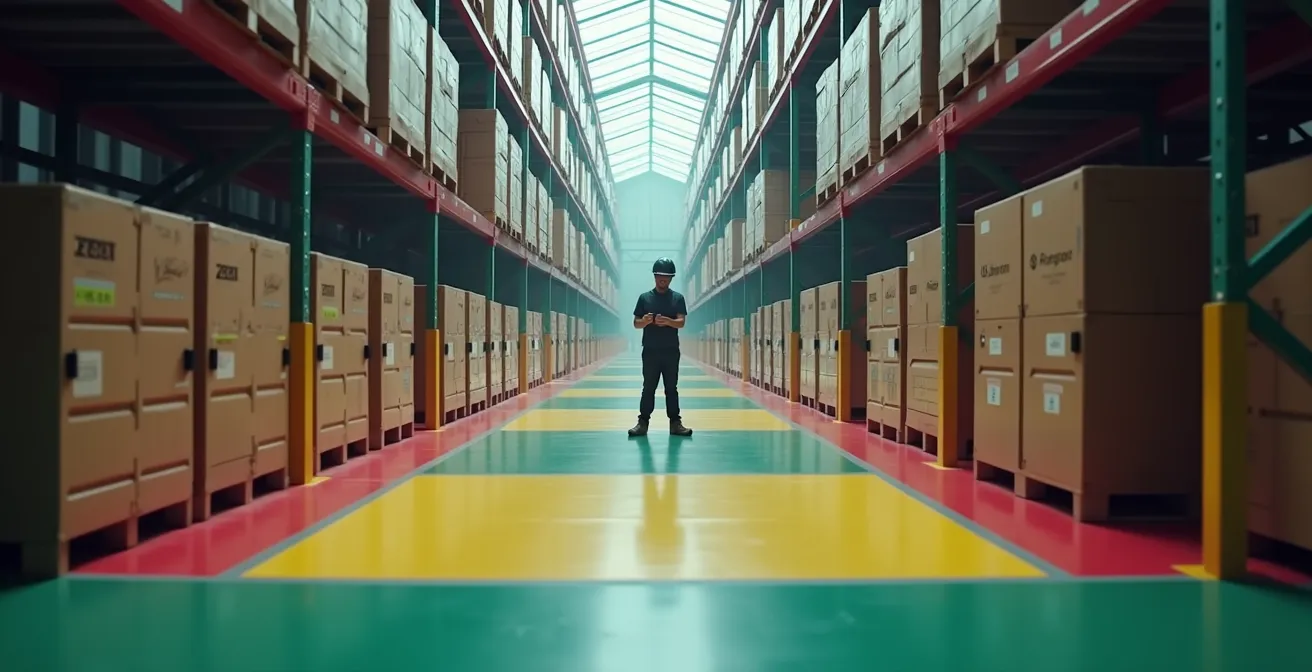
As shown, a truly resilient warehouse isn’t just full; it’s organized. It operates with tiered inventory: Operational Stock for daily use, Safety Stock (the yellow zone) to cover variability, and potentially a third tier, Strategic Stock (the red zone), held for black swan events like a pandemic or geopolitical disruption. This strategic layer is a high-level business decision, justified by the quantified cost of a total production shutdown.
Disposable vs Reusable PPE: comparing the total cost of ownership over 1 year
The debate between disposable and reusable PPE is often oversimplified to a comparison of initial purchase prices. A disposable N95 mask is cheap; a reusable elastomeric respirator is expensive. Case closed? Not for a resilience expert. To make a strategic decision, you must analyze the Total Cost of Ownership (TCO) and, crucially, the associated supply chain risks. The pandemic provided a brutal lesson in the fragility of disposable supply lines, where global demand for PPE surged by 40%, leading to more than 1,000% price hikes on N95 masks.
A TCO analysis forces a more holistic view. While reusable PPE has a high initial cost, it significantly reduces dependency on volatile global supply chains. The case of Honeywell, which rapidly established N95 production in the UK to produce 4.5 million masks monthly during the crisis, shows the power of regionalized manufacturing in ensuring supply. This stability is a significant, if un-costed, benefit of a reusable strategy. The following table breaks down the key variables to consider in your TCO calculation.
| Cost Factor | Disposable PPE | Reusable PPE |
|---|---|---|
| Initial Purchase Price | Low per unit | High per unit |
| Storage Requirements | High volume needed | Lower volume needed |
| Cleaning/Maintenance | None | Energy, water, labor costs |
| Waste Disposal | Ongoing disposal fees | Minimal waste |
| Supply Chain Risk | High dependency | Lower dependency |
| Workforce Training | Minimal | Maintenance skills required |
The analysis must also factor in costs like waste disposal fees for disposables versus the labor, water, and energy costs for cleaning reusables. A high-dependency on disposables means you are perpetually exposed to price shocks, shipping delays, and quality control issues from distant suppliers. A reusable program, while requiring an upfront investment in equipment and training, internalizes control and builds long-term operational resilience.
The CE mark fraud: how to spot fake safety glasses in your supply delivery?
In the rush to secure PPE, even diligent procurement managers can fall victim to sophisticated counterfeiting. The presence of a “CE” mark on a pair of safety glasses is no longer a guarantee of compliance. Fraudulent suppliers mimic these marks with alarming accuracy, putting both your workers and your company at risk. Trusting the mark is not enough; a process of proactive validation is essential at the goods-inward stage. This isn’t about lengthy lab tests; it’s about a quick, effective inspection routine that can spot red flags in minutes.
Your team needs to be trained to look beyond the packaging. Genuine quality is evident in the material itself—the clarity of the polycarbonate, the smoothness of the edge finishing, and the absence of visual distortions. A gloved hand can perform a simple friction test to see if the printed markings rub off, a common sign of a fake. These physical checks are a crucial layer of defense.

This image highlights the pristine material quality of genuine equipment, a detail often missed in a cursory check. To formalize this process, every delivery of critical PPE should be subject to a standardized inspection. The following checklist provides a framework for a rapid but thorough verification process that can be implemented immediately by your receiving team.
Essential checklist: 5-Minute Goods-Inward Inspection for PPE
- Validate Notified Body: Use the EU’s NANDO (New Approach Notified and Designated Organisations) online portal to verify that the 4-digit number next to the CE mark corresponds to a legitimate Notified Body for that type of PPE.
- Cross-Reference Lot Numbers: Ensure the lot or batch numbers on the product, its packaging, and the accompanying Declaration of Conformity or delivery note all match. Any discrepancy is a major red flag.
- Perform Physical Checks: Attempt to rub off the printed markings with moderate friction. Check for poor molding, sharp edges, or optical distortions in lenses. Genuine markings are typically laser-etched or permanently molded.
- Verify Material Quality: Conduct simple, non-destructive tests. Quality safety glasses should exhibit flexibility without snapping. A light tap should sound solid, not brittle.
- Scan QR Codes: If a QR code is present, scan it. It should lead to a professional manufacturer’s website with batch-specific documentation, test reports, or certificates. A dead link or a generic homepage is suspicious.
When to bulk buy PPE: predicting price spikes in the petrochemical market
Strategic procurement is not just about what you buy, but when you buy it. Bulk buying at the wrong time ties up capital and warehouse space. Bulk buying at the right time insulates you from predictable price shocks. For many types of PPE, particularly disposable gloves, the key is to monitor the upstream commodity markets, as the supply chain remains fragile and overtaxed by worldwide demand for PPE. This requires shifting from a reactive purchasing cycle to a proactive, intelligence-led approach.
The price of nitrile gloves, for example, is directly linked to the price of Nitrile Butadiene Rubber (NBR), a petrochemical product. By monitoring NBR futures, you can anticipate price trends weeks or months in advance. A significant upward trend in NBR is a clear signal to consider a strategic bulk purchase before that increase is passed down the supply chain. This is risk mitigation at its most proactive.
Beyond raw materials, other indicators provide crucial foresight. Maritime freight indexes, such as Drewry’s World Container Index (WCI), signal changes in shipping costs that will inevitably impact your landed cost. Similarly, tracking energy costs in key manufacturing hubs (like Southeast Asia for gloves) and currency exchange rates (e.g., USD vs. Malaysian Ringgit or Thai Baht) provides a more complete picture of future price pressures. Setting up automated alerts for a 15% or greater movement in any of these key indicators can provide the trigger needed to act before your competitors and lock in favorable pricing.
How to retrieve a batch history record in under 5 minutes?
Imagine a client auditor is on-site. They pick a product from your line and say, “Show me the certificate of conformity for this specific batch of safety helmets.” The clock starts ticking. Fumbling through binders or disorganized server folders is not an option. Your ability to retrieve a complete batch history record—including purchase orders, delivery notes, certificates, and inspection results—in under five minutes is a direct measure of your process resilience and a key factor in passing a surprise audit.
During a crisis, some organizations found that reverting to manual processes like direct phone orders actually increased accuracy over automated EDI systems, but this is not a scalable solution for traceability. The goal is a system that combines speed, accuracy, and scalability. The choice of system has a direct impact on performance, cost, and error rate, as shown in the comparison below.
The following table, based on an analysis of quality management systems, contrasts the effectiveness of different batch tracking methods.
| System Type | Setup Cost | Retrieval Time | Error Rate | Scalability |
|---|---|---|---|---|
| Manual Logbook | Low ($100s) | 10-15 minutes | 5-10% | Limited |
| Cloud Folder System | Medium ($1000s) | 3-5 minutes | 2-5% | Moderate |
| ERP Integration | High ($10,000s) | <1 minute | <1% | Unlimited |
| RFID/Barcode System | Medium-High | Instant | <0.5% | High |
While an integrated ERP or RFID system offers near-instant retrieval, even a well-structured cloud folder system can meet the five-minute challenge. The key is a disciplined and standardized naming convention and folder structure that is enforced without exception. For example: `[Supplier_Name] > [PPE_Type] > [PO_Number] > [Batch_Number]`, with all relevant documents saved as PDFs within that final folder. This simple discipline turns a chaotic archive into a powerful, audit-proof traceability tool.
The bunding mistake that leads to groundwater contamination lawsuits
A resilient procurement strategy extends beyond PPE for people; it includes equipment to protect the environment and prevent catastrophic legal and financial liability. Secondary containment systems, or bunding, for chemical storage are a prime example. The most common and costly mistake is assuming all bunding is created equal. Using a standard polyethylene bund to store a chemical that degrades it is not just an error; it’s a direct path to a containment failure, a potential environmental disaster, and crippling groundwater contamination lawsuits.
The core of the problem is chemical compatibility. Each stored chemical has a Safety Data Sheet (SDS) that specifies material compatibility requirements. This information must be meticulously cross-referenced with the material specifications of your bunding, spill kits, and the PPE designated for your emergency response team. A spill of a highly corrosive acid requires a different response protocol and different protective gear than a flammable solvent spill. The failure to align these three elements—containment, response equipment, and PPE—creates a critical gap in your safety system.

Regular, documented audits and drills are the only way to ensure this system works in practice. This involves creating an inventory matrix of all stored chemicals, verifying material compatibility, and running quarterly spill drills that test the entire response chain. These drills are not for show; they are for finding the failure points before a real incident does. Any identified gaps must be treated with urgency, with corrective actions implemented and documented within a strict timeframe, such as 30 days.
Key takeaways
- The true cost of PPE is not its purchase price, but the operational cost of its failure (COPQ).
- A data-driven safety stock calculation is superior to reactive hoarding, preventing both stockouts and capital waste.
- Supplier resilience involves not just diversification but proactive validation and intelligence-led purchasing based on market indicators.
Client Audit Preparation: How to Survive a Surprise Inspection from a Major OEM?
A surprise audit from a major OEM client is the ultimate test of your supply chain’s resilience. It is no longer enough to simply have PPE available; you must be able to demonstrate a comprehensive, documented, and risk-based strategy for its selection, procurement, and management. The auditor’s goal is to verify that you are not a risk to *their* supply chain. Your goal is to prove, with evidence, that you have control over every critical dependency.
This requires a “living” documentation system. You need documented risk assessments for every single-source PPE supplier. For each critical item, you must have a “Selection Rationale” document that links its use to specific workplace risk assessments. Records of fit-testing and certification validity can’t be six months old; they should be subject to weekly verification checks. In a crisis, this level of preparedness is what separates reliable partners from liabilities. As the Lifeline Vascular Care Team noted in a report on healthcare supply chains:
Effective, calm and consistent communication, internally and externally, is essential during a pandemic
– Lifeline Vascular Care Team, MGMA Healthcare Supply Chain Report
Your strategy must also demonstrate contingency planning. What is your documented response to a 25%, 50%, or 75% disruption from your primary supplier? A case study in crisis management showed a successful strategy involved adding a major secondary distributor and smaller tertiary suppliers, a move that runs counter to the traditional cost-saving tenet of leveraging volume with a single source. This diversification, when documented as part of a formal contingency plan, is what an OEM auditor wants to see. It shows you don’t just hope for the best; you plan for the worst.
To embed this resilience into your operations, the next logical step is to formalize these processes into your quality management system and conduct internal mini-audits. Begin today by building the documented evidence that will prove your supply chain’s strength when it matters most.