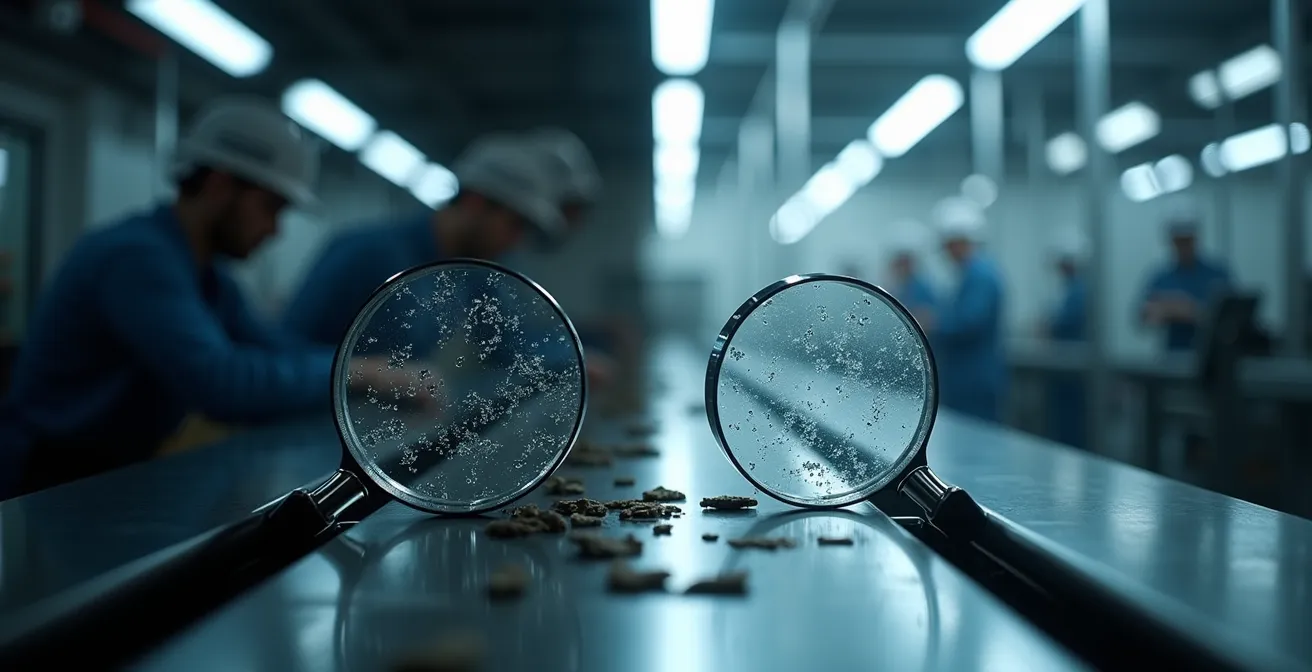
The endless cycle of inspection and rework is not a cost of doing business; it’s a symptom of a flawed system. The real shift happens when quality moves from a cost center to a strategic profit engine.
- The Cost of Poor Quality (COPQ) silently drains revenue through rework, warranty claims, and reputational damage.
- A prevention-focused culture, built on proactive planning and operator empowerment, designs out defects before they ever occur.
Recommendation: Stop funding a larger inspection department and start investing in the systems and culture that make inspection obsolete. The first step is to calculate your true Cost of Poor Quality.
As a leader, you see the numbers. You see the budget allocated to the quality department, the costs of scrap, the warranty claims that eat into your margins. It’s easy to view quality as a necessary evil—a cost center focused on catching mistakes before they reach the customer. The traditional debate of Quality Assurance (QA) versus Quality Control (QC) often reinforces this, painting a picture of two functions: one that sets the rules (QA) and one that polices them (QC).
But this view is fundamentally limited. It frames quality as a defensive action. The most common understanding is that QC is reactive, finding defects in finished products, while QA is proactive, focusing on the processes to prevent them. While true, this simple definition misses the profound business implication. Relying on QC is like paying a tax for having a flawed process. The real opportunity isn’t just to catch defects more efficiently; it’s to create a system where they are engineered out of existence from the very beginning.
This is the shift from defect detection to defect prevention. It’s a move from a culture of inspection to a culture of ownership. This article is not a textbook definition of QA vs. QC. It is a strategic guide for CEOs who want to stop managing the cost of quality and start unlocking its potential as a profit engine. We will dismantle the “cost center” mindset by exploring the true financial impact of failure and provide a roadmap to build a robust prevention culture that pays for itself.
The following sections will guide you through a strategic framework, moving from understanding the financial imperative for prevention to implementing the cultural and systemic changes necessary to make “quality is free” a reality in your organization.
Summary: From a Costly Afterthought to a Strategic Advantage: A CEO’s Guide to Prevention-Based Quality
- Why rework and warranty claims cost 10x more than prevention?
- How to use Advanced Product Quality Planning to design out defects?
- Auditing vs Sampling: which guarantees better raw materials?
- The bureaucracy trap: when too many forms actually reduce quality
- When to stop a project: the stage-gate criteria that save bad launches
- How to write Standard Operating Procedures (SOPs) that operators actually read?
- Why ‘ISO 9001 aligned’ is not enough for government procurement?
- ISO 9001 Certification: How to Use It to Win Public Sector Manufacturing Contracts?
Why rework and warranty claims cost 10x more than prevention?
The most significant barrier to investing in prevention is often a misunderstanding of the true cost of failure. The expenses you see on a spreadsheet—scrap, rework hours, warranty payouts—are just the tip of the iceberg. This is where the “Cost of Poor Quality” (COPQ) becomes the most critical metric your team isn’t tracking. COPQ includes not only these visible, internal failure costs but also the invisible, external ones: lost sales due to a damaged reputation, wasted engineering time on firefighting instead of innovation, and the productivity drain from plummeting employee morale.
The “1-10-100 Rule” provides a powerful mental model to quantify this. As research from the National Institute of Standard Technology shows, if it costs $1 to prevent a defect during the design phase, that cost escalates to $10 to correct it during production, and a staggering $100 to fix it after it has reached the customer. That final $100 doesn’t even account for the loss of future business from that unhappy customer. When you’re only catching defects at the end of the line (QC), you are consistently paying the 10x or 100x penalty.
Intel’s AI-Powered Prevention
To move away from costly late-stage detection, Intel deployed an AI-powered in-line inspection system. Using machine learning models to analyze defects in real-time on the production line, the company was able to shift from detection to prevention, resulting in potential savings of up to $2 million annually in avoided scrap while simultaneously ensuring chip reliability.
Viewing quality through the lens of prevention fundamentally changes the investment equation. It’s not about spending more; it’s about spending smart, early, and strategically to avoid catastrophic costs later. The first step is to make the invisible costs visible.
Your Action Plan: Calculating the Total Cost of Poor Quality (COPQ)
- Identify Visible Costs: Start by tracking the obvious—rework hours, scrap materials, and warranty claims data. This is your baseline.
- Calculate Hidden Factory Costs: Quantify the “hidden factory” of waste. Measure lost sales from reputation damage and the cost of wasted engineering time spent on firefighting instead of new product development.
- Assess Employee Impact: Measure the quantifiable impact on your workforce. This includes productivity loss from low morale, high employee turnover in frustrated teams, and the cost of holding excess inventory to buffer against defects.
- Apply the 1-10-100 Rule: Model your current detection-based spending (your “10” and “100” costs) and compare it to a proposed investment in prevention (your “1” cost).
- Build the Executive Business Case: Present the total COPQ as a percentage of revenue. This frames prevention not as a departmental budget request but as a high-return strategic investment for the entire business.
How to use Advanced Product Quality Planning to design out defects?
Once you accept the financial logic of prevention, the next question is practical: how do you implement it? The answer lies in architecting quality into your product from its very conception. This is the role of Advanced Product Quality Planning (APQP). APQP is not another layer of bureaucracy; it is a structured methodology for collaboration that ensures a product is designed to be made right the first time. It forces cross-functional teams—engineering, manufacturing, purchasing, and quality—to work together to predict and mitigate potential failures before a single part is produced.
A core tool within APQP is the Failure Mode and Effects Analysis (FMEA), a systematic process for identifying potential failures in a design or process. By proactively asking “What could go wrong?”, teams can implement countermeasures before these failures ever materialize. The impact is significant; quality management research indicates that systematic FMEA implementation reduces defect rates by up to 50%. This is the essence of prevention: transforming quality from an inspector’s job into an engineer’s and operator’s responsibility.
This approach moves quality upstream, from the factory floor to the design whiteboard. It builds in error-proofing mechanisms (Poka-Yoke) that make defects physically impossible, rather than relying on an operator to not make a mistake. It is a fundamental cultural shift from “Who made this defect?” to “What in the system allowed this defect to occur?”.

As this visualization of a collaborative session suggests, APQP is a human-centric process. It thrives on bringing diverse perspectives together to challenge assumptions and build a shared understanding of risk. This isn’t about filling out forms; it’s about structured conversations that build a robust, defect-resistant process from the ground up, involving everyone from field service technicians to line operators in the initial planning.
Auditing vs Sampling: which guarantees better raw materials?
A prevention-focused system is only as strong as its weakest link, and often, that link is the supply chain. Defects are frequently imported along with your raw materials. The traditional approach to this problem is incoming inspection, or statistical sampling, which is a classic QC activity. It’s a gatekeeper, designed to catch defects before they enter your production line. Auditing a supplier’s facility is a step up—a QA activity that verifies they have a capable process. However, both of these methods are rooted in a culture of mistrust. They operate on the assumption that your supplier *will* send you bad parts if you don’t check.
A true prevention strategy requires a radical shift from supplier verification to Supplier Quality Development (SQD). This means moving beyond a transactional relationship to a collaborative partnership. Instead of just auditing for compliance, you work with your key suppliers to improve their processes, share best practices, and integrate them into your own quality planning. You stop being a customer who inspects and become a partner who enables.
This evolution can be structured using a tiered trust model. New or high-risk suppliers may require intensive oversight, while long-term, certified partners can move to a model based on shared data and mutual trust, drastically reducing the need for costly incoming inspections.
The table below outlines a strategic framework for evolving supplier relationships from a state of verification to one of full partnership. This approach allows you to focus your resources where the risk is highest and leverage trust to create efficiency with your most reliable partners.
| Supplier Tier | Audit Frequency | Sampling Rate | Trust Level | Investment Focus |
|---|---|---|---|---|
| New/High-Risk | Monthly | 100% inspection | Verification Required | Compliance monitoring |
| Developing | Quarterly | Statistical sampling | Building Trust | Process improvement support |
| Certified Partner | Annual | Skip-lot inspection | Full Trust | Co-innovation projects |
As one expert in Modern Manufacturing Quality Practices notes, the ultimate goal is a system where trust replaces inspection:
The ultimate guarantee is neither auditing nor sampling, but Supplier Quality Development through collaborative partnership.
– Quality Management Expert, Modern Manufacturing Quality Practices
The bureaucracy trap: when too many forms actually reduce quality
As organizations attempt to build quality systems, they often fall into a predictable trap: they create a mountain of paperwork. The quality manual gets thicker, new forms are created for every procedure, and compliance becomes an end in itself. This well-intentioned effort to control processes frequently backfires, creating a bureaucratic maze that slows down operations, disengages employees, and ironically, hides quality problems instead of solving them. Operators spend more time filling out forms than focusing on their work, and the valuable data collected is often buried in clunky ERP systems, never to be seen again.
This “bureaucracy trap” is a clear sign that a quality system is built on a foundation of QC (detection and documentation) rather than QA (prevention and trust). It creates a culture of compliance over commitment. The solution is not to abandon documentation, but to relentlessly simplify it. Every form, every report, and every signature should be challenged with a simple question: “Does this activity actively help us prevent a defect?” If the answer is no, it’s likely a candidate for elimination.
The legendary quality guru W. Edwards Deming captured this perfectly. He understood that excessive paperwork was not a sign of control, but of a deeper cultural issue:
Excessive paperwork is often a symptom of a low-trust, blame-focused culture.
– W. Edwards Deming, Quality Management Philosophy
To escape this trap, leaders must foster an environment of psychological safety where trust replaces excessive documentation. This means transitioning from lengthy reports to real-time visual dashboards, digitizing workflows with user-centric tools, and empowering teams to challenge and eliminate redundant paperwork. When people feel trusted and empowered, their focus shifts from “covering themselves” to actively improving the process.
When to stop a project: the stage-gate criteria that save bad launches
One of the most expensive failures in any manufacturing business is a bad product launch. It’s a “100x cost” event that involves not just product recalls, but also brand damage, loss of market share, and legal liability. Yet, many organizations struggle to stop a failing project. Once momentum builds and resources are committed, a “get-it-out-the-door” mentality takes over. Teams focus on hitting the launch date, ignoring the mounting evidence that the product isn’t ready. This is the ultimate failure of a prevention-based system.
A robust prevention culture needs a powerful safety mechanism: the Stage-Gate process. This is a formal project management framework that divides a project into distinct stages (e.g., Concept, Design, Validation, Launch). At the end of each stage, the project must pass through a “gate,” which is a formal review meeting. At this meeting, leaders make one of three decisions: Go, Kill, or Recycle. The “Kill” decision is the most critical and often the most difficult. It requires the discipline to halt a project that fails to meet pre-defined, objective criteria, even if millions have already been spent.
This is not a sign of failure; it is a sign of a healthy, disciplined organization. Killing a bad project in the design phase is a 1x cost event. Launching it is a 100x cost catastrophe. The data on recalls underscores this financial reality. For instance, ETQ’s 2024 manufacturing survey reveals that for many companies, the cost is staggering, with 39% of recalls costing between $10M-$49.99M each. A single “Kill” decision at the right gate can save the company tens of millions of dollars.
For a Stage-Gate process to be effective, the criteria must be objective, data-driven, and agreed upon in advance. They should cover technical feasibility, financial viability, and market readiness. This removes emotion and politics from the decision, empowering leaders to act as stewards of the company’s resources, not just champions of their pet projects.
How to write Standard Operating Procedures (SOPs) that operators actually read?
The backbone of any quality system is the set of instructions that guide the frontline: the Standard Operating Procedures (SOPs). In theory, SOPs ensure consistency and prevent errors. In reality, they are often dense, text-heavy binders that sit on a shelf gathering dust. They are written by engineers, for auditors, and are largely ignored by the operators who are supposed to use them. When SOPs are not used, consistency is lost, and the process becomes dependent on tribal knowledge and individual habits—a recipe for defects.
To build a true prevention culture, SOPs must be transformed from static documents into dynamic, engaging, and operator-centric tools. The goal is not just to document the process, but to create a “conversation” about the best way to do the work. This means moving away from long-form text and embracing visual and interactive formats. A single, clear image is often more powerful than a page of text. A short video demonstration linked by a QR code on the machine is infinitely more effective than a 30-page manual.
This modern approach empowers operators, treating them as experts in their own work. Instead of being passive recipients of instructions, they become active co-creators of the standard. Wiki-style platforms allow operators to suggest improvements, tablet-based checklists provide real-time guidance, and “Single-Point Lessons” use heavy visuals to explain critical tasks quickly. This transforms SOPs from a compliance tool into a continuous improvement engine.
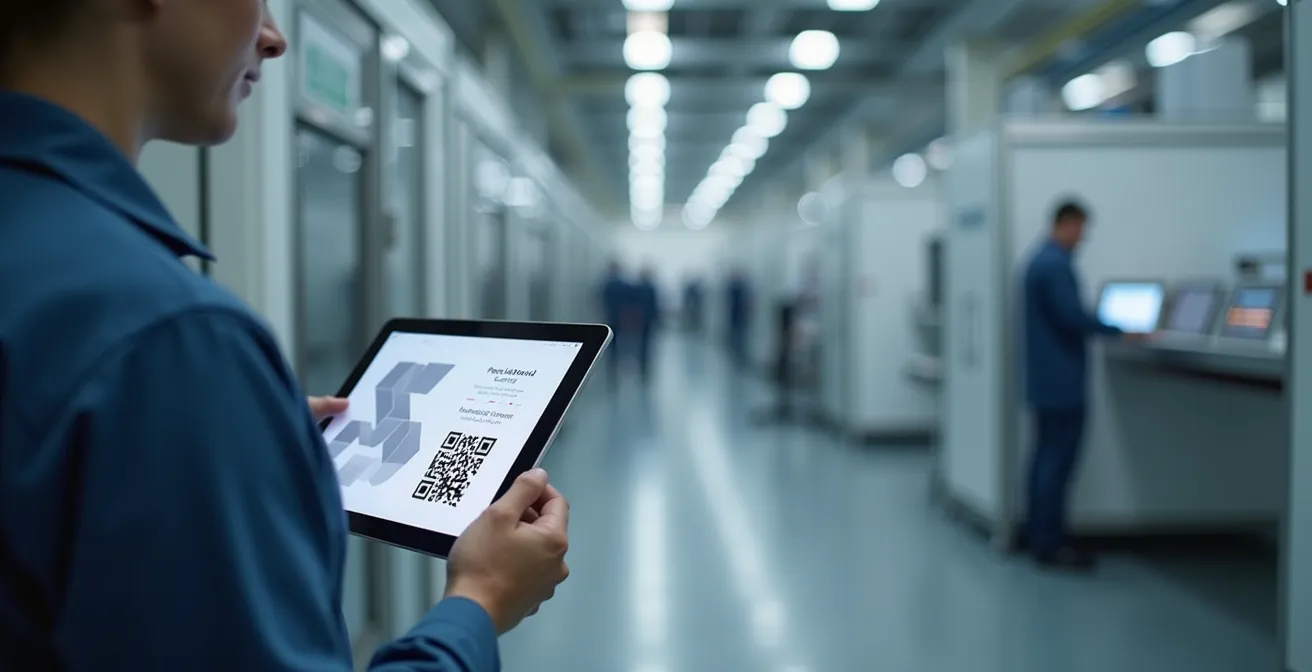
The focus shifts from forcing adherence to a rigid procedure to agreeing on the “current best method,” with the understanding that this method is always open to improvement from the people who know the job best. This builds a sense of ownership and engagement that no top-down manual ever could.
Why ‘ISO 9001 aligned’ is not enough for government procurement?
In the world of B2B sales and particularly in public sector contracting, the credibility of your quality system is paramount. Many companies attempt to gain this credibility by claiming their system is “ISO 9001 aligned.” This term suggests that they follow the principles of the ISO 9001 standard without having gone through the rigorous process of formal certification. From a business perspective, this is a critical mistake. It’s an attempt to get the benefit without making the investment, and sophisticated customers see right through it.
Claiming to be “aligned” is a self-assessed declaration with no external validation. It signals to a procurement officer that you have likely cut corners and that your system has never been challenged by an independent, third-party auditor. It introduces risk into their supply chain. In contrast, ISO 9001 certification is objective proof. It is a credential that demonstrates your organization has not only implemented a quality management system but has also subjected it to scrutiny and passed.
A Procurement Risk Management Expert, in a piece on Government Contracting Standards, put it best with a simple, powerful analogy:
‘ISO 9001 aligned’ is like saying ‘I’m a good driver,’ whereas ISO 9001 certified is showing a valid driver’s license.
– Procurement Risk Management Expert, Government Contracting Standards
For a government agency or any large corporation, which would you trust? The driver who says they are good, or the one with a license to prove it? Certification acts as a risk mitigation tool for your customer. It shows you have robust, documented, and audited processes for things like corrective actions, management reviews, and continuous improvement. It proves that your commitment to quality is not just a marketing slogan but a systemic reality. This is because companies implementing ISO 9000 Quality Management Systems are required to demonstrate advanced levels of control and precision, which inherently reduces risk for their clients.
Key takeaways
- Relying on inspection (QC) is a costly tax for flawed processes; prevention (QA) is the investment that eliminates that tax.
- The Cost of Poor Quality (COPQ) extends far beyond visible scrap, encompassing lost sales, brand damage, and wasted innovation potential.
- A prevention culture is built on three pillars: designing out defects (APQP), developing supplier partnerships, and empowering operators with trust and dynamic tools.
ISO 9001 Certification: How to Use It to Win Public Sector Manufacturing Contracts?
Achieving ISO 9001 certification is not the end of the quality journey; it’s the beginning of a new business strategy. For a CEO, the certificate on the wall is not the asset. The asset is the robust, prevention-focused system it represents, and the ability to leverage that system to generate revenue. In the competitive world of public sector bids, certification is often a minimum requirement. Winning requires you to “weaponize” your Quality Management System (QMS) as a competitive advantage.
This means going beyond simply checking the “ISO 9001 certified” box on a tender. It means proactively demonstrating how your quality system directly addresses the procurement officer’s biggest concern: risk. You must translate your quality processes into your customer’s language. Instead of talking about “corrective actions,” you talk about a “proven risk mitigation process.” Instead of showing them a certificate, you show them performance data: charts of declining non-conformance rates and improving process capability (Cpk) trends. You are not just selling a product; you are selling confidence and reliability.
Furthermore, a sophisticated approach involves researching the target agency’s specific needs. Do they operate in a sector like aerospace that requires “ISO-plus” standards like AS9100? Demonstrating proactive compliance with these higher standards shows you are a true partner, not just a compliant vendor. Ultimately, you present your certification as a risk transfer mechanism. By choosing you, the procurement officer is transferring the risk of quality failures from their organization to yours, backed by an externally audited system. This approach is reinforced by the tangible results such systems can produce, as McKinsey research shows manufacturers can achieve up to a 90% increase in defect detection rates and prevention by using advanced, system-driven technologies like AI.
This transforms your QMS from a compliance cost into a powerful sales and marketing tool, directly connecting your investment in prevention to top-line growth.
By shifting your focus from detection to prevention, you are not just improving your products; you are building a more resilient, efficient, and profitable business. The journey begins by taking the first step to understand the real financial impact of your current system. Evaluate your Cost of Poor Quality today to build the business case for transforming your organization’s culture tomorrow.