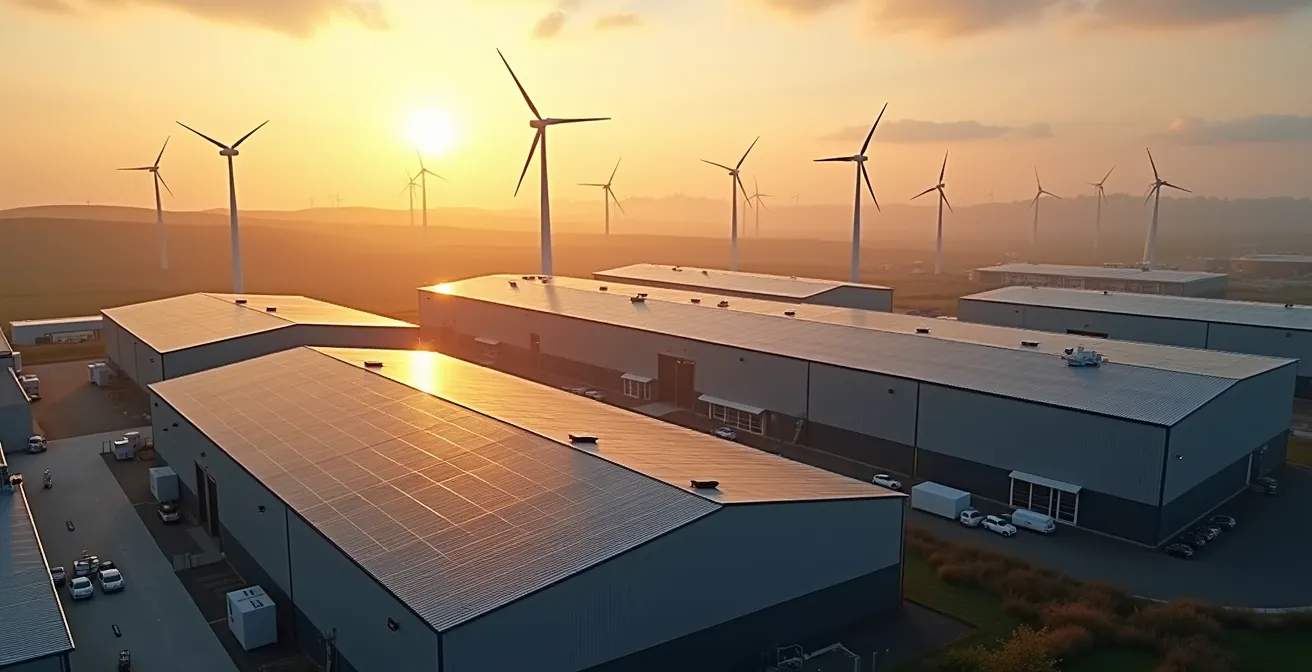
The real ROI from on-site renewables isn’t just about cutting energy bills; it’s about de-risking your operations from grid volatility and guaranteeing production continuity.
- Relying on the National Grid exposes your site to unpredictable peak-hour surcharges and voltage instability that can halt sensitive machinery.
- The biggest barrier to energy independence is often your own site’s infrastructure—specifically the main incomer fuse and grid connection capacity—not the choice between solar or wind.
Recommendation: Before investing in generation technology, conduct a full power capacity and infrastructure audit to identify your site’s true bottlenecks.
For UK manufacturing CEOs, the relentless rise of energy costs is no longer a forecast; it’s a critical operational threat. The standard response involves exploring on-site renewable generation, typically a choice between solar panels on vast factory roofs or wind turbines on available land. Discussions quickly turn to payback periods, installation costs, and corporate social responsibility metrics. While these are valid considerations, they miss the most critical point.
The conversation shouldn’t start with “solar versus wind.” It must start with your site’s inherent vulnerabilities. Relying on an aging and increasingly volatile National Grid is a gamble on your operational continuity. The real risk isn’t just the next energy price cap increase, but the costly production downtime caused by grid instability or hitting the ceiling of your site’s electrical infrastructure. This is a challenge of engineering and risk management, not just finance.
But what if the key to achieving genuine energy independence and a faster ROI lies not in the technology you choose, but in how you overcome the hidden bottlenecks in your own facility? The true value of an on-site renewable system is measured in avoided production stoppages and secured operational resilience. This guide will reframe the decision-making process, moving beyond a simple cost-benefit analysis to a strategic assessment of your site’s power infrastructure, its limitations, and the specific risks you need to mitigate.
This article provides a strategic framework for UK manufacturing leaders. We will dissect the primary risks of grid dependency, navigate the complexities of grid connection, evaluate technology choices based on operational needs, and uncover the infrastructure constraints that could derail your energy independence project before it even begins.
Summary: A CEO’s Guide to On-Site Renewables in UK Manufacturing
- Why relying solely on the National Grid exposes you to peak-hour surcharges?
- How to secure a G99 grid connection permission without 6-month delays?
- Biomass boilers vs Industrial Heat Pumps: which makes sense for 5,000m² halls?
- The voltage drop risk that could stall your CNC machines during cloud cover
- Battery storage ROI: is it worth it for factories operating 24/7?
- Why your main incomer fuse is the biggest bottleneck to expansion?
- Why inefficient HVAC will increase your Climate Change Levy (CCL) bill?
- Manufacturing Infrastructure: Is Your Site Power Capacity Ready for Electric Fleets?
Why relying solely on the National Grid exposes you to peak-hour surcharges?
Full dependency on the National Grid is no longer a stable foundation for a manufacturing business. The primary risk lies in exposure to volatile, non-commodity charges, specifically the Distribution Use of System (DUoS) and Transmission Network Use of System (TNUoS) charges. These are levied to maintain the grid and are increasingly targeted at consumption during peak periods. For a manufacturer, this means your energy bill is dictated not just by how much power you use, but precisely *when* you use it. Running a full production line during a winter afternoon can trigger punitive costs that are difficult to forecast and budget for.
The financial impact is significant and growing. According to a recent analysis from 2024, some UK manufacturers have seen an over 40% increase in DUoS costs. This trend is set to continue as the grid operator incentivises load shifting away from peak times to manage national demand. Relying solely on the grid means your operations are permanently vulnerable to these external pricing mechanisms, turning your energy procurement into a reactive, high-stakes guessing game. On-site generation, by contrast, insulates your core consumption from these charges, providing a critical buffer against market volatility.
Beyond the direct costs, this reliance introduces a level of operational uncertainty. Planning production schedules around potential grid price spikes is inefficient and restricts flexibility. It subordinates your operational needs to the constraints of the national energy infrastructure. Achieving energy independence is therefore not just a cost-saving exercise; it’s a strategic move to regain control over your production environment and de-risk your business from unpredictable external financial pressures.
How to secure a G99 grid connection permission without 6-month delays?
Securing permission from your Distribution Network Operator (DNO) to connect a generation system larger than 3.68kW per phase—a G99 application—is often the first major bottleneck in a renewables project. The standard process can take anywhere from 45 to 90 working days, with complex projects often facing delays of six months or more. For a CEO focused on ROI, this administrative lag represents a significant loss of potential savings and a frustrating drag on project momentum. However, navigating this process efficiently is possible by understanding the available routes.
The key is to determine if your project qualifies for the G99 Fast Track process. This route is designed for installations using type-tested inverters that meet specific DNO requirements. Instead of a full technical review, the DNO performs a simplified assessment, drastically cutting down approval times. In many cases, a well-prepared Fast Track application can be approved in just 15-20 working days. The crucial first step is to work with your installer to ensure the proposed equipment is on the DNO’s approved list, which immediately opens up this accelerated pathway.
A proactive approach can yield even faster results. As one case study of a UK-based installer revealed, direct communication with the DNO can be transformative. By calling the DNO to discuss the application, the installer received G99 approval in less than 24 hours by agreeing to a minor capacity reduction. This highlights a critical lesson: engaging the DNO as a partner rather than a hurdle and showing flexibility can bypass months of waiting. The table below outlines the primary application routes.
| Application Type | Timeline | Requirements | Best For |
|---|---|---|---|
| Standard G99 | 45-90 working days | Full technical assessment | Complex or large systems |
| G99 Fast Track | 15-20 working days | Type-tested equipment, under specific thresholds | Standard installations with approved inverters |
| SGI Application | 10-15 working days | Small Generation Installation criteria met | Systems meeting all three SGI categories |
Biomass boilers vs Industrial Heat Pumps: which makes sense for 5,000m² halls?
Heating large industrial spaces like a 5,000m² manufacturing hall represents a significant portion of a factory’s energy consumption. Shifting this thermal load to a renewable source is a powerful lever for reducing costs and carbon emissions. The two primary contenders for this task are industrial biomass boilers and large-scale air or ground source heat pumps. The choice is not one of simple efficiency but of strategic alignment with your site’s operational profile and infrastructure.
A biomass boiler offers a direct, robust, and powerful heating solution. It burns sustainably sourced wood pellets or chips to generate high-grade heat, making it ideal for processes requiring very high temperatures or for retrofitting into existing hot water or steam-based heating systems. Its primary advantage is its reliability and its ability to provide a consistent, high-temperature output, independent of ambient weather conditions. However, it requires significant physical space for the boiler and fuel storage, a reliable fuel supply chain, and regular maintenance for ash removal. It turns your heating into a logistics and procurement function.
An industrial heat pump, conversely, operates on electricity to transfer ambient heat from the air or ground into your facility. While its maximum output temperature is lower than biomass, its efficiency (Coefficient of Performance) can be 300-400%, meaning it produces 3-4 units of heat for every unit of electricity consumed. This makes it an incredibly cost-effective solution, especially when paired with on-site solar or wind generation. It eliminates fuel logistics but makes your heating dependent on your electrical supply’s stability. As Ryan Law, CEO of Geothermal Engineering Ltd, noted when discussing the UK’s first geothermal plant, the goal is consistent power, stating, “Unlike other renewable sources like wind and solar we are constantly on, 24/7 electricity.” This pursuit of stable, baseload energy is a key consideration when electrifying your heat.
The voltage drop risk that could stall your CNC machines during cloud cover
For a modern manufacturing facility, power quality is as important as power availability. Sensitive equipment, particularly CNC machines, VFDs (Variable Frequency Drives), and robotic arms, are designed to operate within a very tight voltage tolerance. While on-site renewables like solar or wind can reduce your energy bills, their inherent intermittency can introduce a critical operational risk: voltage instability. A sudden drop in generation—for example, when a dense cloud covers a solar array—can cause a momentary voltage sag on your site’s microgrid. This might not be a full-blown outage, but it can be enough to cause a CNC machine to fault, ruining a high-value part and forcing a costly production restart.
The intermittency of renewable sources is a well-documented phenomenon. For instance, an analysis of wind power variability shows an 80% chance that output will change less than 10% in an hour, but a 40% chance of a 10% or more change in 5 hours. While the grid normally smooths this out, a site aiming for energy independence must manage this internally. The financial risk is not the cost of the lost kWhs, but the magnified cost of wasted materials, labour, and production delays. Protecting against this requires a system designed for industrial resilience, not just residential energy saving.
The solution lies in designing a system with power quality at its core. This moves beyond simply installing panels or turbines and involves creating a robust internal microgrid. Integrating grid-forming inverters with a small battery buffer can create a stable power signal, isolating sensitive machinery from fluctuations in generation. This proactive approach to power quality management is non-negotiable for any high-precision manufacturing environment looking to leverage renewables without compromising operational integrity.
Action Plan: Power Quality Protection Strategies
- Conduct a comprehensive Power Quality Audit before renewable system design to profile machinery sensitivity.
- Install grid-forming inverters with a small battery buffer to create a stable microgrid independent of solar fluctuations.
- Implement voltage regulation equipment specifically rated for industrial VFD protection.
- Design the system with tolerance advice and manufacturability input from experienced integrators.
- Consider hybrid solutions combining multiple renewable sources to smooth intermittency.
Battery storage ROI: is it worth it for factories operating 24/7?
For a 24/7 manufacturing operation, the initial business case for a Battery Energy Storage System (BESS) can seem weak. If you are consuming all the energy you generate in real-time, where is the value in storing it? This view, however, overlooks the multifaceted ROI of modern battery systems. The value is not just in storing “spare” solar energy; it’s in providing grid stability, unlocking new revenue streams, and ensuring absolute operational continuity—the most valuable asset for a round-the-clock facility.
The primary ROI driver for a 24/7 site is peak shaving and triad avoidance. A BESS allows you to charge from the grid during the cheapest off-peak hours (e.g., overnight) and discharge during the most expensive peak periods in the late afternoon. This insulates you from the punitive DUoS and TNUoS charges, effectively time-shifting your grid consumption to your financial advantage. This function alone can generate substantial savings, but the business case has evolved beyond mere cost avoidance.

The modern BESS is a revenue-generating asset. By participating in grid-balancing services like the Dynamic Containment or Firm Frequency Response, your battery can earn income by helping the National Grid maintain stability. This transforms an operational asset into a profit centre. A recent analysis of Triad optimization benefits shows that battery operators in certain UK regions can project earnings from grid services for years in advance. This predictable revenue stream radically changes the ROI calculation for a 24/7 facility, justifying the initial capital expenditure.
Case Study: Revenue Generation from Triad Optimisation
Battery operators in the South Western region are positioned to earn significant revenues from Triad optimization strategies. Forecasts show export rates exceeding £16/kW between 2024 and 2026. This allows 24/7 facilities, which might otherwise see a battery as a redundant asset, to project reliable earnings from grid services for the next six years, turning what would be a cost-saving device into a strategic revenue generator.
Why your main incomer fuse is the biggest bottleneck to expansion?
Before you even evaluate solar panels or wind turbines, the most critical component to assess is your site’s main incomer fuse. This fuse, which sits at the point of connection to the DNO’s network, dictates the maximum amount of power your entire facility can draw from—or export to—the grid. For many established manufacturing sites, this connection was sized for historical needs and is now the single biggest physical constraint to both on-site generation and future expansion, such as the electrification of process heat or vehicle fleets.
Adding a significant solar array or wind turbine means you will likely want to export surplus power to the grid to generate revenue. If your generation capacity exceeds your main fuse rating, the DNO will require a connection upgrade. This is where projects stall. A DNO grid connection upgrade is not a simple administrative task; it is a major civil engineering project. Industry analysis indicates that a typical upgrade can cost over £100,000 and involve lead times exceeding a year. This unforeseen cost and delay can completely derail the business case for a renewables project.
Therefore, a “power-first” audit is essential. Before committing to a renewable system, you must determine your current main fuse capacity and model your future needs. If an upgrade is unavoidable, it must be factored into the project’s core budget and timeline from day one. In some cases, a “virtual upgrade” using battery storage to manage peak loads and an export limitation scheme (G100) can provide a faster, cheaper alternative to a full physical upgrade. Ignoring the main incomer is the most common and costly mistake in commercial renewable projects; addressing it first is the key to a successful deployment.
Why inefficient HVAC will increase your Climate Change Levy (CCL) bill?
While the focus of on-site generation is often on producing clean electricity, a significant and often overlooked area of energy consumption is heating, ventilation, and air conditioning (HVAC). Inefficient HVAC systems in large manufacturing halls and warehouses don’t just waste energy; they directly inflate your Climate Change Levy (CCL) bill. The CCL is a tax on electricity, gas, and solid fuels used by businesses. Every kilowatt-hour of wasted energy is a kilowatt-hour you pay tax on, needlessly increasing your operational costs.
The scale of this issue will only grow as national demand increases. With the Climate Change Committee projecting a 50% increase in UK electricity consumption by 2035, the cost of inefficiency will become even more punitive. For a manufacturer, tackling HVAC waste is not just an environmental initiative; it is a direct cost-control strategy. The principle of “efficiency first” is paramount: it is far cheaper to save a kilowatt-hour than it is to generate one. Reducing your baseline energy demand through HVAC optimization means any renewable system you install will be smaller, less expensive, and more effective.
Practical steps include conducting a comprehensive energy audit to identify sources of waste heat from machinery like compressors and furnaces, which can be captured and repurposed for space heating. Upgrading insulation in warehouse spaces can reduce the thermal load by as much as 30%. Implementing smart controls that link HVAC operation to production schedules and occupancy patterns prevents heating or cooling empty spaces. Only after these efficiency measures are implemented should you size your renewable generation system. This ensures you are investing to meet your *actual* optimized demand, not paying to power your own inefficiency.
Key takeaways
- Grid dependency exposes manufacturers to volatile peak-hour surcharges (DUoS/TNUoS) that are hard to predict and control.
- The biggest obstacles to on-site generation are often internal: administrative delays (G99 permits) and physical infrastructure limits (main incomer fuse capacity).
- Battery storage provides ROI for 24/7 operations not by storing spare energy, but by enabling peak shaving, providing power quality, and generating revenue through grid services.
Manufacturing Infrastructure: Is Your Site Power Capacity Ready for Electric Fleets?
The transition to electric vehicles (EVs) is an inevitability, and for manufacturers with logistics and delivery operations, electrifying the HGV and van fleet is on the strategic roadmap. However, this transition represents a monumental new load on your site’s electrical infrastructure—a load that most existing facilities are simply not designed to handle. This is the next great bottleneck that will challenge your site’s power capacity.
The numbers are stark. A single rapid charger for an electric car can draw 50-150kW. For heavy goods vehicles, the demand is an order of magnitude higher. Infrastructure analysis reveals that charging just two electric HGVs simultaneously can add a 1MW load to your site’s demand. This is equivalent to the power consumption of a small factory. If your current main incomer is already near its limit, adding an EV charging hub without a major grid upgrade and on-site generation strategy is impossible. It would immediately trip your main fuse, shutting down your entire operation.
Therefore, planning for an electric fleet must be integrated into your overall energy strategy today. Your on-site solar and battery storage system should not be sized just for your current production needs, but with the future charging load in mind. The business case for a larger solar array or BESS is significantly strengthened when it is seen as the enabling infrastructure for fleet electrification. By generating and storing your own power, you can manage this massive new load, charge vehicles with low-cost renewable energy overnight, and avoid crippling grid upgrade costs. Thinking about fleet charging as a separate project is a strategic error; it must be the capstone of a holistic site energy plan.
The journey to energy independence is a strategic imperative that requires a shift in perspective from short-term cost-saving to long-term operational resilience. By auditing your site’s infrastructure first, planning for future loads, and designing a system that ensures power quality, you can secure a return on investment that goes far beyond the electricity bill. To begin this process, the next logical step is to commission a detailed site power capacity and infrastructure audit.