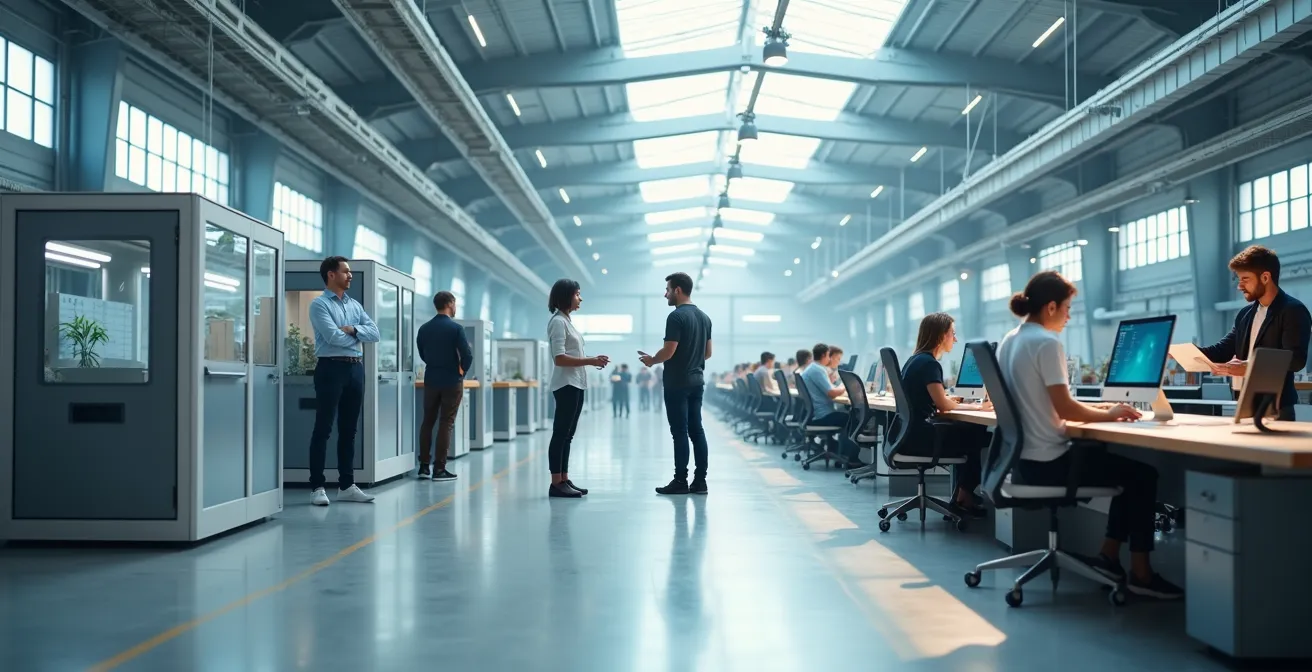
Winning the war for Gen Z engineering talent isn’t about matching tech-company perks; it’s about engineering a workspace that actively enhances their cognitive performance and physiological well-being.
- Chronic industrial noise and poor lighting directly increase stress hormones, hindering the precision work engineers are paid to do.
- Purpose-built ‘recharge zones’ and revitalised canteens are not costs but investments that signal a company values its people, directly impacting retention.
Recommendation: Shift your mindset from viewing the workplace as a cost-centre to seeing it as your most powerful strategic tool for talent acquisition and retention.
As an HR director in manufacturing, you’re on the front lines of a frustrating battle. You invest heavily in recruiting top-tier Gen Z engineers, only to see them walk out the door 18 months later, often for a seemingly “cooler” job at a tech company. You’ve tried offering competitive salaries, highlighting your firm’s innovative projects, and talking up the company’s purpose. Yet, the revolving door keeps spinning, and the cost of recruitment and retraining continues to mount. This isn’t just a frustration; it’s a critical business risk.
The common advice often misses the mark. While flexibility and purpose are important, they don’t address the core, unspoken reality of the industrial workplace. The truth is, the physical environment itself—the constant hum of machinery, the harsh fluorescent lighting, the depressing break room—is actively working against your retention efforts. For a generation hyper-aware of well-being and mental health, a workplace that ignores their physiological and psychological needs is a deal-breaker, no matter the salary.
But what if the very thing that seems like your biggest disadvantage—the industrial environment—could be turned into your greatest strategic asset? This article proposes a fundamental shift. The key isn’t to mimic a tech startup’s campus with beanbags and beer taps. It’s to apply the science of cognitive ergonomics and environmental psychology to create a high-performance ecosystem. It’s about understanding that for an engineer, the workplace isn’t just a location; it’s a tool. By engineering an environment that reduces cognitive load, manages physiological stress, and facilitates deep, focused work, you can offer something even tech giants can’t: a workspace custom-built for an engineer’s brain.
Throughout this guide, we will explore specific, science-backed design interventions that transform your factory and offices from a source of fatigue into a powerful magnet for talent. We will deconstruct how elements like acoustics, lighting, and rest areas can become tangible proof of your company’s commitment to its people, giving you a decisive edge in the war for talent.
Summary: A Strategic Guide to Attracting Gen Z Engineers Through Workspace Design
- Why dingy canteens are contributing to your 20% staff turnover rate?
- How to design ‘recharge zones’ that actually reduce operator fatigue?
- Open plan vs Cellular offices: which works best for engineering teams?
- The noise levels that increase cortisol and reduce cognitive precision
- How to bring natural light into a windowless factory floor without glare?
- How to implement digital near-miss reporting that workers actually use?
- Why 5000K lighting at 3 AM helps night shift alertnes?
- Adaptive Industrial Lighting: Reducing Shift Fatigue and Energy Bills by 30%
Why dingy canteens are contributing to your 20% staff turnover rate?
The factory canteen is often viewed as a logistical necessity—a place for employees to refuel quickly before returning to the line. This perspective is dangerously outdated. For Gen Z, a company’s investment in common areas is a direct reflection of how it values its people. A dingy, loud, and uninspiring canteen sends a clear message: “your comfort and well-being are an afterthought.” This feeling of being devalued is a major, often unspoken, driver of dissatisfaction and eventual departure. When you consider that research from Corporate Navigators indicates that 75% of voluntary employee turnover can actually be avoided, the role of the workplace environment becomes impossible to ignore.
A poorly designed canteen actively contributes to stress. High noise levels from clattering trays and poor acoustics force the brain to work harder to filter out sound, preventing true mental rest. Inadequate seating and a lack of varied spaces—for quiet reflection, quick snacks, or social interaction—create a one-size-fits-none environment that fails to meet diverse psychological needs. This isn’t just about aesthetics; it’s about cognitive ergonomics. A break that doesn’t allow the brain to genuinely recharge is not a break at all; it’s just a pause in a different stressful environment.
Transforming the canteen from a cost-centre to a strategic retention tool requires a deliberate, multi-faceted approach. It involves managing acoustics to create a calmer atmosphere, designing modular zones that cater to different needs, and even considering the nutritional value of the food offered. By investing in this space, you create a powerful, tangible symbol of your commitment to employee well-being, which resonates far more deeply with Gen Z than a line in a mission statement.
Your Action Plan: 5 Steps to Transform Your Factory Canteen
- Acoustic Audit: Conduct a professional acoustic assessment. Install sound-absorbing baffles, panels, and furniture to reduce ambient noise from a stressful 85dB to a conversational level below 60dB.
- Modular Zoning: Implement distinct seating zones. Create a ‘grab-and-go’ area for quick meals, a quiet ‘decompression’ space with comfortable seating for solo breaks, and larger communal tables that encourage team collaboration.
- Brain-Food Focus: Partner with nutrition consultants or local suppliers to design menus rich in ‘brain foods’ like Omega-3s, antioxidants, and complex carbohydrates that sustain energy and focus, rather than causing sugar crashes.
- Feedback Integration: Install simple, non-intrusive QR-code feedback systems on tables. This allows for continuous sentiment monitoring and shows employees their opinions are valued and lead to tangible changes.
- Biophilic Connections: Even in a windowless space, create visual connections to nature. Use high-resolution virtual skylights or large-format digital displays showing serene, dynamic landscapes to promote mental restoration.
How to design ‘recharge zones’ that actually reduce operator fatigue?
Operator fatigue is more than just feeling tired; it’s a state of cognitive and physiological exhaustion that directly impairs decision-making, precision, and safety. While manufacturing environments are inherently demanding, the mistake many firms make is assuming breaks are only for physical rest. Gen Z engineers and operators, accustomed to managing their mental bandwidth, need spaces designed for sensory regulation—environments where they can consciously down-regulate from the high-stimulus factory floor.
A true ‘recharge zone’ is an intentional sanctuary engineered to provide a stark contrast to the work environment. It’s not another break room with a vending machine; it’s a space designed to calm the nervous system. This means considering textures, lighting, and sound. Soft furnishings, natural materials like wood, and tactile elements like kinetic sand or textured wall panels can provide a much-needed sensory reset. The goal is to create a space that feels psychologically safe and restorative, allowing the brain to switch off from problem-solving mode and enter a state of passive rest. The evidence is clear: creating these supportive environments is a powerful retention strategy, as effective ergonomic design reduces staff turnover by 87%.
This illustration captures the essence of a sensory reset area within an industrial context. It’s not about luxury; it’s about a deliberate focus on providing calming, tactile experiences that help de-stress the mind.

As shown, the focus is on natural textures and soft, warm lighting. These elements are crucial for creating a space that feels distinct from the clinical, functional nature of the factory floor. By providing these dedicated zones, you acknowledge the cognitive and emotional demands of the job and give your team the tools they need to manage their own well-being. This proactive approach to preventing burnout is a powerful signal to a generation that prioritizes mental health.
Open plan vs Cellular offices: which works best for engineering teams?
The debate between open-plan and cellular offices is often oversimplified. For engineering teams, the answer isn’t one or the other; it’s a strategic combination of both. Engineers perform a variety of tasks: they need to collaborate on complex problems, but they also require long, uninterrupted periods of deep work for detailed design, calculation, and coding. A purely open-plan office optimises for collaboration at the expense of focus, while a purely cellular layout can stifle innovation and team cohesion. Gen Z engineers, being digital natives, expect a workspace that is as flexible and multi-functional as the software they use.
To attract and retain this talent, the most effective approach is a hybrid or “zoned” model. This involves creating a diverse ecosystem of spaces within the office environment. This could include an open, collaborative hub for team meetings and brainstorming, flanked by “library-style” quiet zones for focused work, and enclosed, bookable pods for private calls or pair-programming. This variety gives engineers the autonomy to choose the environment that best suits their task at hand, a key desire for this generation. As a comparative analysis from Onshape shows, Gen Z’s preferences are nuanced.
| Workspace Feature | Gen Z Engineers | Millennials | Performance Impact |
|---|---|---|---|
| Remote Work Capability | Critical (Top Priority) | Very Important | Workplace flexibility ranked as top concern |
| Open Office Preference | 63% prefer with quiet zones | 45% prefer fully open | Requires acoustic treatment |
| Technology Integration | AR/VR stations essential | Digital tools important | 2x more likely to use Slack |
| Collaboration Spaces | Task-based zones | Open collaboration | Improved team communication |
The data is clear: a significant majority of Gen Z engineers— 63%—prefer an open office layout, but only if it includes quiet zones. This highlights their practical need for both social connection and deep concentration. They don’t want to be isolated, but they also can’t afford constant interruptions. Designing a workspace that provides this balance is a direct response to their stated needs, demonstrating that your company understands the nature of their work.
This practical mindset is a defining characteristic of the generation, as noted by industry experts. As one study on workplace design puts it:
Gen Z is a very practical generation… They’ve been told that for ages and I think they are willing to work hard. They just have to see that there’s a reward and not a reward two years from now.
– Industry Expert, IE-UK Workplace Design Study
Providing a thoughtfully designed, zoned office is that immediate, tangible reward. It shows you’re invested in their daily performance and comfort, not just their long-term output.
The noise levels that increase cortisol and reduce cognitive precision
In a manufacturing environment, noise is often accepted as an unavoidable part of the job. While safety regulations mandate hearing protection in high-decibel areas, the more insidious threat to your engineering talent is the chronic, low-to-mid-level noise of the office and adjacent factory floor. Sounds like the constant hum of HVAC systems, distant machinery, and overlapping conversations create a stressful auditory backdrop. This isn’t just an annoyance; it’s a biological stressor that directly impacts physiological well-being and cognitive function.
The science is unequivocal. The brain is hardwired to process sound, and when it’s constantly forced to filter out irrelevant noise, it depletes mental resources needed for complex problem-solving. More alarmingly, persistent noise triggers the body’s fight-or-flight response, leading to an increase in the stress hormone cortisol. A 2025 study published in Discover Public Health found that higher sound pressure levels lead to significant increases in serum cortisol concentration. Elevated cortisol impairs memory, reduces focus, and stifles creativity—the very skills you hire engineers for. In essence, a noisy office is actively making your most valuable employees less effective.
The solution lies in proactive acoustic design. This goes beyond simply putting up walls. It involves a strategic approach to sound management, as visualized below, using a combination of materials and zoning to create acoustically comfortable environments.
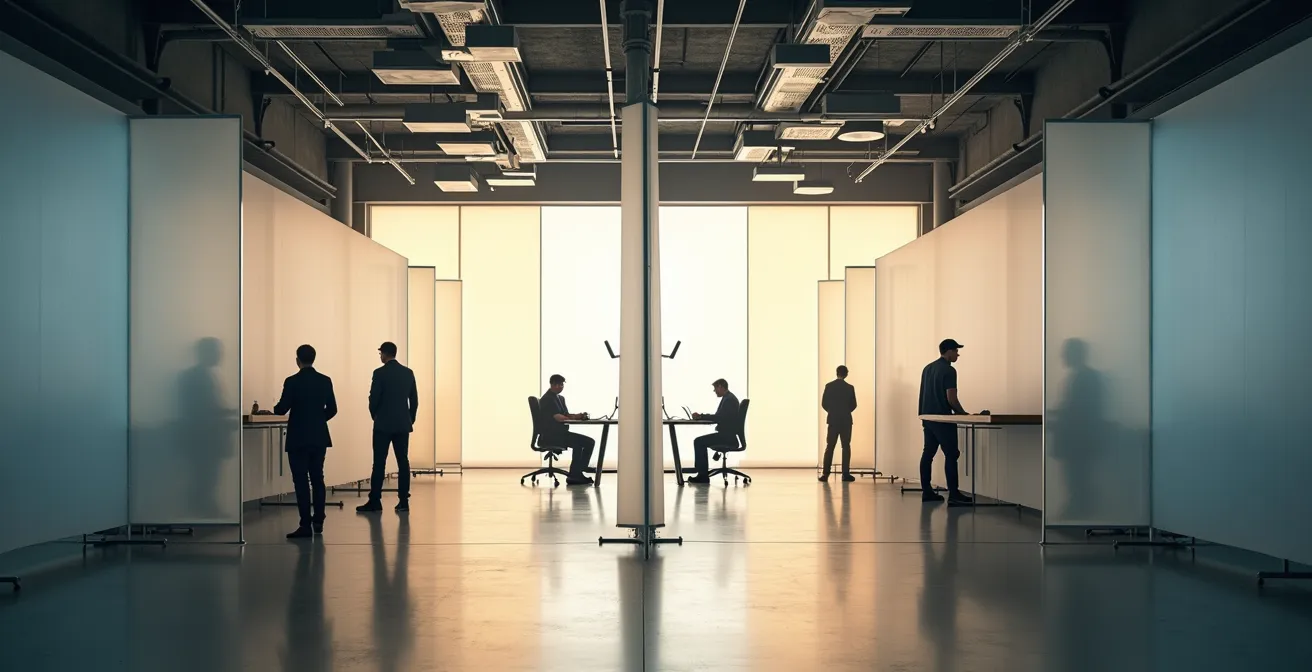
This approach involves using sound-absorbing materials like acoustic baffles (hanging from the ceiling), fabric-wrapped panels on walls, and even acoustic-rated carpeting and furniture. Furthermore, it means creating distinct acoustic zones. By separating quiet, focused work areas from collaborative, higher-energy zones using physical or architectural barriers, you give employees control over their auditory environment. Addressing noise is not a luxury; it’s a prerequisite for creating a high-performance workspace that attracts and retains precision-focused talent.
How to bring natural light into a windowless factory floor without glare?
For decades, the standard for industrial facilities has been uniform, shadowless fluorescent lighting. While functional for basic visibility, this static approach ignores a fundamental biological need: the human body’s reliance on the natural cycle of light. This is governed by our circadian rhythm, the internal 24-hour clock that regulates sleep, alertness, and hormone production. A lack of exposure to natural, dynamic light disrupts this rhythm, leading to fatigue, poor sleep quality, and reduced cognitive performance—all significant issues for shift workers and engineers requiring high levels of precision.
The benefits of natural light are well-documented; office workers with access to windows get better sleep and are more productive. Research shows that workplaces with good natural light can see productivity gains between 3% and 40%. But how can you replicate this in a vast, windowless factory? The answer lies in human-centric lighting technology. Modern LED systems can be programmed to mimic the natural progression of daylight, changing in both intensity and color temperature throughout the day. This is more than just a gimmick; it’s a way to provide the biological cues your team needs to stay alert and focused.
Technologies like virtual skylights and circadian lighting systems are game-changers for industrial settings. Virtual skylights are LED panels that use advanced optics to realistically recreate the look and feel of a real sky, providing a powerful psychological boost and a connection to the outdoors. Similarly, implementing a full circadian lighting system has been shown to deliver tangible results. For example, research from Signify demonstrates a potential 12% productivity gain from such implementations in office environments, a benefit that can be extrapolated to any space where cognitive performance is key. These technologies bring the benefits of natural light indoors without the associated problems of glare or solar heat gain, creating a healthier and more stimulating environment for all employees.
How to implement digital near-miss reporting that workers actually use?
Traditional near-miss reporting systems are broken. They often involve cumbersome paperwork, are perceived as a way to assign blame, and provide zero feedback to the reporter. For a digitally native, impact-driven generation like Gen Z, this analogue, one-way process is a non-starter. They won’t engage with a system they see as pointless bureaucracy. To create a system that workers actually use, you must shift the focus from a top-down compliance exercise to a bottom-up tool for empowerment and continuous improvement.
The key to adoption is making the process frictionless, transparent, and rewarding. “Frictionless” means using technology that’s already in their pocket. Placing QR codes on machinery that link to a simple, three-click mobile reporting interface removes all barriers to entry. No more searching for forms or logging into a clunky desktop portal. The report can be filed in seconds, right at the point of observation.
“Transparent and rewarding” means closing the feedback loop. Gen Z workers need to see that their input matters. When a report is submitted, an automated system should instantly acknowledge it. More importantly, the system should provide updates as the issue is addressed and, finally, confirm when a solution has been implemented. This creates a visible link between their action and a positive change in their work environment. Gamification elements, such as team-based leaderboards for quality reports or “Safety Win” features that highlight positive interventions, can further transform reporting from a chore into an engaging, team-oriented activity. Crucially, this must all be underpinned by a guaranteed no-blame culture, where reporting is seen as a proactive contribution to collective safety, not an act of whistleblowing.
Why 5000K lighting at 3 AM helps night shift alertnes?
To understand the power of lighting on a night shift, you first need to understand a unit of measurement: the Kelvin (K). Kelvin is used to describe the color temperature of light. A low Kelvin value (e.g., 2700K) produces a warm, yellowish-orange light, similar to a sunset or a traditional incandescent bulb. A high Kelvin value (e.g., 5000K or higher) produces a cool, crisp, blue-toned light that closely mimics natural daylight at noon. This distinction is not merely aesthetic; it’s a powerful biological signal.
The human brain’s alertness is heavily influenced by the pineal gland, which produces melatonin, the hormone that regulates sleep. The production of melatonin is suppressed by exposure to blue-wavelength light. When a night shift operator at 3 AM is working under dim, warm-toned light, their brain receives a signal that it’s time to wind down, increasing the risk of drowsiness, errors, and accidents. This is where 5000K lighting becomes a critical safety tool.
By bathing the primary work areas in cool, 5000K light during the graveyard shift, you are essentially sending a direct message to the operators’ brains: “It’s daytime. Stay alert.” This strategic use of blue-rich light helps to suppress melatonin production, promoting a state of heightened awareness and cognitive function precisely when the body’s natural circadian rhythm is encouraging sleep. This is a form of ‘biological hacking’ that uses light as a tool to enhance safety and performance. Conversely, break areas for the night shift should use warm-toned light (under 3000K) to allow workers to relax and de-stress without further disrupting their long-term sleep patterns.
Key takeaways
- Your physical workspace is not a passive backdrop; it is an active tool that either enhances or degrades the cognitive performance of your engineering talent.
- Focus on fundamental physiological needs—like reducing cortisol through noise control and supporting circadian rhythms with proper lighting—to achieve tangible gains in productivity and well-being.
- Empower Gen Z with autonomy and feedback. Zoned offices, sensory recharge areas, and transparent digital reporting systems show you trust and value their ability to manage their own work and environment.
Adaptive Industrial Lighting: Reducing Shift Fatigue and Energy Bills by 30%
We’ve seen how specific light temperatures can boost alertness on a night shift and how mimicking natural light can improve well-being. The ultimate expression of a human-centric design philosophy is to combine these principles into a single, intelligent system: adaptive industrial lighting. This is no longer the realm of science fiction; it is a practical and powerful tool for creating a truly high-performance work environment. An adaptive system doesn’t just turn on and off; it dynamically changes its intensity and color temperature throughout a 24-hour cycle to support both human biology and your bottom line.
This approach delivers two significant, intertwined benefits. First, it directly combats shift fatigue and improves safety. For the day shift, the system can track the natural path of the sun, starting with warmer tones, moving to a cool, alerting 5000K-6000K light at midday to peak productivity, and then warming again in the afternoon to help workers wind down. For the night shift, it can provide that crucial cool, alerting light during the main work hours while integrating with lighting in break areas to provide restorative, warm light. Companies that have implemented such circadian lighting systems have seen great employee feedback and significant productivity gains, proving the concept’s value.
Second, it delivers substantial energy savings, often in the range of 30% or more. An intelligent system integrates daylight harvesting, automatically dimming artificial lights near windows or skylights. It uses motion and presence sensors to ensure that light is only used when and where it’s needed, eliminating the massive waste of illuminating empty corridors or storage areas 24/7. This dual victory—enhancing human performance while drastically cutting operational costs—is the very definition of a strategic investment. It moves lighting from a simple utility expense to a core component of your firm’s ESG (Environmental, Social, and Governance) and talent retention strategy.
To begin transforming your facility into a talent magnet, the next logical step is to conduct a comprehensive workplace audit focused on these human-centric principles. Evaluating your current environment against these benchmarks of noise, light, and restorative space will provide a clear roadmap for strategic investment and a decisive advantage in attracting the next generation of engineering talent.
Frequently Asked Questions on Attracting Gen Z Engineers
How can we ensure anonymous reporting while maintaining accountability?
Implement blockchain-based reporting systems that create immutable, time-stamped records while preserving the reporter’s anonymity through advanced cryptographic techniques. Accountability is maintained through the system’s transparent and unalterable tracking of how and when the report is addressed by management, without exposing the individual who submitted it.
What incentives work best for Gen Z workers to report near-misses?
Gamification is highly effective. This includes team-based leaderboards with monthly rewards for the most impactful reports, instant digital micro-rewards (like points or badges), and, most importantly, a visible impact tracker. Showing workers a real-time dashboard of how their reports have led to specific safety improvements creates a powerful sense of purpose and agency.
How quickly should management respond to near-miss reports?
Speed is critical to maintaining engagement. Best practice, using modern systems, is an instant, AI-powered acknowledgement of receipt. The report should then be automatically categorized and assigned within one hour. A preliminary action plan or status update should be communicated back to the reporter (or the team) within 24 hours to demonstrate urgency and close the feedback loop.