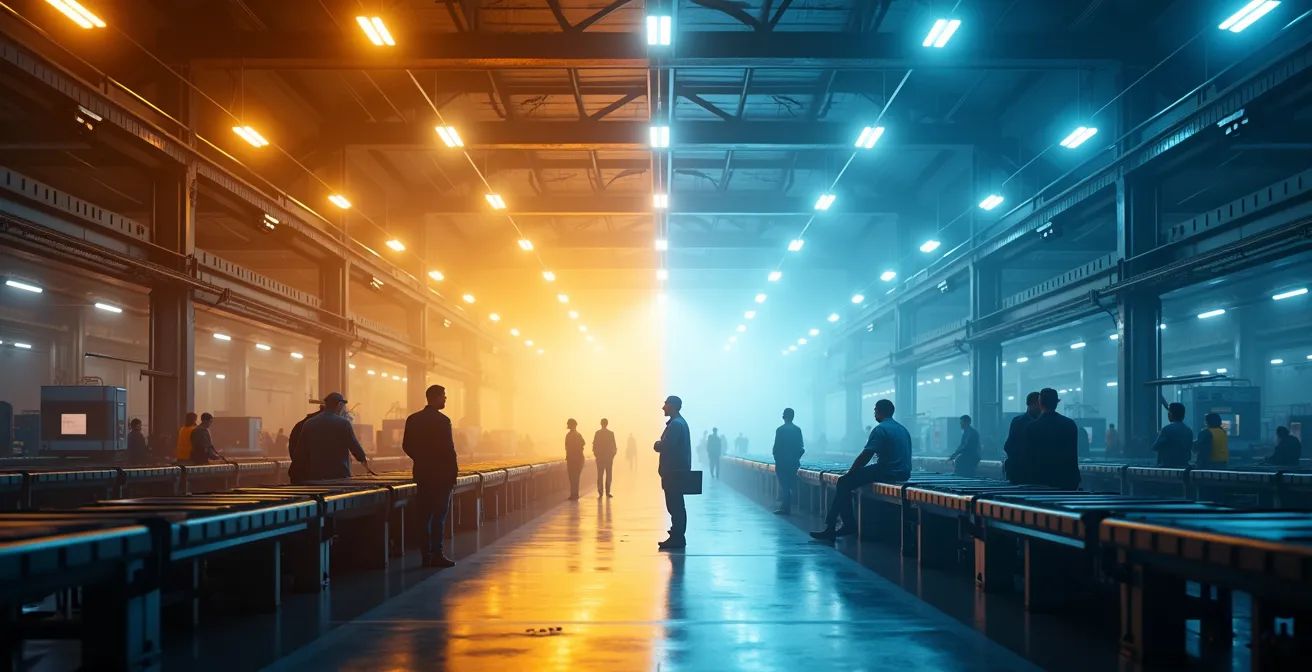
Treating industrial light as a strategic biological tool, not just an electrical expense, is the key to unlocking hidden productivity and safety on the factory floor.
- Tuning light color and intensity to match human circadian rhythms directly combats night shift fatigue and reduces costly errors.
- Modern wireless controls and smart fixtures allow for a complete human-centric lighting retrofit without the need for expensive and disruptive factory-wide rewiring.
Recommendation: Shift from a ‘lumens per watt’ mindset to a ‘right light, right time’ strategy to see simultaneous improvements in worker alertness, safety, and energy efficiency.
For any facilities manager in a 24/7 operation, the 3 AM slump is a familiar and costly problem. It’s the time when focus wavers, mistakes happen, and the fourth cup of coffee fails to make a dent. The conventional responses are often limited to procedural changes, more training, or a simple upgrade to “brighter” LED fixtures. While well-intentioned, these solutions only scratch the surface because they fail to address the root cause of the issue: a profound disconnect between the factory environment and the workers’ own biology.
The common approach is to treat lighting as a static utility—a fixed cost to be minimized. But what if the true key to unlocking productivity and safety isn’t just about how much light you provide, but what *kind* of light you provide, and when? The core of the problem lies in circadian disruption. Our bodies are wired to respond to the daily cycle of the sun, and traditional, unchanging factory lighting actively works against this internal clock, especially during night shifts. This leads to fatigue, reduced cognitive function, and an increase in human error.
This guide offers a different perspective. We will explore how to treat light as a dynamic, biological tool—a “nutrient” for alertness and well-being. By strategically managing color temperature, intensity, and placement, you can actively support your team’s natural rhythms, creating a safer and more productive environment. This article will deconstruct the science, explore the practical technology for implementation, and demonstrate how a human-centric lighting strategy is not a cost, but a powerful investment in operational excellence.
To navigate this crucial topic, we have structured this guide to address the most pressing questions a facilities manager faces, from the underlying science to the practicalities of installation and the long-term benefits for both your people and your bottom line. Explore the sections below to build a comprehensive understanding of adaptive industrial lighting.
Summary: A Strategic Guide to Adaptive Industrial Lighting
- Why 5000K lighting at 3 AM helps night shift alertnes?
- How to install smart dimming without rewiring the entire factory roof?
- High bay vs Low bay: which fixture provides better uniformity for assembly?
- The flicker risk in cheap LEDs that causes migraines and machinery accidents
- How to place occupancy sensors so lights don’t turn off on forklift drivers?
- How to design ‘recharge zones’ that actually reduce operator fatigue?
- Why confusing dashboard layouts are a primary cause of ‘human error’?
- The Recruitment Crisis: Can Better Workspace Design Attract Gen Z Engineers?
Why 5000K lighting at 3 AM helps night shift alertnes?
The human body runs on an internal 24-hour clock known as the circadian rhythm. This biological process governs our sleep-wake cycles, hormone release, and alertness levels. One of its most powerful regulators is light. Specifically, high-intensity light rich in blue wavelengths signals to the brain that it’s daytime, triggering the suppression of melatonin, the hormone that promotes sleep. This process is called entrainment—the synchronization of our internal clock to the external environment.
During a night shift, particularly around the 2-4 AM window, a worker’s circadian rhythm is at its lowest point, screaming for sleep. This is where standard, warm-colored lighting fails. It does nothing to counteract this powerful biological drive. However, introducing light with a high color temperature, such as 5000K to 6000K, mimics the properties of midday sun. This “blue-enriched” light sends a strong “wake up” signal to the brain, actively suppressing melatonin production and boosting alertness, cognitive function, and reaction times precisely when they are most likely to dip.
Implementing this isn’t about blasting bright light all night. A strategic, dynamic approach yields the best results. A well-designed schedule can ease workers into their shift and prepare them for the commute home, minimizing disruption to their sleep cycle once they leave the facility. The key is to think of light not as simple illumination, but as a timed biological input.
- Start the shift at a neutral 4000K to ease the transition from home lighting.
- Ramp up to a bright 5000K-6000K during the circadian low point (typically 2-4 AM).
- Maintain this bright, cool light through the peak fatigue hours to sustain alertness.
- Gradually reduce the color temperature to a warmer 3500K in the final hour before the shift ends to prepare the body for rest.
- Consider providing workers with blue-blocking glasses for their commute home to prevent daylight from further disrupting their ability to sleep.
How to install smart dimming without rewiring the entire factory roof?
The idea of a “dynamic” lighting system often conjures images of a massive, disruptive, and costly rewiring project. For a 24/7 facility, the operational downtime alone can make such an upgrade seem impossible. Fortunately, the evolution of wireless lighting controls (WLC) has completely changed the game. It is now entirely feasible to implement a sophisticated smart dimming and color-tuning system by retrofitting your existing infrastructure, not ripping it out.
Modern systems operate using small, wireless nodes that can be attached directly to individual or groups of LED fixtures. These nodes communicate with a central gateway or controller using reliable wireless protocols, eliminating the need to run new control wires across vast ceiling expanses. Installation can be done fixture-by-fixture or section-by-section, often by a technician on a scissor lift, minimizing disruption to floor operations. This approach dramatically reduces installation time, labor costs, and operational downtime.
This paragraph introduces the concept of wireless retrofitting. To better understand this process, the image below shows a technician performing such an installation.
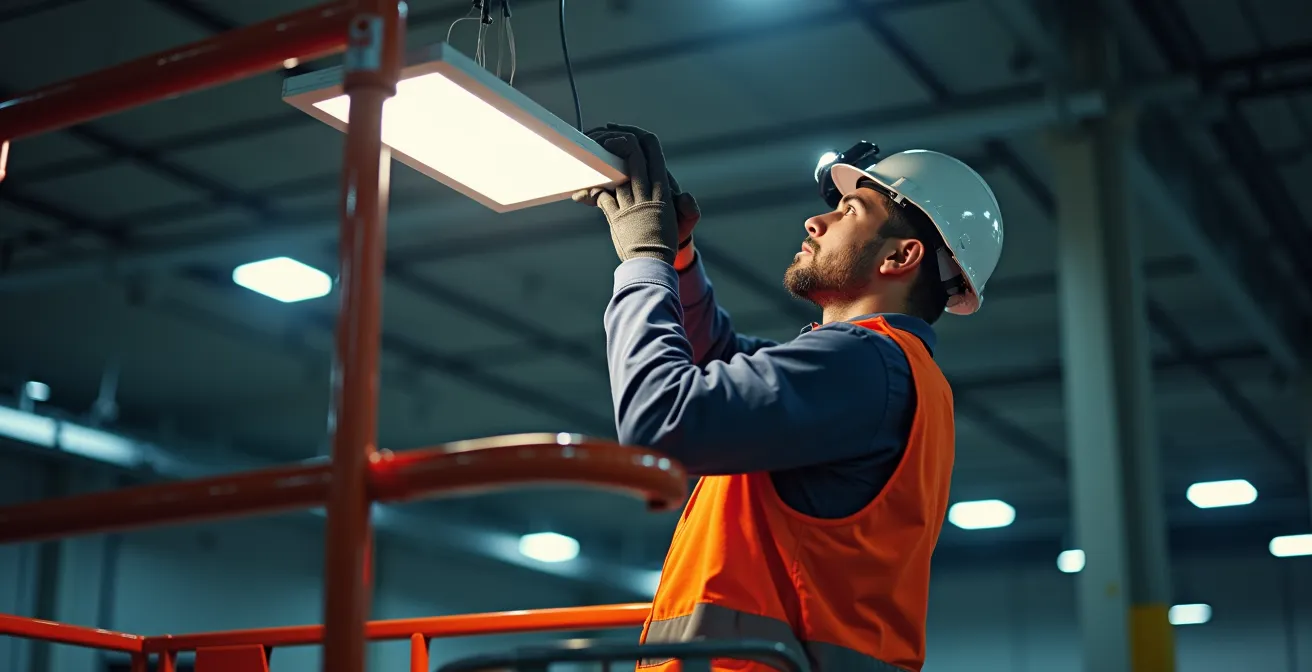
As this image demonstrates, the process involves adding a component to the existing fixture, a far less invasive procedure than a full rewiring. Choosing the right wireless protocol is crucial for ensuring reliability in a potentially noisy industrial environment. Different protocols offer trade-offs in range, scalability, and resistance to interference.
Case Study: The Rapid ROI of a Wireless Retrofit
The financial benefits extend beyond just the installation cost savings. By enabling advanced control strategies, a wireless retrofit unlocks significant productivity gains. A study of garment factories that adopted LED lighting found that when accounting for the co-benefits of improved productivity and reduced errors, the payback period for the investment plummeted. Specifically, the payback period dropped from over 3.5 years to less than eight months. The average factory in the study gained approximately $2,880 in annual energy savings, but an additional $7,500 in productivity gains, showcasing the powerful business case for adaptive lighting.
Here is a comparison of the most common wireless protocols used in industrial settings to help you decide which technology best fits your facility’s scale and operational needs.
| Protocol | Range | Interference Resistance | Scalability |
|---|---|---|---|
| Zigbee Mesh | 10-100m | Moderate | High (65,000 nodes) |
| Bluetooth Mesh | 10-50m | Good | Medium (32,000 nodes) |
| LoRaWAN | 2-5km | Excellent | Very High |
High bay vs Low bay: which fixture provides better uniformity for assembly?
Once you’ve committed to an adaptive system, fixture selection becomes the next critical step. The choice between high bay and low bay lighting isn’t just about the height of your ceiling; it’s about the quality and uniformity of light on the work surface. For detailed assembly tasks, uniformity is paramount. Pockets of shadow and pools of intense light create visual inconsistency, forcing workers’ eyes to constantly readjust. This increases cognitive load and can lead to errors in quality control and precision tasks.
High bay fixtures are designed to project light over long distances from ceilings typically higher than 20 feet. While powerful, they can create a “scalloping” effect on vertical surfaces and may produce harsh shadows if not spaced correctly. Low bay fixtures, used for ceilings under 20 feet, distribute light more broadly and from a closer proximity. For a dedicated assembly line or a quality inspection station, multiple low bay fixtures can provide a much more even and diffuse layer of light, minimizing shadows and glare.
The goal is to achieve optimal visual ergonomics. This means delivering the right amount of light exactly where it’s needed. Industry standards provide clear targets for this. For example, a recent industry report specifies that while general equipment observation may only require 30 foot-candles (fc), close inspection tasks demand up to 100 fc for optimal visibility and accuracy. Achieving this level of brightness without creating glare is the central challenge that fixture selection and placement must solve.
Tunable LED lighting allows adjustment not only of brightness but also of color temperature, so that lighting can be optimized for specific tasks
– Interact Lighting Research Team, Lighting for well-being in industry
Ultimately, the best solution might be a hybrid approach: high bay fixtures for general warehouse aisles and circulation areas, supplemented by precisely placed, tunable low bay fixtures directly over assembly lines and workstations. This allows you to deliver high-intensity, uniform light for critical tasks without over-lighting the entire facility.
The flicker risk in cheap LEDs that causes migraines and machinery accidents
In the rush to save energy, many facilities opt for the cheapest LED fixtures available. This is a critical mistake. Low-quality LEDs carry a hidden but significant danger: invisible flicker. While the light may appear constant to the naked eye, the LED is actually turning on and off at a very high frequency. In poorly designed drivers, this frequency is too low, creating a neurological and safety hazard. This flicker is a known trigger for eye strain, fatigue, and even severe migraines in sensitive individuals.
The risk escalates dramatically around rotating equipment. A low-frequency flicker can create a stroboscopic effect, where a spinning lathe, fan, or gear can appear to be stationary or moving slowly. An operator, believing the machine is safe, might reach in and suffer a catastrophic injury. This is not a theoretical risk; it’s a documented phenomenon that makes flicker one of the most serious aspects of lighting quality and safety.

The health impacts are significant and widespread. Beyond the acute safety risk of the stroboscopic effect, poor lighting quality is a major contributor to worker discomfort and absenteeism. In fact, comprehensive studies on workplace lighting health effects reveal that up to 45% of workers have experienced headaches directly attributable to inadequate or poor-quality lighting. Investing in flicker-free fixtures is not a luxury; it’s a fundamental requirement for a safe and healthy workplace.
Your Action Plan: The Flicker-Free LED Specification Checklist
- Verify that the “Percent Flicker” is below 5% at all dimming levels, not just at full brightness.
- Check that the “Flicker Index,” a more comprehensive measure, is under 0.02.
- Confirm that the product complies with IEEE 1789-2015 recommendations for low-risk flicker.
- Request flicker measurement data from the manufacturer across the full 0-100% dimming range.
- Ensure the driver operates at a frequency well above 1250Hz to be safely outside the human perception range.
- Always test a sample fixture with your existing dimming systems before committing to a large-scale purchase to ensure compatibility.
How to place occupancy sensors so lights don’t turn off on forklift drivers?
Occupancy sensors are a cornerstone of energy efficiency, but a poorly implemented system can create more frustration and safety risks than it solves. The classic complaint is the “lights out” problem: a sensor fails to detect a forklift operator who is briefly stationary while loading a pallet, plunging the area into darkness. This happens because the most common and inexpensive sensors, Passive Infrared (PIR), are not suited for every industrial application.
PIR sensors work by detecting body heat and movement. They are excellent for offices or small, defined spaces where people are walking. However, they struggle to detect a person who is sitting still, such as an operator inside the cab of a forklift or a technician at a workstation. This limitation is what causes the frustrating and unsafe “lights out” scenarios. For large, open warehouse spaces with both pedestrian and vehicle traffic, a different technology is required.
Microwave or Doppler sensors are often the superior choice for industrial environments. Unlike PIR, they work by emitting low-power microwaves and detecting a shift in the frequency of the return signal caused by motion. This allows them to detect the movement of a vehicle, not just a person, and they can cover much larger areas. The most robust solutions use Dual Technology sensors, which combine a PIR sensor with a microwave sensor. The light only turns on when both technologies detect presence, reducing false activations, and stays on as long as at least one technology detects presence, eliminating false deactivations.
To ensure you select the right technology for each area of your facility, consider this breakdown of sensor types and their ideal applications.
| Sensor Type | Detection Method | Best For | Limitations |
|---|---|---|---|
| PIR (Passive Infrared) | Body heat | Small areas, offices | Can miss seated drivers |
| Microwave/Doppler | Motion of objects | Large warehouses | Detects vehicle movement |
| Dual Technology | PIR + Microwave | High accuracy needs | Higher cost |
How to design ‘recharge zones’ that actually reduce operator fatigue?
An effective fatigue management strategy extends beyond the production floor. The break room, or “recharge zone,” is a critical component. Too often, these spaces are afterthoughts, lit with the same harsh, overhead fluorescent or LED fixtures as the rest of the facility. This is a missed opportunity. To truly allow an operator to rest and mentally disengage, the lighting environment must be a deliberate contrast to the work area, signaling to the brain that it is time to relax.
This is where the principles of circadian lighting are applied in reverse. Instead of using cool, blue-enriched light to promote alertness, recharge zones should feature warm, low-intensity light with a color temperature between 2200K and 2700K. This mimics the calming light of a sunset or a campfire, promoting relaxation and helping the body’s natural rhythm without inducing sleepiness. This concept is a cornerstone of biophilic design, which seeks to connect humans with nature within the built environment.
A well-designed recharge zone provides a true sensory break, which has a measurable impact on performance once the worker returns to their station. According to modern research, a combination of proper task lighting and well-designed break areas can lead to a 6% to 15% increase in worker productivity. Creating an effective recharge zone involves more than just the lights:
- Install tunable lighting that can be set to a warm 2200K-2700K color temperature.
- Incorporate living green walls or potted plants to introduce natural elements.
- Use natural materials like wood furnishings and stone textures.
- Consider sound masking with gentle nature sounds or a water feature to block out factory noise.
- Design small privacy pods or nooks where an individual can take a 5-minute micro-break without social pressure.
- Position seating to face away from sight lines to the production floor to encourage mental disconnection.
Why confusing dashboard layouts are a primary cause of ‘human error’?
In a modern control room, “human error” is often a symptom of poor environmental design, not operator incompetence. The human-machine interface is not just the screen; it’s the entire environment in which information is consumed. A primary, and often overlooked, cause of cognitive strain is glare and reflections on control dashboards, monitors, and screens. When an operator has to squint, shift their body, or shield their eyes to read critical data, their cognitive load increases dramatically.
This extra mental effort consumes finite cognitive resources that should be dedicated to decision-making and problem-solving. Poorly positioned overhead lights are the main culprit. They create “veiling reflections,” a subtle, washed-out glare that reduces contrast and makes text and graphics difficult to read. This single factor can be the root cause of missed alarms, incorrect data entry, and delayed responses in critical situations.
Veiling reflections from poorly positioned overhead lights can obscure critical information, increasing cognitive load and forcing operators into awkward postures
– Industrial Ergonomics Research, Effects of Lighting Quality on Working Efficiency
Solving this requires a specialized approach to control room lighting. The goal is to illuminate the space and the task surfaces without directing any light onto the vertical screens. This is a core tenet of advanced visual ergonomics. It’s not about making the room darker, but about lighting it more intelligently. Implementing best practices can drastically reduce visual fatigue and lower the risk of error.
- Maintain a Unified Glare Rating (UGR) below 19, the standard for demanding visual tasks.
- Use indirect lighting fixtures that bounce light off the ceiling or asymmetric fixtures that direct light away from screens.
- Carefully position all light sources to ensure they are outside the reflection angle for all primary displays.
- Consider implementing ambient status lighting (e.g., a subtle amber glow throughout the room for system warnings) to reduce reliance on screen-only alerts.
- Provide individually adjustable and dimmable task lighting at each workstation so operators can customize it to their preference.
Key takeaways
- Light is a biological tool: strategically managing light’s color and timing directly impacts worker alertness and reduces fatigue-related errors.
- Wireless retrofits are a reality: you can implement a sophisticated, adaptive lighting system without the cost and disruption of a full-scale rewiring project.
- Quality over quantity: flicker-free fixtures and uniform light distribution are more critical for safety and productivity than raw brightness alone.
The Recruitment Crisis: Can Better Workspace Design Attract Gen Z Engineers?
In today’s competitive labor market, attracting and retaining skilled talent, especially younger Gen Z engineers and technicians, is a major challenge for industrial companies. While compensation and benefits remain crucial, the quality of the work environment itself has become a powerful differentiator. A factory that is perceived as dark, dated, and uncomfortable is at a significant disadvantage. A modern, human-centric workspace is no longer a perk; it’s a strategic asset in the war for talent.
Implementing an adaptive, human-centric lighting system sends a clear and powerful message: this is a company that invests in its people’s well-being and safety. It demonstrates a commitment to providing a modern, comfortable, and technologically advanced workplace. For a generation that places a high value on mental health and work-life balance, this can be a deciding factor. They are not just looking for a job; they are looking for a supportive environment where they can do their best work.
Furthermore, this approach aligns perfectly with the strong sustainability values held by many younger workers. A smart LED lighting system is inherently energy-efficient. On a basic level, LED technology statistics show up to 75% less energy consumption than traditional incandescent and significant savings over fluorescent and HID lighting. When combined with smart controls like occupancy sensing and daylight harvesting, the energy savings can be even more substantial. Highlighting this commitment to sustainability in your recruitment efforts can significantly boost your appeal as an employer of choice.
Investing in a better workspace is a direct investment in your brand as an employer. It’s a tangible, visible demonstration that you are a forward-thinking company that values both its people and the planet. In the face of a recruitment crisis, creating an environment that is not only productive but also genuinely pleasant and healthy to work in may be your most effective long-term strategy.
To implement these strategies effectively and transform your facility into a model of safety and efficiency, the next logical step is to conduct a professional lighting audit to identify the most impactful upgrade opportunities.