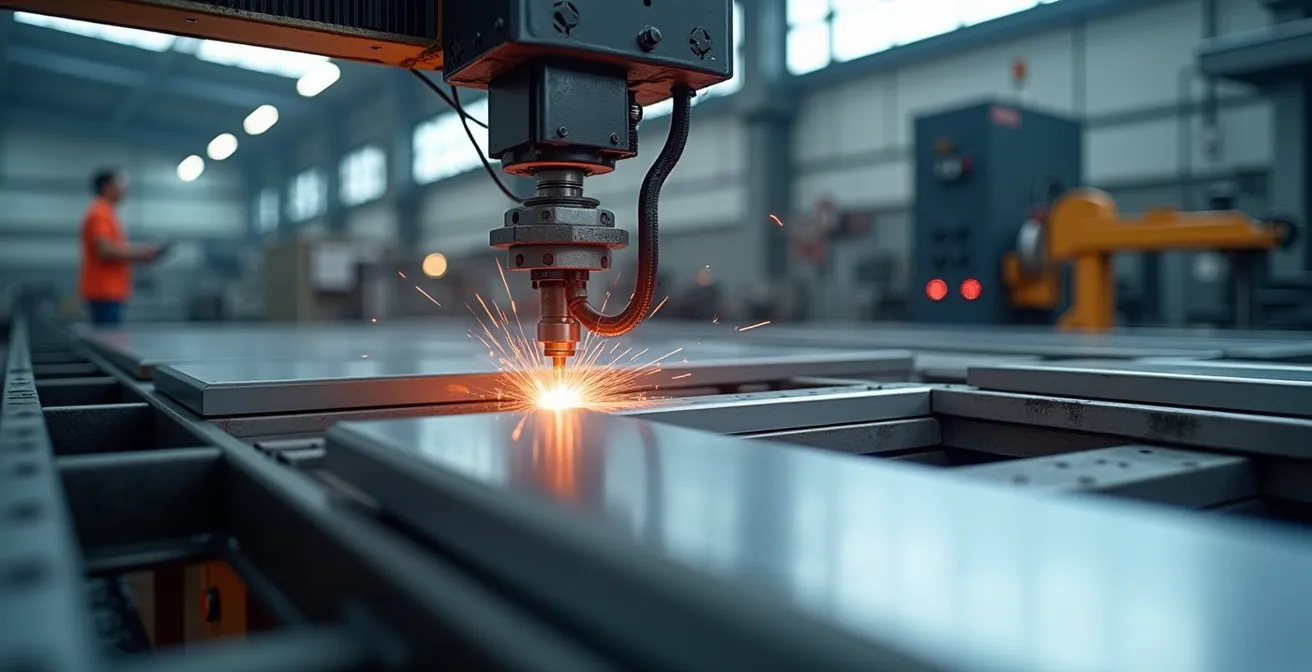
Switching to solid-state welding is the single most impactful step to decarbonise fabrication, slashing energy consumption and eliminating health risks at the source.
- It avoids the massive thermal inefficiency of melting metal, which is the root cause of high energy use in traditional arc welding.
- It completely removes the cost, supply chain vulnerability, and carbon footprint of consumables like shielding gas and filler wire.
Recommendation: Assess your high-volume aluminium and repetitive welding tasks as prime candidates for a pilot conversion to validate savings and performance.
As a sustainability manager, you are tasked with decarbonising every corner of your facility. While progress is made in lighting, HVAC, and logistics, the fabrication workshop often remains a stubborn source of high energy consumption and environmental health risks. The intense heat, bright arcs, and visible fumes of traditional welding seem an unavoidable cost of manufacturing. The common response involves incremental gains: slightly more efficient inverter power sources or more robust fume extraction systems.
But what if these are just minor optimisations of a fundamentally inefficient technology? What if the real leap forward in green manufacturing isn’t about better ways to melt metal, but in avoiding the need to melt it altogether? This is the paradigm shift offered by solid-state joining processes like Friction Stir Welding (FSW). This technology doesn’t treat energy waste and toxic fumes as problems to be managed; it eliminates them by design by changing the fundamental physics of the joining process.
This article provides the business case for this strategic shift. We will break down precisely how moving away from thermal processes delivers compounding benefits in energy reduction, operational cost, worker safety, and even the viability of your on-site renewable energy strategy. It’s time to move beyond containment and toward elimination.
This guide provides a comprehensive overview of the strategic advantages of adopting solid-state welding. Below, you will find a detailed breakdown of each key area, from direct energy savings to systemic facility-wide benefits.
Summary: Green Welding: How Solid-State Processes Cut Energy Bills and Fumes?
- Why solid-state joining uses 80% less energy than arc welding?
- How to remove shielding gas and filler wire costs from your budget?
- Solid-state vs MIG: which produces a ‘machined-look’ finish without grinding?
- The hexavalent chromium risk: why moving away from arc welding saves lungs
- Can you convert existing CNC milling machines into friction stir welders?
- Biomass boilers vs Industrial Heat Pumps: which makes sense for 5,000m² halls?
- How to recapture 70% of waste heat from your extraction system?
- Solar or Wind? Choosing the Right Renewable System for UK Manufacturing Sites
Why solid-state joining uses 80% less energy than arc welding?
The core reason for the immense energy consumption of arc welding is simple: thermal inefficiency. Processes like MIG (GMAW) or TIG rely on creating an electrical arc hot enough to melt both the parent material and a filler wire into a liquid pool. This phase change from solid to liquid and back again consumes a massive amount of energy, much of which is lost to the surrounding environment as radiant heat. It is an inherently wasteful approach to joining two components.
Solid-state processes, particularly Friction Stir Welding (FSW), bypass this inefficiency entirely. Instead of melting, FSW uses a rotating tool to generate frictional heat and mechanically “stir” the two pieces of metal together in a plasticized, solid state. No melting occurs. This fundamental difference drastically reduces the energy required. A 2015 comparative study on aluminium alloys found that FSW consumed 42% less energy than GMAW for joints of equivalent strength. The energy is used precisely at the joint line, not wasted heating the entire component.
This advantage is not just theoretical; it represents a direct and significant reduction in your workshop’s electricity bill. When you eliminate the need to melt metal, you eliminate the primary driver of energy waste in your joining operations, creating a direct path to lower operational costs and a smaller carbon footprint.
The following table illustrates how the baseline energy consumption of FSW compares to common, energy-intensive arc welding processes, highlighting the inherent advantage of avoiding a liquid phase.
| Process Type | Energy Consumption | Environmental Impact | Filler Material Required |
|---|---|---|---|
| Friction Stir Welding (FSW) | Baseline (100%) | Minimal – no fumes | None |
| Gas Metal Arc Welding (GMAW) | 142% of FSW | High – fumes, gases | Yes – up to 80% impact |
| Shielded Metal Arc (SMAW) | 160% of FSW | Very High – heavy fumes | Yes – electrodes |
| Tandem GMAW (Advanced) | 124% improvement over standard GMAW | Moderate – reduced fumes | Yes – dual wire |
How to remove shielding gas and filler wire costs from your budget?
Beyond direct energy costs, a significant portion of a welding budget is consumed by consumables: shielding gases like argon and CO2, and spools of filler wire. These are not just material costs; they represent a complex and vulnerable supply chain you must manage, with expenses for cylinder rental, storage, transport, and inventory management. In an era of volatile supply chains and prices, this reliance is a strategic risk.
Solid-state welding offers a simple, powerful solution: designed-out waste. Because FSW is a solid-state, mechanical process, it requires zero filler material. The parent materials are joined directly. Furthermore, because there is no electrical arc or molten pool to protect from the atmosphere, the need for shielding gas is completely eliminated. The process can be performed in ambient air, removing an entire category of cost and complexity from your operations.
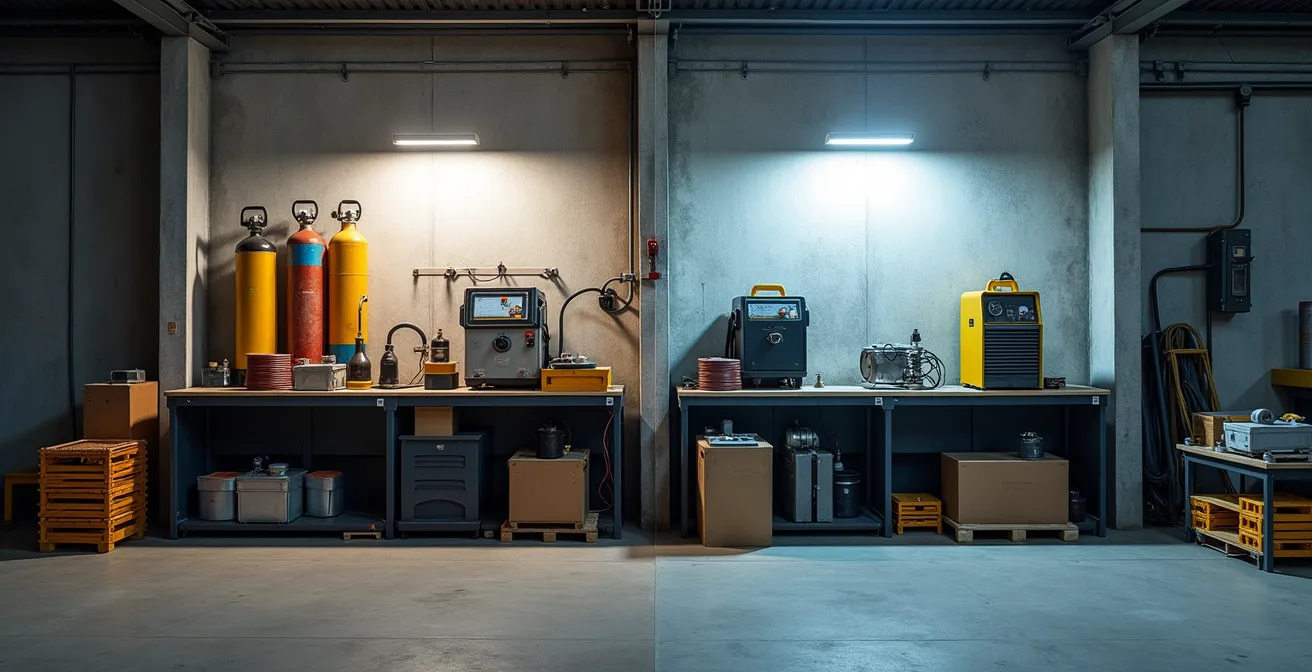
This transformation declutters the workshop, frees up floor space previously dedicated to cylinder and wire storage, and simplifies procurement. More importantly, it insulates your production from the price volatility and supply disruptions associated with industrial gases and specific metal alloys for filler wires. By removing consumables, you are not just cutting costs; you are building a more resilient and streamlined manufacturing process.
Your Action Plan: Eliminating Consumable Costs with Solid-State Welding
- Audit Consumption: Quantify your current annual spend on shielding gases (Argon, CO2, etc.) and filler materials for all welding stations.
- Calculate Hidden Costs: Inventory the “soft” costs associated with consumables, including cylinder rental fees, storage space, inventory management labor, and transport logistics.
- Identify Prime Candidates: Pinpoint welding applications best suited for FSW conversion, focusing first on high-volume aluminium alloys (like 2000, 6000, 7000 series) and repetitive production runs.
- Launch a Pilot Program: Implement FSW on a targeted 30% of suitable applications to validate the projected cost savings while ensuring production capacity is maintained.
- Update Procurement Strategy: Document the elimination of consumable-related risks, such as price volatility and supply chain disruptions, in your official procurement and risk management plans.
Solid-state vs MIG: which produces a ‘machined-look’ finish without grinding?
The quality of a finished product is as important as the efficiency of its production. A major hidden cost in traditional arc welding is the need for post-weld finishing. The melting and solidification process of MIG welding creates spatter, uneven beads, and thermal distortion, which often require time-consuming grinding, sanding, or straightening to meet aesthetic or dimensional specifications. This secondary operation adds labor costs, consumes energy, and creates another source of workplace dust and noise.
This is where the process purity of solid-state welding creates another significant advantage. FSW produces a clean, smooth, and highly consistent weld seam that often resembles a machined surface. Because there is no molten metal, there is no spatter. The low heat input and mechanical nature of the process result in minimal thermal distortion. As noted by experts at Grenzebach Engineering, this delivers a superior and predictable outcome:
FSW ensures minimal thermal distortion and consistently high-quality welds particularly effective for aluminum alloys considered non-weldable or difficult to weld.
– Grenzebach Engineering, What is friction stir welding? Technical Overview
This “as-welded” quality means that for many applications, the need for post-weld grinding is completely eliminated. This directly translates into significant labor savings and increased throughput. In fact, by removing secondary processing steps, research indicates that advanced welding processes can achieve over a 50% reduction in process time. For a sustainability manager, this is a powerful dual benefit: a greener process that also drives Lean manufacturing principles by eliminating a non-value-added step.
The hexavalent chromium risk: why moving away from arc welding saves lungs
Perhaps the most compelling argument for transitioning away from traditional welding lies in occupational health and safety. The high-temperature arc in processes like MIG, TIG, and stick welding vaporizes metals, creating a plume of toxic fumes. One of the most dangerous components of this fume, especially when welding stainless steel, is hexavalent chromium [Cr(VI)], a known human carcinogen.
The risk is not minor. According to the National Institute for Occupational Safety and Health (NIOSH), an estimated 558,000 workers in the U.S. are exposed to hexavalent chromium annually. Managing this risk requires expensive and energy-intensive ventilation and fume extraction systems, as well as rigorous personal protective equipment (PPE) protocols. Despite these measures, the risk of exposure remains.
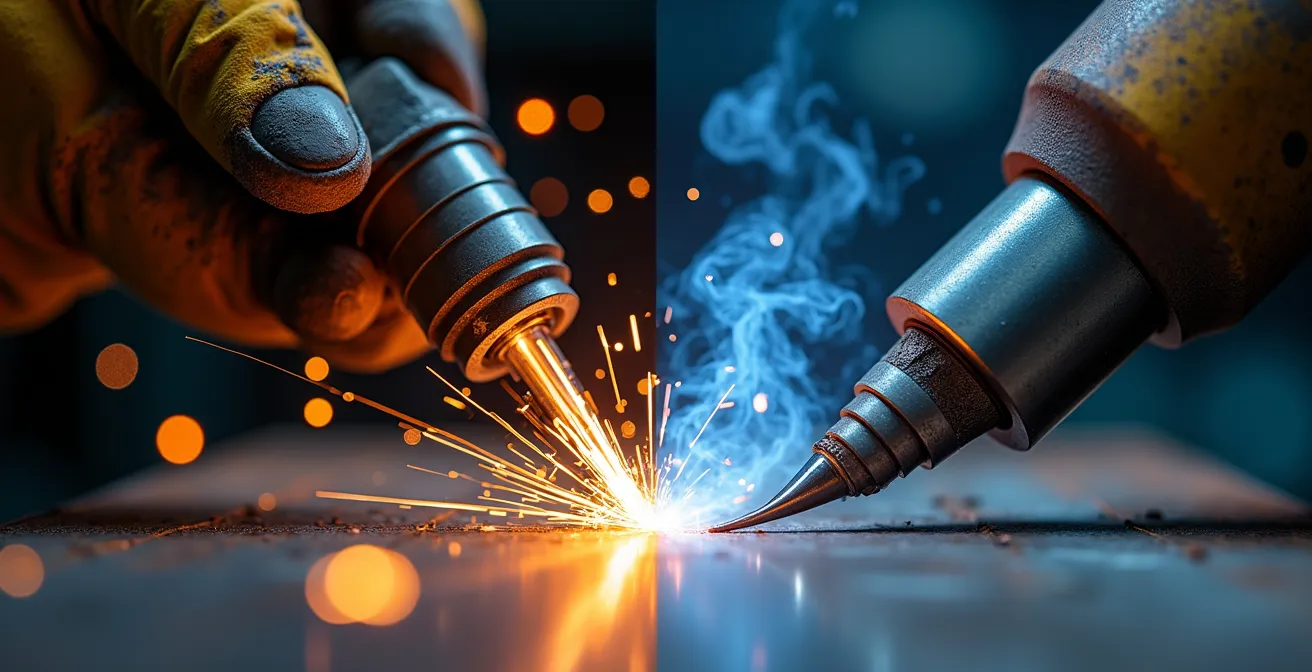
Solid-state welding eliminates this hazard at its source. Because FSW operates below the melting point of the materials, it does not create vaporization and therefore generates zero welding fumes. This isn’t a reduction in risk; it is a complete eradication of the primary hazard. Adopting FSW means you are no longer managing a toxic substance—you have removed it from your process entirely. This fundamentally changes the safety profile of your workshop, reduces liability, and simplifies compliance with occupational health standards.
The table below, based on data from regulatory bodies like OSHA, provides a stark contrast between the hazardous substances generated by arc welding and their complete absence in solid-state processes.
| Hazardous Substance | Arc Welding Exposure | Health Effects | Solid-State Welding |
|---|---|---|---|
| Hexavalent Chromium [Cr(VI)] | 5 μg/m³ PEL limit | Lung cancer, respiratory damage | Zero exposure |
| Manganese fumes | Present in steel welding | Neurological effects | Not generated |
| Nickel oxides | Common in stainless steel | Respiratory sensitization | Not produced |
| Zinc oxides | From galvanized steel | Metal fume fever | Eliminated |
| Ozone | Generated by UV arc | Respiratory irritation | No UV generation |
Can you convert existing CNC milling machines into friction stir welders?
A common barrier to adopting transformative technology is the perceived high capital expenditure (CAPEX) for new, dedicated machinery. For many managers, the idea of replacing an entire fleet of welding stations is a non-starter, regardless of the long-term benefits. However, a key advantage of Friction Stir Welding is its compatibility with existing manufacturing platforms, offering a lower-risk, phased adoption pathway.
Robust, high-stiffness CNC milling machines and industrial robots already possess the precise motion control and structural rigidity required for the FSW process. This opens the door to retrofitting. Specialized, self-contained FSW heads can be integrated into your existing CNC equipment, effectively converting a milling machine into a dual-use platform capable of both machining and solid-state welding. This approach dramatically lowers the initial investment and allows you to test and scale the technology using assets you already own.
Case Study: FSW Retrofit on CNC Platforms
Modular FSW solutions, such as those demonstrated in Stirweld’s FSW-as-a-Head implementations, have proven the success of retrofitting existing CNC machines and robots. These heads integrate all necessary force control, tool management, and process monitoring. This provides a much lower-risk entry point than purchasing a dedicated FSW machine. For companies replacing a portion of their conventional welding operations, these case studies show a typical return on investment (ROI) within 18-24 months, making it a financially viable strategy for prototyping and low-to-medium volume production.
This retrofit strategy allows you to begin your decarbonization journey without a massive upfront capital outlay. You can start with a single machine, validate the process and savings on a specific product line, and build a powerful internal business case for further investment. It turns a revolutionary process change into an evolutionary, manageable project.
Biomass boilers vs Industrial Heat Pumps: which makes sense for 5,000m² halls?
The debate over the most sustainable way to heat large industrial spaces often centers on a choice between technologies like biomass boilers and large-scale heat pumps. While this is a valid consideration, it overlooks a more fundamental and impactful first step: drastically reducing the building’s overall heat load. This is a prime example of systemic decarbonization, where changing a core manufacturing process has cascading benefits for the entire facility.
Traditional arc welding is a major contributor to a workshop’s heat load. As a thermally inefficient process, it radiates enormous amounts of waste heat into the surrounding environment. In warmer climates or seasons, this requires energy-intensive HVAC systems to work harder to cool the space. In colder climates, this “free” heat is often lost through mandatory fume extraction systems. In fact, research on friction welding efficiency reveals that 28-80% of energy can be lost as parasitic waste in conventional processes.
By switching to solid-state welding, which generates significantly less ambient heat, you fundamentally lower the baseline heating and cooling demand of your facility. This makes your entire HVAC system more efficient. The required size and capacity of a new heat pump or boiler can be reduced, lowering CAPEX. As a research team noted in a technical report on the topic, the benefits are clear and holistic:
FSW can be considered a green and energy-efficient technique without deleterious fumes, gas, radiation, and noise.
– Research Team, Science.gov Technical Report on Solid State Welding
Before you invest in a new heating system, the most strategic move is to first reduce the heat you need to manage. Adopting a low-heat process like FSW means your subsequent investment in a heat pump or boiler will be smaller, more efficient, and more cost-effective for years to come.
How to recapture 70% of waste heat from your extraction system?
The question of recapturing waste heat from fume extraction systems is a common one in efforts to improve facility efficiency. The concept seems simple: use an air-to-air exchanger to capture the thermal energy from the exhausted air and use it to pre-heat fresh intake air. However, the reality, especially with welding fumes, is far more complex and expensive.
Welding fumes are not just hot air; they are laden with metallic particulates, oxides, and other contaminants. As highlighted in a case study on the topic, heat recovery from this type of particulate-laden exhaust requires highly sophisticated and expensive air-to-air exchangers. These systems are prone to clogging, require frequent and intensive maintenance to remain effective, and suffer from reduced efficiency over time. The capital expenditure and ongoing operational cost can often negate the energy savings.
Case Study: The Complexity of Heat Recovery from Welding Fumes
Detailed analysis of assembly shops shows that arc welding operations are a primary driver of energy consumption, with significant additional losses through fume extraction. Attempting to recover heat from this contaminated air is a significant technical challenge. The most effective long-term solution is not to install a better filter or exchanger, but to eliminate the source of the fumes. By adopting solid-state welding, facilities can completely avoid the capital and maintenance costs of a sophisticated heat recovery system, fundamentally changing the economic equation for industrial HVAC.
The most powerful strategy is not to find a better way to solve the problem of contaminated waste heat, but to prevent the problem from being created. By switching to solid-state welding, which produces no fumes, you eliminate the need for a high-volume extraction system over the welding station. This doesn’t just save the energy used by the extraction fans; it completely removes the need to consider a complex, expensive, and high-maintenance heat recovery unit. It is a classic case of simplification driving both sustainability and cost savings.
Key Takeaways
- Solid-state welding avoids melting metal, cutting direct energy use by 40-80% compared to traditional arc welding.
- It eliminates consumables (gas, wire), removing associated costs, supply chain risks, and their embedded carbon footprint.
- The process generates no fumes, completely removing health risks like hexavalent chromium exposure and the need for complex extraction systems.
Solar or Wind? Choosing the Right Renewable System for UK Manufacturing Sites
The final piece of the systemic decarbonization puzzle is integrating on-site renewable energy generation. The choice between solar, wind, or other systems is a major capital decision. However, the success and ROI of that investment are directly tied to the nature of your facility’s energy demand. This is where, once again, your choice of manufacturing process plays a critical role.
Arc welding creates a challenging energy profile for renewables. It is characterized by spiky, high-amperage loads. When an arc is struck, the power draw spikes dramatically, requiring oversized inverters and potentially a battery storage system to handle the peak demand without destabilizing the microgrid. This increases the complexity and cost of a solar or wind installation.
Solid-state welding, by contrast, presents a much more favorable load profile. It is a steady, predictable, and lower-power process, more akin to a CNC machine tool. This stable demand is far easier to meet with the intermittent generation of solar or wind power. It allows for better self-consumption of the generated electricity, reduces the required size of inverters and storage, and ultimately makes the entire renewable energy project more financially viable. As ProLean Tech summarizes, the benefits are interconnected:
In many cases, solid-state welding processes can reduce production costs by minimizing material waste, reducing energy consumption, and improving product quality.
– ProLean Tech, Solid State Welding: Techniques, Benefits, & Industry Impact
The table below, using the UK as an example for a region with variable renewable output, shows how a stable load from FSW makes for a much better pairing with on-site generation. The principle applies globally.
| Energy Source | Arc Welding Compatibility | Solid-State Welding Compatibility | Key Considerations |
|---|---|---|---|
| Solar PV | Poor – spiky loads require oversized inverters | Good – steady, predictable load | Better self-consumption with FSW |
| Wind Power | Moderate – intermittent generation issues | Good – lower baseline consumption | Storage requirements reduced with FSW |
| Combined Heat & Power | Good – handles variable loads | Excellent – maximizes efficiency | Lower heat demand with solid-state |
| Green PPAs | Suitable for all | Optimal with lower consumption | No capital outlay required |
To translate these benefits into a concrete plan, the next step is to audit your current welding operations to identify the best candidates for a solid-state conversion pilot project. This strategic shift is the cornerstone of a truly green and efficient fabrication workshop.