Manufacturing and production
Running a manufacturing operation in the United Kingdom involves far more than setting up production lines. From selecting energy sources to power heavy machinery, through to ensuring every component meets exacting tolerances, modern production facilities face interconnected challenges that demand systematic attention and continuous improvement.
Whether you manage a small fabrication workshop in the Midlands or oversee a large-scale industrial plant, decisions about energy infrastructure, tooling, safety compliance, and quality systems directly impact your competitiveness and bottom line. Getting any single element wrong creates ripple effects across your entire operation.
This resource covers essential topics shaping contemporary manufacturing operations across the United Kingdom. You will find practical insights into renewable energy choices, rapid prototyping technologies, precision tooling strategies, facility maintenance requirements, regulatory compliance frameworks, and cutting-edge quality control methods. Each section introduces fundamental concepts while highlighting critical considerations that distinguish successful operations from those struggling with inefficiency, waste, or safety concerns.
How do energy systems shape manufacturing competitiveness?
Energy costs represent one of the largest operational expenditures for UK manufacturers, often accounting for 15-25% of total production costs in energy-intensive sectors. Choosing between solar arrays, wind turbines, biomass boilers, and industrial heat pumps is not merely an environmental decision—it is a strategic business choice with long-term financial implications.
Facilities with large roof areas may suit photovoltaic installations, while sites with consistent airflow favour wind systems. Both technologies face intermittency challenges affecting precision equipment like CNC machines, where voltage drops can stall production during cloud cover or calm conditions.
Relying exclusively on the National Grid exposes manufacturers to peak-hour surcharges that significantly increase costs during high-demand periods. Battery storage systems offer one solution, though ROI calculations vary depending on whether your facility operates 24/7 or runs single shifts with predictable demand patterns.
Grid connection presents additional hurdles. Securing G99 permission for larger renewable installations requires careful preparation to avoid six-month delays. Understanding application processes and technical requirements before breaking ground saves considerable time and prevents costly project holdups that affect production timelines.
What makes rapid prototyping essential for product development?
Moving from CAD design to physical test part in under 48 hours has transformed how manufacturers approach product development. Prototyping delays translate directly to lost market opportunity—some estimates suggest £15,000 or more in foregone revenue for every two weeks of unnecessary delay in competitive sectors.
Selecting the right 3D printing technology
3D printing technologies form the backbone of rapid prototyping operations. Selecting filaments that mimic production materials like injection-moulded ABS ensures prototypes provide meaningful fit and function data. Choosing between SLA and SLS often depends on surface finish requirements—client demonstrations typically benefit from SLA’s smoother output.
Avoiding common prototyping pitfalls
Shrinkage miscalculations render many prototypes useless for fit testing, wasting time and materials. Understanding anisotropic properties—the directional weakness inherent in printed parts along the Z-axis—prevents unexpected failures during evaluation or client presentations.
From prototype to pilot production
Beyond prototyping, additive manufacturing increasingly serves maintenance operations. Holding spare parts inventories costs approximately 25% of part value annually in storage, insurance, and obsolescence charges. Identifying which components suit on-demand printing, and selecting between technologies like DMLS and binder jetting for non-critical brackets, opens pathways to leaner inventory management.
How do precision tools drive zero-defect manufacturing?
The relationship between tool quality and material waste proves more direct than many manufacturers realise. High-precision cutting tools can reduce scrap rates by 15% or more, while cheap alternatives often cost £200 extra per shift in rejected parts—a false economy that erodes profit margins continuously.
Maintaining micron-level tolerances requires systematic calibration protocols. In-house CNC probe calibration, when performed correctly, maintains accuracy without outsourcing delays. For aerospace components, understanding when laser interferometry outperforms mechanical gauges determines whether parts meet demanding certification requirements.
Tool condition monitoring separates proactive from reactive maintenance approaches. Subtle vibration signatures often precede catastrophic failure by hours or days—operators trained to recognise these patterns prevent costly machine damage. Understanding spindle lifecycle economics helps determine when refurbishment makes sense versus complete replacement.
Yield optimisation extends beyond tooling into material utilisation strategies:
- Nesting software extracts 5% additional parts from each material sheet
- Premium versus standard stock decisions affect overall yield calculations
- Training consistency between shifts eliminates hidden waste variations
- Calibration drift recognition prevents gradual quality degradation
Your actual scrap rate likely costs double what spreadsheet calculations suggest when accounting for embedded labour, machine time, and opportunity costs in rejected parts.
Why is facility safety and structural integrity critical?
Many UK manufacturing facilities operate in structures dating from the 1970s or earlier, when construction standards differed significantly. RAAC (reinforced autoclaved aerated concrete) and period-specific materials now demand careful inspection and proactive maintenance planning.
Structural assessment and maintenance
Hairline cracks in concrete beams represent gambles with structural safety and insurance validity—certain maintenance clauses can void property coverage entirely. Non-destructive testing methods like ultrasonic inspection reveal hidden rebar corrosion without destructive drilling, enabling informed maintenance decisions.
Choosing between patch repair and cathodic protection depends on expected asset lifespan—each approach offers roughly 20 years additional service under appropriate conditions. Modern manufacturing equipment often exceeds original floor load specifications, requiring structural engineering assessment before installation.
ATEX compliance requirements
ATEX compliance under DSEAR regulations creates binding requirements for UK sites handling combustible materials. Flour dust presents explosion risks comparable to natural gas in confined spaces—a fact many facility managers underestimate.
Zone classification governs equipment and procedural requirements:
- Zone 0: Explosive atmospheres exist continuously or frequently
- Zone 1: Explosive atmospheres occur periodically during normal operations
- Zone 2: Explosive atmospheres occur infrequently and briefly
Proper ventilation strategies can sometimes downgrade Zone 1 areas to Zone 2 classification, reducing equipment costs—though such changes require documented risk assessment and regulatory consultation.
How are advanced welding technologies transforming production?
Friction stir welding (FSW) has emerged as transformative joining technology, particularly for electric vehicle battery manufacturing where aluminium-to-copper joints demand exceptional quality. Traditional TIG welding warps battery trays and compromises seal integrity—problems FSW eliminates through its solid-state approach.
Validating FSW joints for automotive crash safety standards requires understanding both testing protocols and process parameters ensuring consistent results. The exit hole defect inherent to FSW requires either retractable pin tooling or intelligent process planning to achieve clean terminations.
Solid-state joining processes offer significant operational advantages:
- Energy consumption 80% lower than traditional arc welding
- Elimination of shielding gas and filler wire costs
- No hexavalent chromium exposure affecting worker respiratory health
- Surface finish often requires no post-weld grinding operations
Some manufacturers convert existing CNC milling machines into friction stir welders, leveraging capital equipment for new capabilities—though such conversions require careful assessment of spindle specifications and structural rigidity.
What role does automated quality control play?
Human visual inspection shows measurable degradation after extended shifts—studies suggest inspectors miss approximately 20% of defects after four hours of concentrated scrutiny. Machine vision systems maintain consistent detection accuracy regardless of shift duration, making them increasingly essential for quality-critical manufacturing.
Implementing effective machine vision
Successful automated inspection requires attention to frequently overlooked details:
- Lighting selection determines whether surface scratches become visible to cameras
- Camera type (line-scan versus area-scan) must match inspection speed requirements
- Programming errors can cause systems to reject conforming parts
- Image storage strategies must balance traceability needs against server capacity
Precision metrology considerations
Precision metrology complements automated inspection for dimensional verification. Aerospace geometries demand micron-level accuracy, yet environmental factors introduce surprising variability—thermal expansion from afternoon sunlight through windows can compromise measurements entirely.
Inspection tool selection depends on application specifics. Fixed CMMs cannot reach inside large castings, making portable measurement arms or 3D scanners necessary despite different accuracy profiles. Understanding whether blue light or laser line scanning handles reflective surfaces better guides procurement decisions. The transition from analogue gauges to digital data collection enables statistical process control—increasingly mandatory for certified supply chains.
How can logistics optimisation reduce manufacturing bottlenecks?
Production efficiency means little if finished goods cannot move smoothly through dispatch operations. Many UK warehouses experience loading bay utilisation below 60% despite apparent congestion—a paradox revealing scheduling and flow inefficiencies rather than genuine capacity constraints.
Cross-docking strategies can reduce storage time by 24 hours or more, improving cash flow and reducing handling damage risks. The choice between zone picking and wave picking methods depends on order profiles—multi-line orders often benefit from different approaches than single-item dispatches.
Seemingly minor process failures create outsized operational impacts. Labelling errors cause approximately 15% of inventory discrepancies in facilities without robust verification systems. Vehicle booking systems smooth peak arrival patterns, reducing driver wait times and loading bay conflicts that disrupt production schedules.
Facilities mastering energy efficiency, precision production, safety compliance, and logistics flow position themselves to compete effectively in demanding markets. Those neglecting any single area often find that weakness constrains overall performance—regardless of excellence achieved elsewhere in their operations.
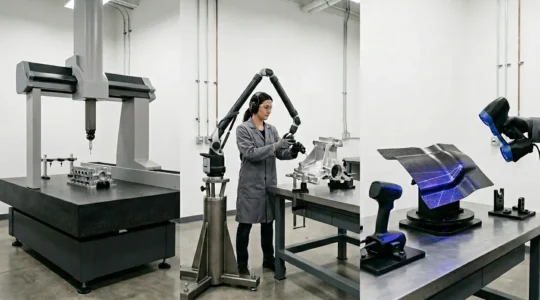
Inspection Tool Selection: Beyond CMM vs. Portable Arms vs. 3D Scanners
The right choice isn’t picking one tool, but building a hybrid metrology strategy that assigns the best technology to each specific stage of your workflow. Fixed CMMs provide micron-level accuracy for critical features but create inspection bottlenecks. Portable arms and…
Lire la suite
High-Precision Metrology: Verifying Complex Aerospace Geometries Down to the Micron
Achieving true micron-level accuracy on complex aerospace parts has less to do with the CMM’s price tag and more with mastering the environmental and physical forces that actively corrupt data. Thermal expansion is not a minor nuisance; it’s a primary…
Lire la suite
Automated Quality Control: Replacing Human Visual Inspection with Machine Vision
The biggest mistake in quality control is trying to replace human eyes with a « better » eye; the real solution lies in replacing subjective perception with objective, quantifiable data. Human inspectors are biologically wired to fail due to vigilance decrement, with…
Lire la suite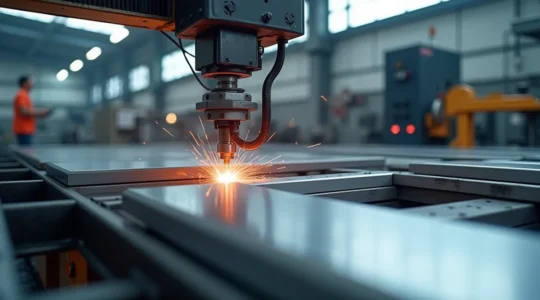
Green Welding: How Solid-State Processes Cut Energy Bills and Fumes?
Switching to solid-state welding is the single most impactful step to decarbonise fabrication, slashing energy consumption and eliminating health risks at the source. It avoids the massive thermal inefficiency of melting metal, which is the root cause of high energy…
Lire la suite
Friction Stir Welding: Joining Aluminium and Copper for EV Battery Efficiency
For automotive engineers, traditional fusion welding is the primary source of thermal distortion, compromising the hermetic seal and structural integrity of EV battery trays. Friction Stir Welding (FSW) offers a definitive solution. FSW is a solid-state process that joins metals…
Lire la suite
Beyond the Hype: Building a Digital Spare Parts Inventory That Actually Cuts Costs and Risk
Transitioning to a digital spare parts inventory is a strategic overhaul of risk and cost management, not a simple technology swap. Holding physical spares is an escalating financial liability, costing up to 25% of the inventory’s value each year in…
Lire la suite
Boosting Operational Yield: How to Reduce Material Scrap by 10% in Manufacturing?
The true cost of your scrap is likely double what you think, and it’s not a cost of business—it’s a process failure that’s actively eroding your margins. The « Yield Fallacy » of using cheaper materials or tools often increases total cost…
Lire la suite
Logistic Flow Management: How to Eliminate Despatch Bottlenecks in UK Warehouses?
The constant queues at your despatch dock are not a single problem but the result of cascading micro-inefficiencies—hidden ‘time taxes’ that cripple your entire operation. Idle loading bays and waiting trucks are symptoms of poor data choreography, not just a…
Lire la suite
ATEX Compliance in the UK: Defining Zones 0, 1, and 2 for Dust and Gas Safety
The biggest mistake in ATEX compliance for facilities like flour mills or wood shops is treating fine dust as less dangerous than gas; in reality, it’s often a more insidious and widespread explosion risk. Effective compliance isn’t about memorising legal…
Lire la suite
The Concrete Cancer Risk: Inspecting 1970s Industrial Frames for RAAC and Corrosion
The greatest risk in managing aging industrial property isn’t the visible wear and tear; it’s the hidden structural vulnerabilities like RAAC and rebar corrosion that standard inspections miss. Ignoring minor concrete cracks can escalate repair costs from under a thousand…
Lire la suite